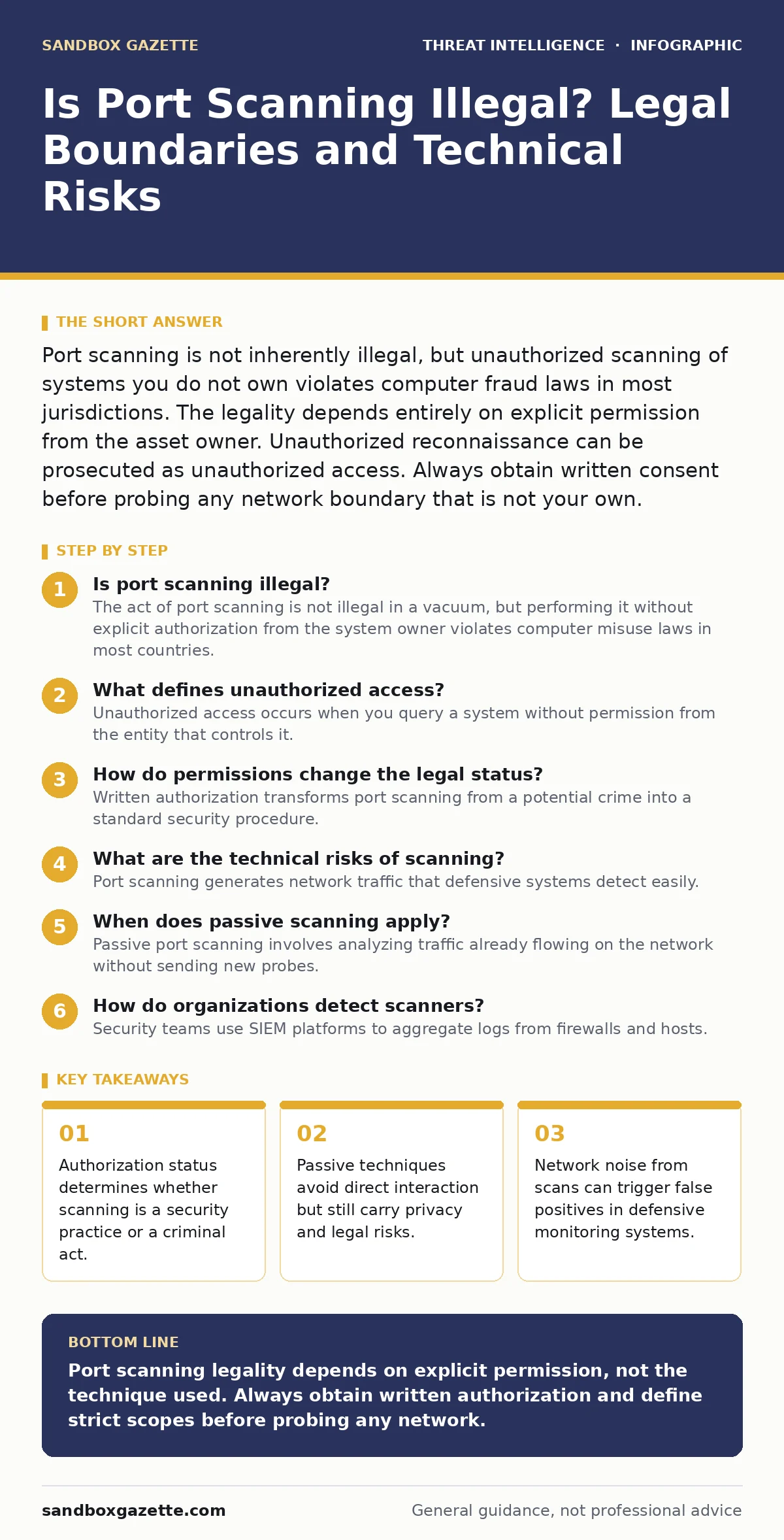
Port scanning is not inherently illegal, but unauthorized scanning of systems you do not own violates computer fraud laws in most jurisdictions. The legality depends entirely on explicit permission from the asset owner. Unauthorized reconnaissance can be prosecuted as unauthorized access. Always obtain written consent before probing any network boundary that is not your own.
Is port scanning illegal?
The act of port scanning is not illegal in a vacuum, but performing it without explicit authorization from the system owner violates computer misuse laws in most countries. The law targets the lack of consent, not the tool used. Imagine you scan your own router to check for open services. This is legal. Suppose you scan a neighbor’s network to map their devices. This is likely illegal. The boundary is ownership and permission.
What defines unauthorized access?
Unauthorized access occurs when you query a system without permission from the entity that controls it. Many laws treat even a single probe as a violation if intent to investigate vulnerabilities is proven. You do not need to exploit a vulnerability to break the law. Merely gathering information about closed or open ports without consent can constitute unauthorized access. This definition protects critical infrastructure from casual curiosity.
How do permissions change the legal status?
Written authorization transforms port scanning from a potential crime into a standard security procedure. Organizations use this process during red teaming exercises or vulnerability assessments. The scope must be clearly defined. If you scan a port outside the agreed range, you lose legal protection. Verbal permission is rarely sufficient in court. Document the exact IP ranges, time windows and allowed techniques. This record serves as your defense if a third party claims harm.
What are the technical risks of scanning?
Port scanning generates network traffic that defensive systems detect easily. Intrusion Detection Systems flag unusual connection attempts. You may trigger automated blocklists that isolate your own source IP. Some legacy systems crash when receiving unexpected packets. This is a denial-of-service side effect. Your scan could unintentionally disrupt services you did not mean to touch. The risk is not just legal; it is operational.
| Technique | Detection Risk | Legal Risk | Disruption Potential |
|---|---|---|---|
| TCP Connect Scan | High | High if unauthorized | Low |
| SYN Scan | Medium | High if unauthorized | Medium |
| ICMP Sweep | Low | Medium if unauthorized | Low |
| Service Banner Grab | High | High if unauthorized | High |
When does passive scanning apply?
Passive port scanning involves analyzing traffic already flowing on the network without sending new probes. You observe packets to infer open ports. This method is quieter and less likely to trigger alerts. However, it still requires permission to monitor the network segment. Intercepting traffic on a public Wi-Fi network to map ports is often illegal under wiretapping statutes. The lack of active probing does not grant immunity from surveillance laws.
See also: Warning Signs of Advanced Persistent Threats: What to Spot First · Zero Trust Security Checklist for Modern Network Defense
How do organizations detect scanners?
Security teams use SIEM platforms to aggregate logs from firewalls and hosts. They look for patterns like multiple connection attempts from one source to many ports. This is port sweeping. Algorithms flag these patterns as reconnaissance. Defenders may also use honeypots with fake services. When you probe a honeypot, the system logs your IP and triggers an incident response. The detection relies on behavioral analysis, not just signature matching.
What is the impact on endpoint telemetry?
Scanning activity creates logs on target endpoints. These logs feed into endpoint telemetry systems. The data helps defenders understand the attack surface. If you scan a machine that has telemetry agents installed, the agent records the connection attempt. This creates an audit trail. Even if you do not breach the system, the attempt is recorded. This data can be used in legal proceedings to establish intent and timeline.
How does this relate to remote desktop abuse?
Port scanning often targets common service ports like 3389 for Remote Desktop Protocol. Attackers use this to find exposed management interfaces. Once found, they may attempt brute-force attacks. This is a precursor to remote desktop abuse. The scan itself is the reconnaissance phase. Defenders monitor for failed login attempts on these ports. The combination of scanning and subsequent access attempts strengthens the case for malicious intent.
What about DCSync attacks in this context?
DCSync attacks do not use port scanning directly. They abuse legitimate Active Directory replication protocols. However, attackers may scan for domain controllers first. They look for ports 389 and 636. The scan identifies the target for the later abuse. The scanning phase is separate from the exploitation. Defenders focus on monitoring replication traffic anomalies. The initial scan helps the attacker locate the high-value target.
Can hacktivism influence legal interpretation?
Hacktivism groups often scan government or corporate networks to make political statements. The motive does not change the legality. Unauthorized scanning remains a violation regardless of political intent. Courts look at the technical act and the lack of permission. The narrative does not provide a legal defense. You must still have authorization. The public eye may scrutinize the case, but the law applies equally.
How does strategic threat intelligence help?
Strategic threat intelligence provides context on common scanning patterns. It helps you understand what attackers look for. This knowledge informs your defensive posture. You can adjust firewall rules to block known scanner IPs. You can also tune detection rules to reduce false positives. Understanding the broader landscape helps you prioritize which ports to secure. It is not about stopping all scans, but managing the risk.
What are the consequences of false positives?
Aggressive scanning can trigger false positives in defensive systems. This leads to unnecessary alert fatigue. Security teams may ignore legitimate threats because of noise. You might block legitimate traffic if your scan triggers a broad block. This disrupts business operations. The cost of a false positive is often higher than the scan itself. Always coordinate with the target organization to avoid disruption.
How do pass-the-hash attacks relate?
Pass-the-hash attacks reuse credential hashes to access other systems. Scanning helps attackers find machines where these credentials might work. They scan for SMB ports 445. The scan identifies potential targets for lateral movement. The scanning phase is critical for the attack chain. Defenders monitor for unusual SMB traffic. The combination of scanning and hash reuse is a common attack pattern.
What should you do before scanning?
You must obtain written permission. Define the scope clearly. Use non-disruptive methods where possible. Monitor your own traffic to ensure you stay within bounds. Document everything. If you are unsure, do not scan. The legal risks outweigh the technical benefits. Always prioritize authorization and safety. This protects you and the target organization.
Key takeaways
- Authorization status determines whether scanning is a security practice or a criminal act.
- Passive techniques avoid direct interaction but still carry privacy and legal risks.
- Network noise from scans can trigger false positives in defensive monitoring systems.
Port scanning legality depends on explicit permission, not the technique used. Always obtain written authorization and define strict scopes before probing any network.
Frequently asked questions
Can I scan my own company network without telling IT?
No, you should still coordinate with IT to avoid triggering security alerts or disrupting services. Internal policies often require approval even for authorized employees.
Is scanning a public website legal?
Yes, if the website is publicly accessible and you do not violate their terms of service. However, aggressive scanning may still be blocked by their defenses.
What if I accidentally scan a neighbor's network?
Stop immediately. Document the incident. Contact your IT team. Accidental scans are usually not prosecuted if you act in good faith and stop quickly.
How can I prove I had permission?
Keep a signed agreement or email chain that explicitly lists the IP ranges, dates and allowed techniques. This document is your primary legal defense.
How this guide was produced: written by the Sandbox Gazette editorial team with AI assistance, checked against the public references listed below, and reviewed when the facts change. See our editorial policy or report an error.