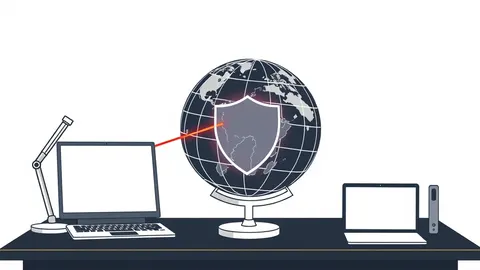
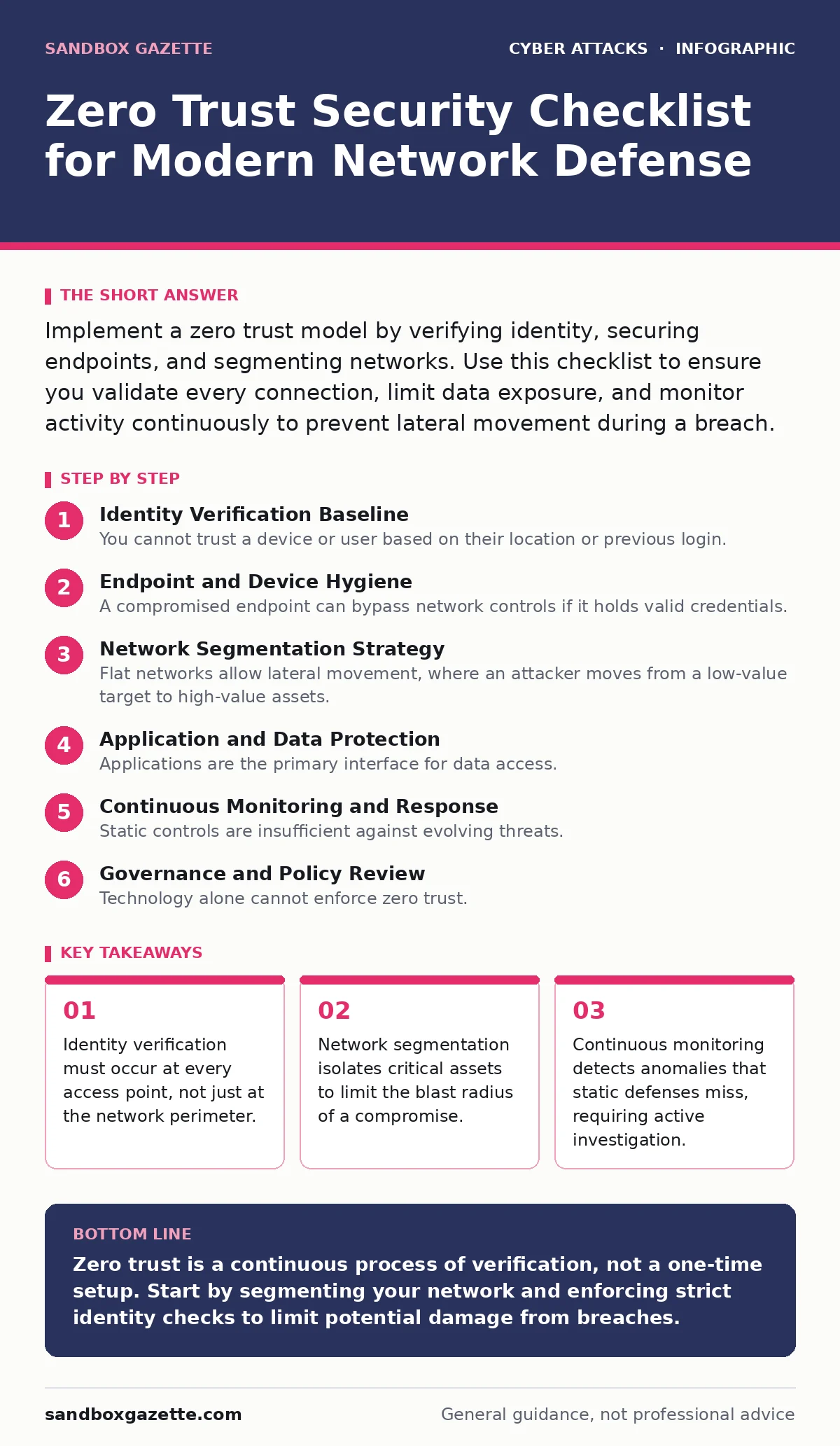
Implement a zero trust model by verifying identity, securing endpoints, and segmenting networks. Use this checklist to ensure you validate every connection, limit data exposure, and monitor activity continuously to prevent lateral movement during a breach.
Identity Verification Baseline
You cannot trust a device or user based on their location or previous login. This checklist begins with identity, which is the new perimeter. Every access request must be validated against current credentials and context.
- Enforce multi-factor authentication (MFA): Verifies identity beyond a single password, reducing the risk of credential theft.
- Implement just-in-time access: Grants privileges only for the duration needed, minimizing the window for abuse.
- Audit service accounts regularly: Ensures automated processes do not retain excessive or unused permissions.
Endpoint and Device Hygiene
A compromised endpoint can bypass network controls if it holds valid credentials. You must ensure that every device connecting to your resources meets strict security standards before it is allowed to interact with data.
- Require device compliance checks: Confirms that operating systems are patched and security software is active before granting access.
- Encrypt data at rest: Protects stored information from physical theft or unauthorized local access, even if the device is lost.
- Disable unused ports and services: Reduces the attack surface by closing entry points that attackers often scan for vulnerabilities.
Devices that fail these checks must be isolated into a remediation network. This prevents an infected laptop from communicating with servers or other user devices. This isolation is a core component of a strong cyber incident response team workflow, allowing you to contain threats without disrupting the entire organization.
Network Segmentation Strategy
Flat networks allow lateral movement, where an attacker moves from a low-value target to high-value assets. You must break the network into smaller, isolated zones to stop this progression.
- Segment critical databases: Isolates sensitive data from general user traffic, ensuring that a breach in the email system does not expose customer records.
- Apply micro-segmentation policies: Controls traffic between individual workloads, preventing east-west movement within data centers.
- Restrict inter-segment communication: Ensures that only explicitly allowed traffic flows between different network zones, blocking unauthorized scans.
This approach mirrors the principles used in secure email gateways, where traffic is inspected and filtered at the boundary before it enters the main system. By applying similar logic internally, you create chokepoints that make lateral movement difficult and detectable.
Application and Data Protection
Applications are the primary interface for data access. You must secure these interfaces directly, rather than relying on network-level controls alone. This layer ensures that even if the network is breached, the application itself remains resistant to abuse.
- Enforce least-privilege access: Grants users only the permissions necessary for their role, reducing the impact of account takeover.
- Validate all input data: Prevents injection attacks by ensuring that applications reject malformed or malicious requests.
- Monitor API traffic: Detects unusual patterns in application calls that may indicate automated scraping or exploitation.
Imagine an attacker gains access to a developer account. If that account has broad permissions, they can exfiltrate source code or deploy malicious updates. By limiting scope, you ensure that the damage remains contained to a single service. This is similar to how DKIM adds a digital signature to emails, verifying that the content has not been altered in transit.
Continuous Monitoring and Response
Static controls are insufficient against evolving threats. You must actively monitor all activities for anomalies and respond quickly to suspicious behavior. This requires a shift from assuming trust to verifying intent.
- Log all access events: Creates an audit trail for forensic analysis and helps identify patterns of abuse over time.
- Correlate identity and device data: Combines signals from multiple sources to detect complex attacks that single logs might miss.
- Automate response actions: Reduces reaction time by automatically isolating compromised devices or revoking tokens upon detection.
This continuous loop is vital for maintaining security posture. It allows you to adapt to new threats without manual intervention for every incident. For instance, if a user attempts to access a resource from an unusual location, the system can automatically challenge the request or block it entirely. This proactive stance is more effective than relying solely on security awareness training to prevent mistakes.
See also: Is Port Scanning Illegal? Legal Boundaries and Technical Risks · Remote Desktop Abuse: The Configuration Mistakes That Hand Over Control
Governance and Policy Review
Technology alone cannot enforce zero trust. You need clear policies that define how access is granted, monitored, and revoked. These policies must be reviewed regularly to ensure they align with current business needs and threat realities.
- Define access control policies: Clearly documents who can access what, under which conditions, and for how long.
- Review permissions quarterly: Removes stale access rights that accumulate over time, reducing the risk of insider threats.
- Document incident response procedures: Ensures that teams know exactly how to act when a zero trust control is triggered or bypassed.
Governance ensures that your technical controls are applied consistently. Without clear policies, teams may bypass security measures for convenience, creating gaps that attackers can exploit. Regular reviews help you stay ahead of changes in your environment, ensuring that your zero trust architecture remains effective against social engineering and other sophisticated attack vectors.
Key takeaways
- Identity verification must occur at every access point, not just at the network perimeter.
- Network segmentation isolates critical assets to limit the blast radius of a compromise.
- Continuous monitoring detects anomalies that static defenses miss, requiring active investigation.
Zero trust is a continuous process of verification, not a one-time setup. Start by segmenting your network and enforcing strict identity checks to limit potential damage from breaches.
Frequently asked questions
Does zero trust require replacing all existing network infrastructure?
No, you can implement zero trust principles incrementally by adding identity verification and segmentation to your current setup without a full hardware overhaul.
How does zero trust differ from traditional perimeter security?
Traditional security trusts everything inside the network, while zero trust verifies every request regardless of location, assuming breaches will occur.
Is zero trust compatible with remote work environments?
Yes, zero trust is designed for distributed access, securing users and devices wherever they connect, rather than relying on a physical office boundary.
What is the biggest challenge in implementing zero trust?
The main challenge is cultural resistance and the complexity of mapping all assets and access patterns to create effective, non-disruptive policies.
How this guide was produced: written by the Sandbox Gazette editorial team with AI assistance, checked against the public references listed below, and reviewed when the facts change. See our editorial policy or report an error.