An autonomous system number is a unique identifier assigned to a large network or group of networks under single administrative control. Threat intelligence teams use these numbers to map traffic origins, identify compromised infrastructure, and distinguish between legitimate cloud providers and malicious command-and-control servers during incident response.
The Postal Service Analogy for Network Ownership
Imagine the internet as a global postal system. An IP address is the specific street address of a house. An autonomous system number is the postal district or city code. When you see a letter, the street address tells you exactly where it is. The city code tells you which municipality manages the roads, the zoning laws, and the local regulations.
In cybersecurity, knowing the street address helps you find the specific server. Knowing the city code helps you understand who controls the infrastructure, what rules apply, and whether the location matches the claimed identity of the sender. This distinction matters because attackers often hide behind generic infrastructure that spans multiple jurisdictions.
Defining Autonomous System Numbers in Practice
An autonomous system is a collection of IP networks and routers under the control of one entity, presenting a common routing policy to the internet. The Internet Assigned Numbers Authority assigns a unique autonomous system number to each entity. These numbers are 32-bit integers, though most legacy systems still use 16-bit numbers. The number itself carries no inherent security value.
It is purely an administrative identifier. However, the routing policies associated with that number determine how traffic flows across the global internet backbone. Threat intelligence analysts use these numbers to group millions of IP addresses into manageable organizational units. This grouping allows for faster correlation of events across large datasets.
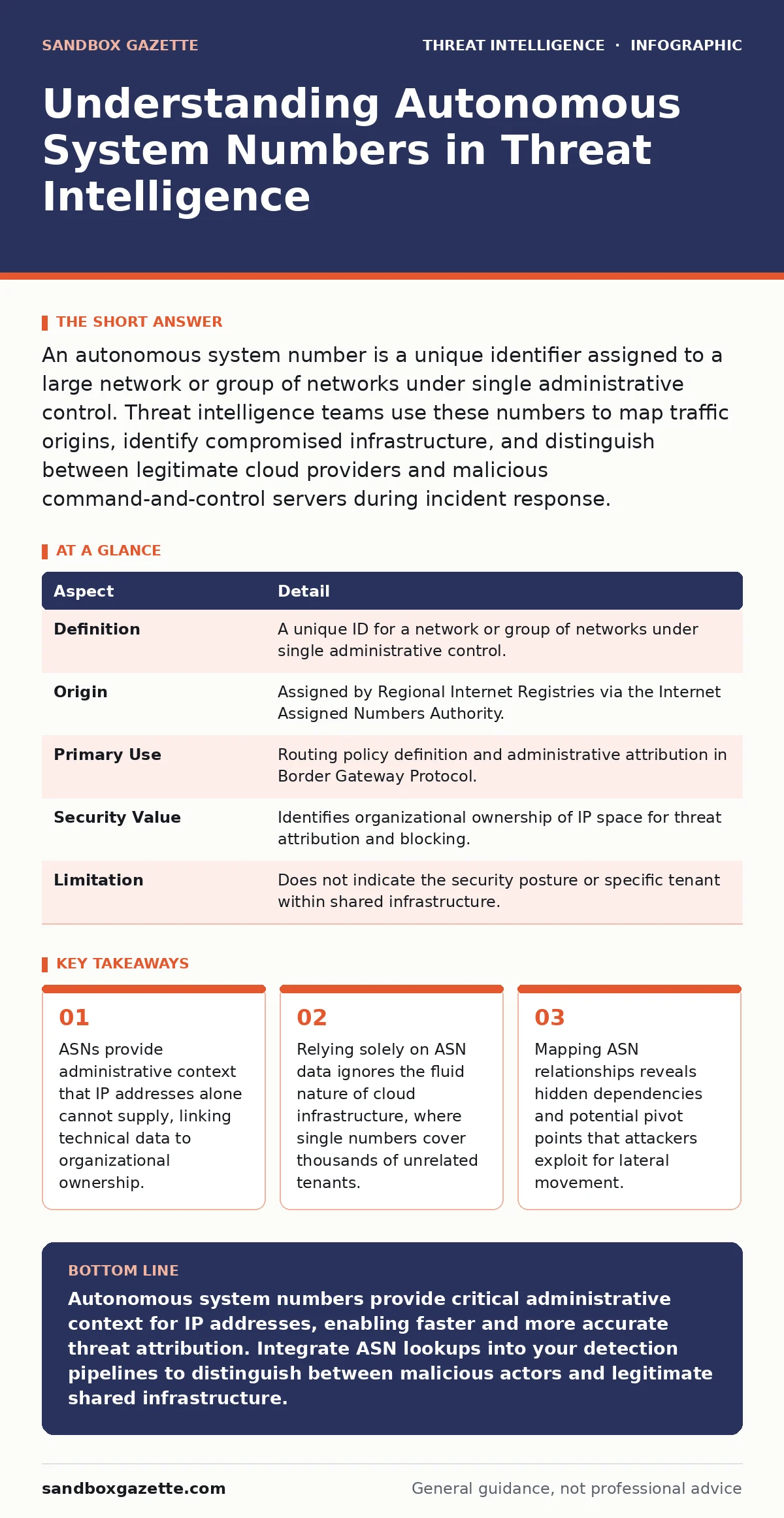
| Aspect | Detail |
|---|---|
| Definition | A unique ID for a network or group of networks under single administrative control. |
| Origin | Assigned by Regional Internet Registries via the Internet Assigned Numbers Authority. |
| Primary Use | Routing policy definition and administrative attribution in Border Gateway Protocol. |
| Security Value | Identifies organizational ownership of IP space for threat attribution and blocking. |
| Limitation | Does not indicate the security posture or specific tenant within shared infrastructure. |
How Analysts Use ASNs Daily
Security operations teams integrate autonomous system numbers into their detection pipelines to reduce noise. When an alert triggers for a suspicious IP address, analysts look up the associated ASN. This step reveals whether the traffic originates from a known cloud provider, a residential ISP, or a data center. If the traffic comes from a residential ASN but claims to be a corporate server, that mismatch is a strong indicator of compromise or spoofing.
Analysts also use ASN data to build blocklists. Instead of blocking individual IP addresses, which change frequently, they can block entire autonomous systems known to host malicious activity. This approach is more efficient but carries the risk of false positives if legitimate traffic shares the same routing infrastructure.
The Hidden Cost of Broad Attribution
Attributing an attack to an autonomous system is not the same as attributing it to a person or group. Many attackers use compromised servers within large, reputable autonomous systems. If you block the entire ASN, you harm legitimate users who share that routing infrastructure. This is known as collateral damage. The trade-off is between speed and precision.
Blocking an ASN is fast and stops immediate threats. It is also blunt and often ineffective against sophisticated attackers who rotate through many different autonomous systems. Analysts must balance the need for rapid containment with the requirement to maintain business continuity. Misidentifying the owner of an ASN can lead to unnecessary legal friction and operational disruption.
What People Usually Get Wrong
A common mistake is assuming that an autonomous system number remains static. Organizations merge, split, or sell their infrastructure. When this happens, the IP address space may move to a different autonomous system, or the number itself may be reassigned. Historical data loses its meaning if the underlying ownership changes. Another error is treating all IP addresses within an ASN as equal.
Large cloud providers host millions of unrelated customers under a single ASN. An attack from one customer does not imply the provider is malicious. It implies the customer is. Analysts must drill down from the ASN to the specific IP or subnet to avoid misattribution. This requires access to more granular data than simple ASN lookups provide.
See also: Hacktivism Risks for Small Business: Real Threats and Low-Cost Defenses · Is Port Scanning Illegal? Legal Boundaries and Technical Risks
Integrating ASN Data with Other Signals
Autonomous system numbers work best when combined with other indicators. IP reputation scores provide historical context. Geolocation data offers physical context. Autonomous system numbers provide administrative context. Together, they form a complete picture. For instance, if an IP address has a poor reputation, is located in a country known for high fraud rates, and belongs to an ASN that frequently hosts bulletproof hosting services, the confidence level for blocking increases significantly. Analysts should also monitor changes in ASN routing. Sudden changes in how an ASN routes traffic can indicate hijacking or misconfiguration. These anomalies often precede larger attacks.
The Role of Routing Protocols
Border Gateway Protocol is the routing protocol that connects autonomous systems. It allows networks to exchange reachability information. This protocol is inherently trust-based. One autonomous system trusts another to route traffic correctly. Attackers exploit this trust through route hijacking. They announce that they own IP address space they do not control.
This diverts traffic through their infrastructure. Threat intelligence teams monitor these announcements to detect anomalies. A sudden change in the origin autonomous system for a well-known IP block is a red flag. It suggests either a misconfiguration or a deliberate attack. Detecting this requires real-time monitoring of routing data, not just static IP lists.
Advanced Techniques for Deeper Insight
For teams dealing with sophisticated threats, basic ASN lookup is insufficient. You need to understand the relationships between autonomous systems. Some are customers of others. Some are peers. Some are siblings. Attackers often pivot through these relationships to obscure their origin. By mapping these relationships, analysts can trace the path of an attack back to its true source.
This process is complex and requires specialized tools. It also requires understanding the business models of internet service providers. A peer relationship might indicate a strategic partnership that an attacker could exploit. A customer relationship might indicate a dependency that, if compromised, affects multiple downstream services. This depth of analysis separates reactive security from proactive threat hunting.
Practical Steps for Implementation
- Integrate autonomous system number lookups into your incident response playbook. Make it a standard step for every external alert.
- Maintain a list of known good autonomous systems for your business partners and cloud providers. Use this list to filter false positives.
- Monitor for changes in ASN ownership and routing policies. Set up alerts for unexpected changes in critical IP blocks.
- Correlate ASN data with endpoint telemetry to identify internal systems communicating with suspicious external networks.
- Review your blocking policies to ensure you are not blocking entire autonomous systems unnecessarily. Focus on specific IPs or subnets when possible.
Conclusion on Utility and Limits
Autonomous system numbers are a powerful tool for contextualizing network traffic. They provide a layer of administrative truth that IP addresses lack. However, they are not a silver bullet. They do not tell you who is sitting at the keyboard. They do not tell you the intent of the traffic. They only tell you who manages the pipes. Effective threat intelligence requires combining this administrative data with behavioral analysis, reputation data, and human judgment. The goal is not to block everything that looks strange. The goal is to understand what is strange and why. This understanding allows for more precise and effective defensive actions.
Key takeaways
- ASNs provide administrative context that IP addresses alone cannot supply, linking technical data to organizational ownership.
- Relying solely on ASN data ignores the fluid nature of cloud infrastructure, where single numbers cover thousands of unrelated tenants.
- Mapping ASN relationships reveals hidden dependencies and potential pivot points that attackers exploit for lateral movement.
Autonomous system numbers provide critical administrative context for IP addresses, enabling faster and more accurate threat attribution. Integrate ASN lookups into your detection pipelines to distinguish between malicious actors and legitimate shared infrastructure.
Frequently asked questions
Can an attacker spoof an autonomous system number?
Attackers can spoof IP addresses, but they cannot easily spoof the routing announcements that define autonomous system relationships. Route hijacking is the closest equivalent, but it requires control over a router connected to the internet backbone.
How often do autonomous system numbers change?
Autonomous system numbers rarely change for established organizations. However, the IP address space associated with an ASN can change frequently due to mergers, acquisitions, or renumbering events.
Is ASN data free to access?
Basic ASN to IP mapping data is often available for free through public registries. Detailed routing data, historical changes, and relationship mapping usually require paid subscriptions or specialized tools.
How does this relate to port scanning?
Port scanning identifies open services on specific IP addresses. ASN data helps determine if those open ports belong to a legitimate organization or a known malicious network, providing context for the scan results.
How this guide was produced: written by the Sandbox Gazette editorial team with AI assistance, checked against the public references listed below, and reviewed when the facts change. See our editorial policy or report an error.