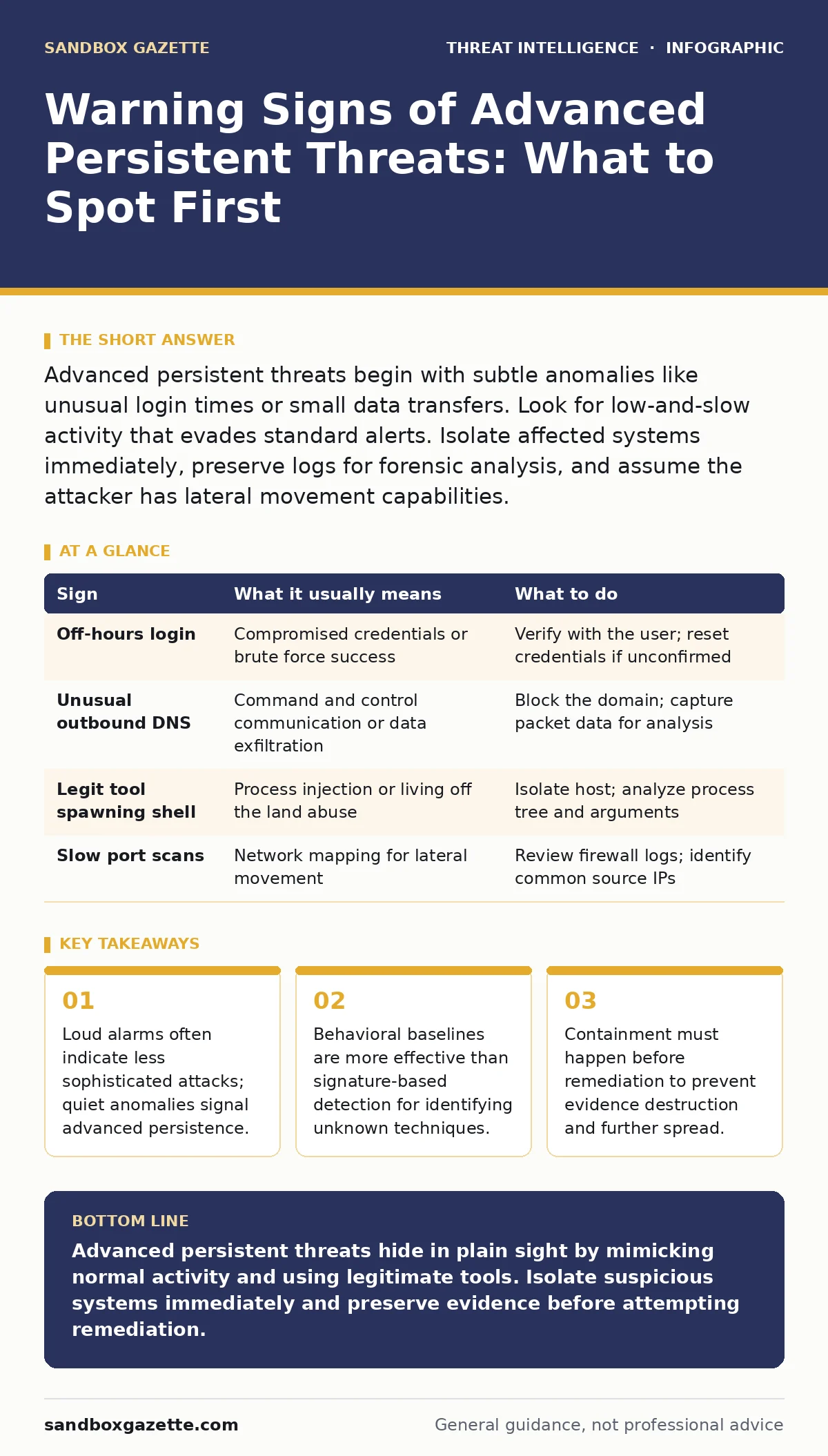
Advanced persistent threats begin with subtle anomalies like unusual login times or small data transfers. Look for low-and-slow activity that evades standard alerts. Isolate affected systems immediately, preserve logs for forensic analysis, and assume the attacker has lateral movement capabilities.
The Illusion of Quiet
Advanced persistent threats do not announce themselves with ransomware notes or system crashes. These campaigns prioritize stealth over speed. The attackers want to stay inside your network long enough to map your environment and exfiltrate specific data. This changes what you see in your monitoring tools. You will not see a spike in failed login attempts. Instead, you will see activity that looks almost normal but violates your established baseline.
Signs You Notice First
The most visible indicators are often behavioral changes in user accounts or network traffic patterns. You might notice a service account logging in from a new geographic region at an unusual hour. This is a common entry point because attackers compromise credentials rather than breaking encryption. Another early sign is a sudden increase in outbound traffic to an unfamiliar domain. This domain may look legitimate if it uses a recently registered generic name.
Suppose a database administrator account suddenly queries tables it never touches. This is a clear deviation from normal behavior. Even if the queries are small, the context is wrong. Attackers often probe for sensitive columns before they begin exfiltration. These actions trigger alerts in most security information and event management systems. However, analysts often dismiss them as misconfigured scripts or legitimate maintenance tasks.
Signs That Are Easy to Miss
The hardest signs to spot are those that blend into background noise. Fileless malware, which runs entirely in memory, leaves no executable files on disk. This bypasses traditional antivirus scans that look for known file signatures. You might see a legitimate process, like a web browser, spawning a command shell. This is a technique called process injection, where malicious code hides inside a trusted application.
Another hidden indicator is the use of legitimate administrative tools for malicious purposes. Attackers often use built-in Windows or Linux utilities to move laterally. This is known as living off the land. Since these tools are signed by the operating system vendor, they rarely trigger security alerts. You must look at what the tools are doing, not just that they are running.
Understanding the Mechanics
To detect these threats, you must understand how they operate. Attackers often use pass-the-hash attacks to move between systems without knowing the actual password. They steal a cryptographic hash of the password and present it to other servers. This allows them to escalate privileges silently. They may also use remote desktop abuse to gain interactive access to critical servers. This gives them a direct view of the system, making their actions look like an administrator’s work.
Port scanning helps attackers map your network to find vulnerable services. However, advanced threats often use slow, low-volume scans to avoid detection. They might check one port per minute over several days. This technique stays below the threshold for most intrusion detection systems. You need endpoint telemetry to see the connections being made from inside the host.
Contextualizing the Threat
Not every anomaly is an advanced persistent threat. Some organizations face hacktivism, which is politically motivated disruption. These groups often care little about stealth and may deface websites or leak data quickly. Their behavior is loud and brief. In contrast, advanced persistent threats are patient. They may spend months in the reconnaissance phase. Understanding this difference helps you prioritize your response.
If you suspect a sophisticated campaign, you should consult your strategic threat intelligence. This involves analyzing broader trends and adversary tactics rather than just technical indicators. It helps you understand who might be targeting you and why. This context guides your defensive posture and resource allocation.
See also: Endpoint Telemetry FAQs: What Agents Actually See · SIEM Explained: How Log Aggregation Stops Silent Breaches
Response Protocol
When you identify a potential sign, do not disconnect the system immediately. This can destroy volatile memory evidence and alert the attacker. Instead, isolate the host at the network level. Block its inbound and outbound connections while keeping it powered on. Capture a memory dump and relevant log files. Then, begin your investigation.
| Sign | What it usually means | What to do |
|---|---|---|
| Off-hours login | Compromised credentials or brute force success | Verify with the user; reset credentials if unconfirmed |
| Unusual outbound DNS | Command and control communication or data exfiltration | Block the domain; capture packet data for analysis |
| Legit tool spawning shell | Process injection or living off the land abuse | Isolate host; analyze process tree and arguments |
| Slow port scans | Network mapping for lateral movement | Review firewall logs; identify common source IPs |
The Hidden Cost of Detection
Detecting these threats requires a shift in mindset. You cannot rely on signatures alone. You must monitor for behavior. This creates a trade-off. More detailed monitoring generates more noise. You need better tools and skilled analysts to filter the false positives. This increases operational costs. However, the cost of a missed detection is far higher.
Imagine you ignore a small anomaly for weeks. By the time you notice a data leak, the attacker has already moved laterally and installed backdoors. Remediation becomes a multi-month effort. You must rebuild trust in your network integrity. Early detection saves time and resources.
Maintaining Vigilance
Your defenses must evolve as attacker tactics change. Regularly review your detection rules and baseline behaviors. Update your endpoint telemetry collection to ensure you are capturing relevant data. Train your team to recognize the subtle signs of compromise. Remember that no single tool provides complete protection. Layered defenses and human expertise are your best assets.
Key takeaways
- Loud alarms often indicate less sophisticated attacks; quiet anomalies signal advanced persistence.
- Behavioral baselines are more effective than signature-based detection for identifying unknown techniques.
- Containment must happen before remediation to prevent evidence destruction and further spread.
Advanced persistent threats hide in plain sight by mimicking normal activity and using legitimate tools. Isolate suspicious systems immediately and preserve evidence before attempting remediation.
Frequently asked questions
How do I distinguish between a misconfigured script and an advanced persistent threat?
Misconfigured scripts usually have consistent, predictable patterns and are documented. APTs often show irregular timing, unusual data access, and lack of business justification.
Can endpoint detection and response prevent all advanced persistent threats?
No, because these threats often use legitimate tools and fileless techniques. EDR helps by monitoring behavior, but it cannot stop all activity, especially if the attacker has high-level access.
What is the first step if I suspect a credential compromise?
Reset the compromised credentials immediately and revoke any active sessions. Then, review access logs for that account to identify lateral movement.
Why is strategic threat intelligence useful for operational teams?
It provides context on adversary goals and methods, helping teams prioritize alerts and understand the broader campaign rather than just reacting to individual events.
How this guide was produced: written by the Sandbox Gazette editorial team with AI assistance, checked against the public references listed below, and reviewed when the facts change. See our editorial policy or report an error.