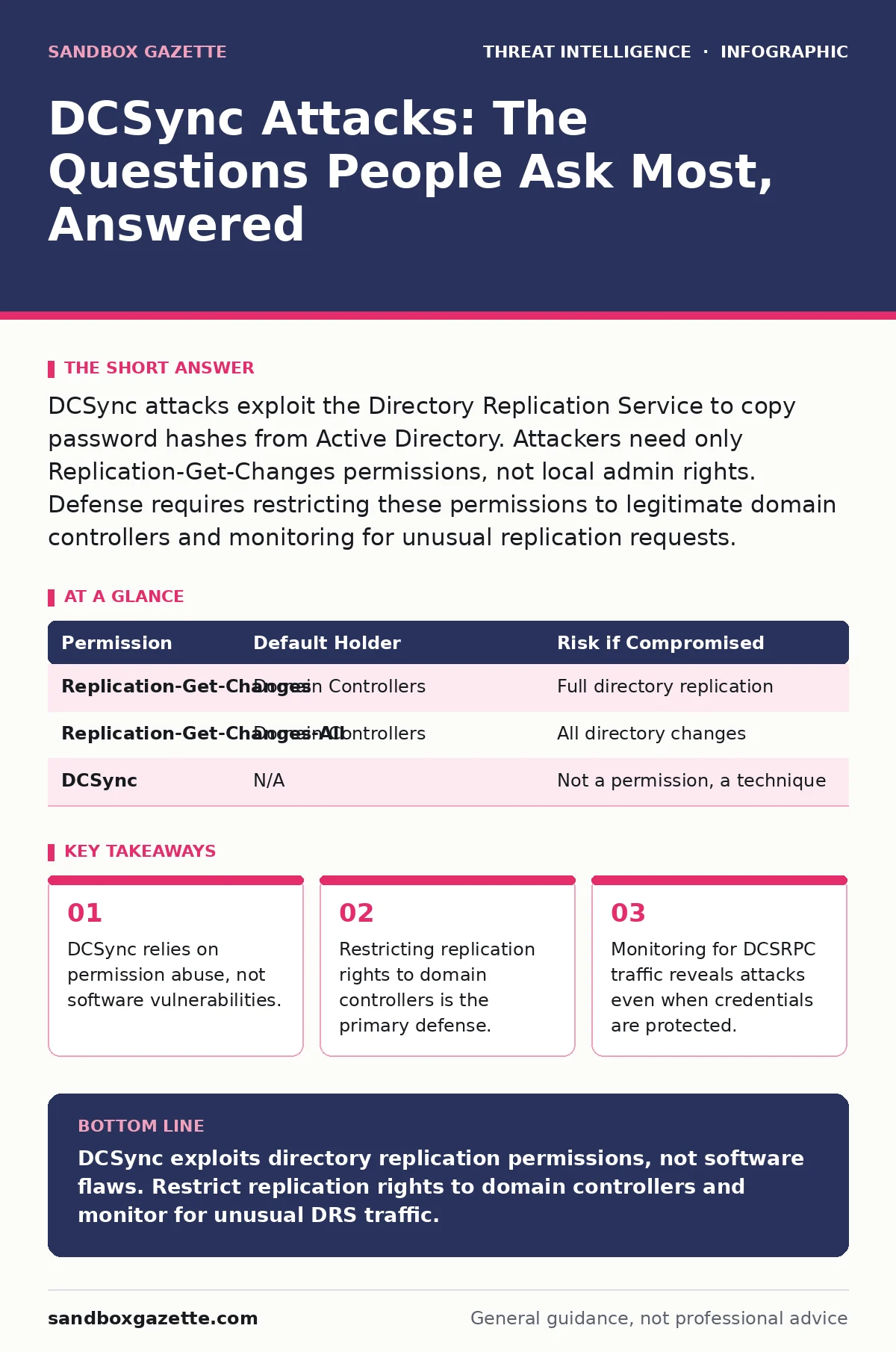
DCSync attacks exploit the Directory Replication Service to copy password hashes from Active Directory. Attackers need only Replication-Get-Changes permissions, not local admin rights. Defense requires restricting these permissions to legitimate domain controllers and monitoring for unusual replication requests.
What exactly is a DCSync attack?
A DCSync attack is a technique that forces a domain controller to replicate password hashes to an attacker’s machine. It abuses the Directory Replication Service (DRS), which synchronizes Active Directory data between servers. The attacker does not break encryption or guess passwords. Instead, they convince the directory that they are another domain controller requesting data.
Why is DCSync so dangerous?
DCSync bypasses many traditional defenses because it uses legitimate Windows protocols. The traffic looks identical to normal domain controller synchronization. Defenders cannot block it by closing ports or updating software. The attack succeeds if the attacker holds specific permissions, regardless of password complexity or multi-factor authentication settings.
What permissions does an attacker need?
An attacker needs the Replication-Get-Changes permission on the domain object. This permission allows reading directory changes, including password hashes. By default, only domain controllers have this right. If an attacker compromises a machine with this permission, they can replicate the entire directory. They do not need local administrator rights on the server they are targeting.
How do attackers get these permissions?
Attackers usually elevate privileges to obtain replication rights. They may exploit misconfigured groups or abuse delegation. A common path involves compromising a user with the ability to modify group memberships. Once inside a privileged group, they can grant themselves replication access. This is why endpoint telemetry is vital for detecting initial footholds.
Can you detect DCSync in real time?
Yes, by monitoring for specific RPC calls to the DRS service. The attack generates distinct traffic patterns on the domain controller. Security Information and Event Management (SIEM) systems can flag these requests. Look for process creation events involving tools that invoke DRS APIs. Correlating this with user login events helps distinguish legitimate admin work from attacks.
What is the difference between DCSync and Golden Ticket?
DCSync steals the hashes needed to create a Golden Ticket. A Golden Ticket is a forged Kerberos ticket granting domain admin access. DCSync is the theft; the Golden Ticket is the result. Defending against DCSync stops the attack chain before the attacker can forge tickets. This prevents the persistence and lateral movement enabled by Golden Tickets.
How do you restrict replication permissions?
You must ensure only domain controllers hold Replication-Get-Changes rights. Audit the ACLs on the domain object regularly. Remove any user or group that does not need to replicate directory data. This includes service accounts and backup operators. Tightening these permissions reduces the attack surface significantly. It forces attackers to find other, noisier paths to privilege escalation.
What are the limitations of DCSync defenses?
Restricting permissions does not stop an attacker who already has domain admin rights. If they control the domain, they can grant themselves replication access. Defense must focus on preventing initial compromise and privilege escalation. Process injection techniques often accompany these attacks to hide malicious activity. Monitoring for such behavior adds another layer of detection.
| Permission | Default Holder | Risk if Compromised |
|---|---|---|
| Replication-Get-Changes | Domain Controllers | Full directory replication |
| Replication-Get-Changes-All | Domain Controllers | All directory changes |
| DCSync | N/A | Not a permission, a technique |
Does disabling NTLM stop DCSync?
No, DCSync uses RPC over TCP, not NTLM authentication. Disabling NTLM reduces lateral movement but does not block replication requests. The attack relies on the directory service itself. Defenders must focus on the permissions model and network segmentation. Isolating domain controllers limits the impact of a compromised workstation.
How does remote desktop abuse relate?
Attackers often use Remote Desktop Protocol to reach privileged machines. Once inside, they can execute DCSync commands locally. Securing RDP access reduces the chance of initial compromise. Enforcing strict access controls and monitoring for unusual RDP sessions helps. This complements defenses against port scanning and other reconnaissance activities.
What is the role of SOAR in defense?
Security Orchestration, Automation, and Response (SOAR) platforms can automate detection and response. They can trigger alerts when DRS API calls are detected. Automated playbooks can isolate affected systems and revoke permissions. This reduces the time between detection and containment. Integrating SOAR with SIEM data improves response speed and accuracy.
How do you recover from a DCSync attack?
First, identify the compromised account and revoke its permissions. Reset all domain admin passwords and service account credentials. Rebuild affected domain controllers if necessary. Audit all replication permissions to ensure no lingering access. Conduct a thorough investigation to determine the initial entry point. This prevents recurrence and strengthens overall security posture.
Is DCSync only a Windows threat?
Yes, DCSync is specific to Microsoft Active Directory environments. It exploits the DRS protocol unique to Windows domains. Linux and macOS systems do not use this replication method. However, attackers may use similar techniques in other directory services. Understanding the underlying mechanism helps defenders anticipate similar threats in different environments.
What about deep web implications?
Stolen password hashes may appear on the deep web if exfiltrated. Attackers often sell these credentials to other criminals. Monitoring for leaked hashes helps identify compromised accounts. This is part of a broader threat intelligence strategy. Combining internal logs with external threat data improves detection capabilities.
How does hacktivism relate to DCSync?
Hacktivist groups rarely use DCSync directly. They prefer public-facing exploits for visibility. DCSync is typically used by advanced persistent threats. These groups seek long-term access and data theft. Understanding the attacker's motive helps prioritize defenses. Focus on protecting critical infrastructure from targeted attacks.
What is the future of DCSync defenses?
Defenses will increasingly rely on behavioral analytics. Machine learning models can detect anomalous replication patterns. Zero Trust architectures limit lateral movement and privilege escalation. Regular audits of directory permissions remain critical. Staying ahead of attackers requires continuous improvement and adaptation.
Key takeaways
- DCSync relies on permission abuse, not software vulnerabilities.
- Restricting replication rights to domain controllers is the primary defense.
- Monitoring for DCSRPC traffic reveals attacks even when credentials are protected.
DCSync exploits directory replication permissions, not software flaws. Restrict replication rights to domain controllers and monitor for unusual DRS traffic.
Frequently asked questions
Can DCSync be performed remotely?
Yes, if the attacker has network access to a domain controller and the necessary permissions.
Does multi-factor authentication stop DCSync?
No, MFA protects login but does not restrict directory replication permissions.
How often should I audit replication permissions?
Regularly, and after any changes to group memberships or user roles.
Is DCSync legal?
No, it is unauthorized access to directory services and violates computer fraud laws.
How this guide was produced: written by the Sandbox Gazette editorial team with AI assistance, checked against the public references listed below, and reviewed when the facts change. See our editorial policy or report an error.