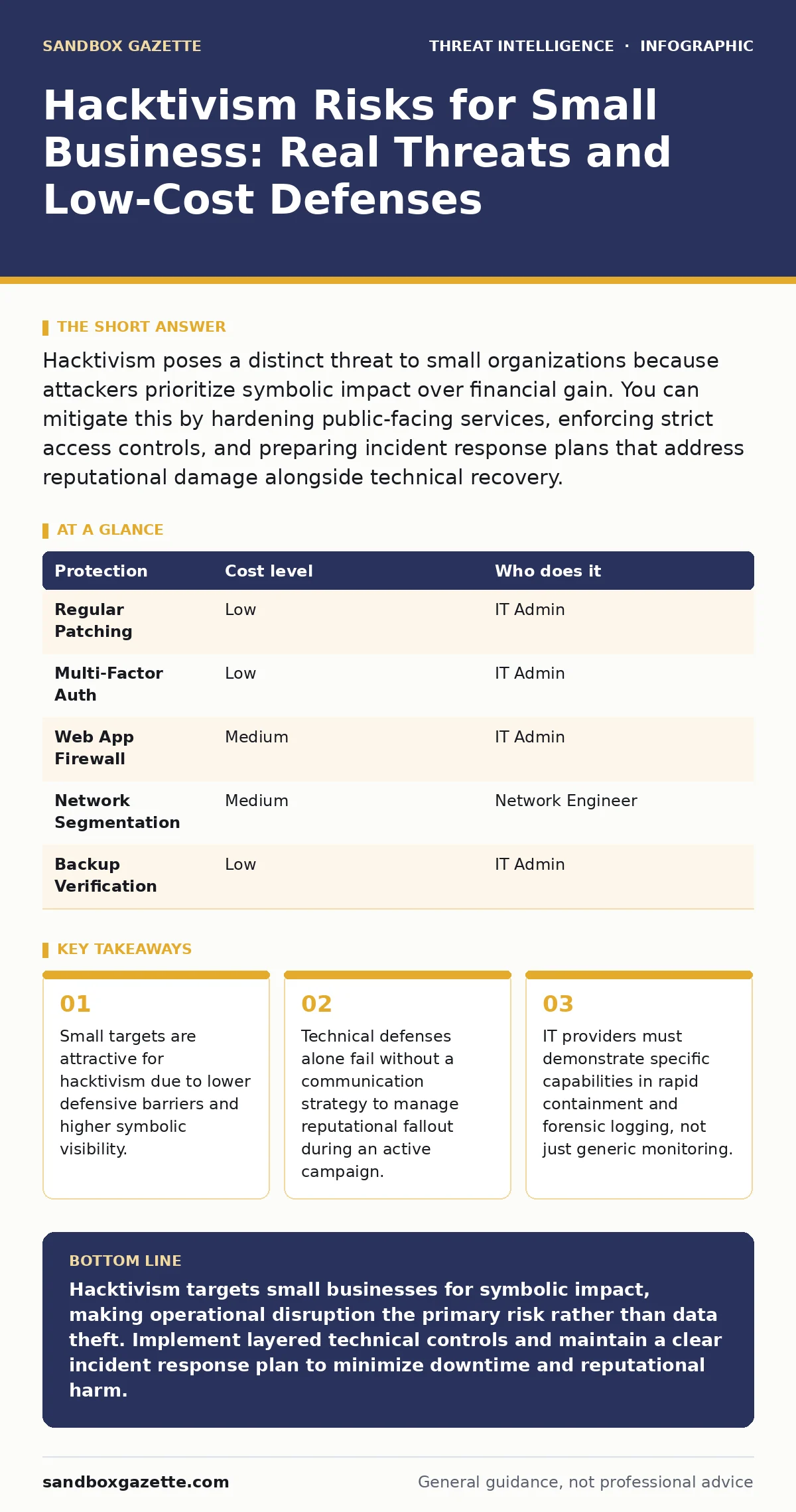
Hacktivism poses a distinct threat to small organizations because attackers prioritize symbolic impact over financial gain. You can mitigate this by hardening public-facing services, enforcing strict access controls, and preparing incident response plans that address reputational damage alongside technical recovery.
The Symbolic Value of Small Targets
Hacktivism differs from traditional cybercrime because the primary motivation is political or social protest, not financial theft. Attackers seek to disrupt operations or alter public perception to support a cause. Small organizations often believe they are invisible to these actors. This assumption is dangerous. A small business can serve as a convenient proxy to send a message to a larger industry or government body. The goal is visibility, not profit.
When you are small, your digital footprint is easier to map. Attackers use automated tools to identify services running on your network. They look for misconfigurations that allow easy entry. A single exposed service can provide a foothold for further compromise. The attacker does not need to steal customer records to achieve their goal. Disrupting your ability to operate is sufficient.
This dynamic creates a unique risk profile. You may not have valuable intellectual property, but you have operational continuity. Stopping your business for even a few hours can generate the attention the attacker seeks. This makes availability your primary concern, rather than confidentiality. Understanding this shift in objective changes how you structure your defenses.
Why Standard Defenses Often Fail
Many small organizations rely on basic antivirus software and firewalls to protect their infrastructure. These tools are designed to stop known malware and block unauthorized access from outside. They are less effective against determined human actors who exploit human error or logical flaws. Hacktivists often use social engineering to bypass technical controls. They may pose as a vendor or a customer to gain access.
Another common failure point is the lack of segmented networks. If an attacker compromises a public-facing web server, they may move laterally to internal systems. Without network segmentation, the entire organization is at risk. This lateral movement allows the attacker to disrupt critical internal processes. It also makes it harder to isolate the threat and restore services quickly.
You must also consider the human element. Employees may be pressured to disclose credentials or sensitive information. Training staff to recognize these attempts is necessary but often insufficient. The attacker adapts their tactics to match your training. This cat-and-mouse dynamic requires a layered approach to security. No single tool provides complete protection.
Low-Cost Technical Protections
Implementing strong technical controls does not require a large budget. Many effective measures are built into standard operating systems or available as open-source solutions. The key is consistent configuration and maintenance. Start by ensuring all software is updated regularly. Unpatched vulnerabilities are the easiest entry point for attackers. Automate updates where possible to reduce human error.
Enable multi-factor authentication on all accounts that access external services. This adds a layer of security that is difficult to bypass with stolen passwords. Even if an attacker obtains credentials, they cannot access the account without the second factor. This simple step significantly reduces the risk of unauthorized access. It is one of the most effective defenses available.
Use a Web Application Firewall to filter malicious traffic before it reaches your servers. This tool can block common attack patterns such as SQL injection and cross-site scripting. It provides an additional layer of defense for public-facing applications. Configure it to log suspicious activity for later analysis. This helps you identify trends and improve your security posture over time.
| Protection | Cost level | Who does it |
|---|---|---|
| Regular Patching | Low | IT Admin |
| Multi-Factor Auth | Low | IT Admin |
| Web App Firewall | Medium | IT Admin |
| Network Segmentation | Medium | Network Engineer |
| Backup Verification | Low | IT Admin |
The Hidden Cost of Downtime
The immediate impact of a hacktivist attack is often technical disruption. However, the longer-term consequences can be more damaging. Reputational harm can persist long after the technical issue is resolved. Customers may lose trust in your ability to protect their data or maintain service. This loss of trust can lead to churn and reduced revenue.
Recovering from an attack requires more than just restoring systems. You must communicate clearly with stakeholders about what happened and what you are doing to fix it. Silence or vague statements can worsen the situation. Transparency helps rebuild trust, even if the news is bad. You need a communication plan ready before an incident occurs.
Consider the operational costs of recovery. Staff time diverted to fixing the issue reduces productivity. Legal fees may arise if customer data was compromised. Insurance premiums may increase after an incident. These costs add up quickly. Budgeting for incident response and recovery is part of a mature security strategy.
What to Ask an IT Provider
Choosing the right IT provider is critical for small organizations. You need a partner who understands the specific risks of hacktivism and other targeted attacks. Do not settle for a provider who only offers basic break-fix services. Ask specific questions about their security capabilities and incident response procedures.
- How do you monitor for unusual activity on our network?
- What is your process for isolating a compromised system?
- Do you provide regular security awareness training for our staff?
- How do you verify the integrity of our backups?
- What is your experience with handling public-facing incidents?
These questions help you assess the provider’s depth of knowledge. A competent provider will have clear answers and documented procedures. They should also be willing to explain their methods in plain language. This transparency allows you to make informed decisions about your security investments.
See also: Build an Incident Response Plan for Small Business Teams · How to Implement SOAR: A Step-by-Step Guide for Automation
Integrating Threat Intelligence
Understanding the broader threat environment helps you anticipate potential attacks. Strategic threat intelligence provides context about emerging tactics and trends. It helps you prioritize your defenses based on real-world risks. You do not need to be a large corporation to benefit from this information. Many open-source resources provide valuable insights.
Be aware of advanced persistent threats that may target your industry. These are long-term, stealthy attacks that aim to remain undetected for extended periods. While hacktivism is often loud and disruptive, APTs are quiet and persistent. Defending against both requires different approaches. You need to balance visibility with stealth detection.
Monitor for signs of process injection or other evasion techniques. These methods allow attackers to hide their activities within legitimate processes. Endpoint telemetry can help detect these subtle anomalies. Ensure your provider uses modern detection methods that look for behavior, not just signatures. This proactive approach improves your chances of early detection.
Preparing for the Inevitable Incident
No security strategy is perfect. You must assume that an incident will occur at some point. Preparation is the difference between a minor disruption and a catastrophic failure. Test your incident response plan regularly. Conduct tabletop exercises to simulate various attack scenarios. This helps identify gaps in your procedures and improves team coordination.
Document your recovery procedures clearly. Ensure that key staff know their roles during an incident. Practice restoring systems from backups to verify their integrity. This step is often overlooked but is critical for recovery. If your backups are compromised, you have no fallback. Regular testing ensures they are reliable.
Finally, maintain a calm and professional demeanor during an incident. Panic leads to poor decisions. Follow your plan and communicate clearly. This discipline minimizes damage and speeds up recovery. It also demonstrates competence to your stakeholders. Resilience is built through preparation and practice.
Key takeaways
- Small targets are attractive for hacktivism due to lower defensive barriers and higher symbolic visibility.
- Technical defenses alone fail without a communication strategy to manage reputational fallout during an active campaign.
- IT providers must demonstrate specific capabilities in rapid containment and forensic logging, not just generic monitoring.
Hacktivism targets small businesses for symbolic impact, making operational disruption the primary risk rather than data theft. Implement layered technical controls and maintain a clear incident response plan to minimize downtime and reputational harm.
Frequently asked questions
How do I know if my small business is a target for hacktivism?
Assess your public profile and any controversial positions your company or owners may hold. If you have a visible stance on social or political issues, you are more likely to be targeted.
Can antivirus software stop a hacktivist attack?
Antivirus helps block known malware, but it cannot stop determined human actors using social engineering or exploiting logical flaws. You need a broader defense strategy.
What is the first step if I suspect a hacktivist attack?
Isolate affected systems from the network to prevent further spread. Then, contact your IT provider and follow your incident response plan.
Do I need expensive security tools to protect against hacktivism?
No. Basic measures like patching, multi-factor authentication, and network segmentation are highly effective and low-cost. Consistency is more important than cost.
How this guide was produced: written by the Sandbox Gazette editorial team with AI assistance, checked against the public references listed below, and reviewed when the facts change. See our editorial policy or report an error.