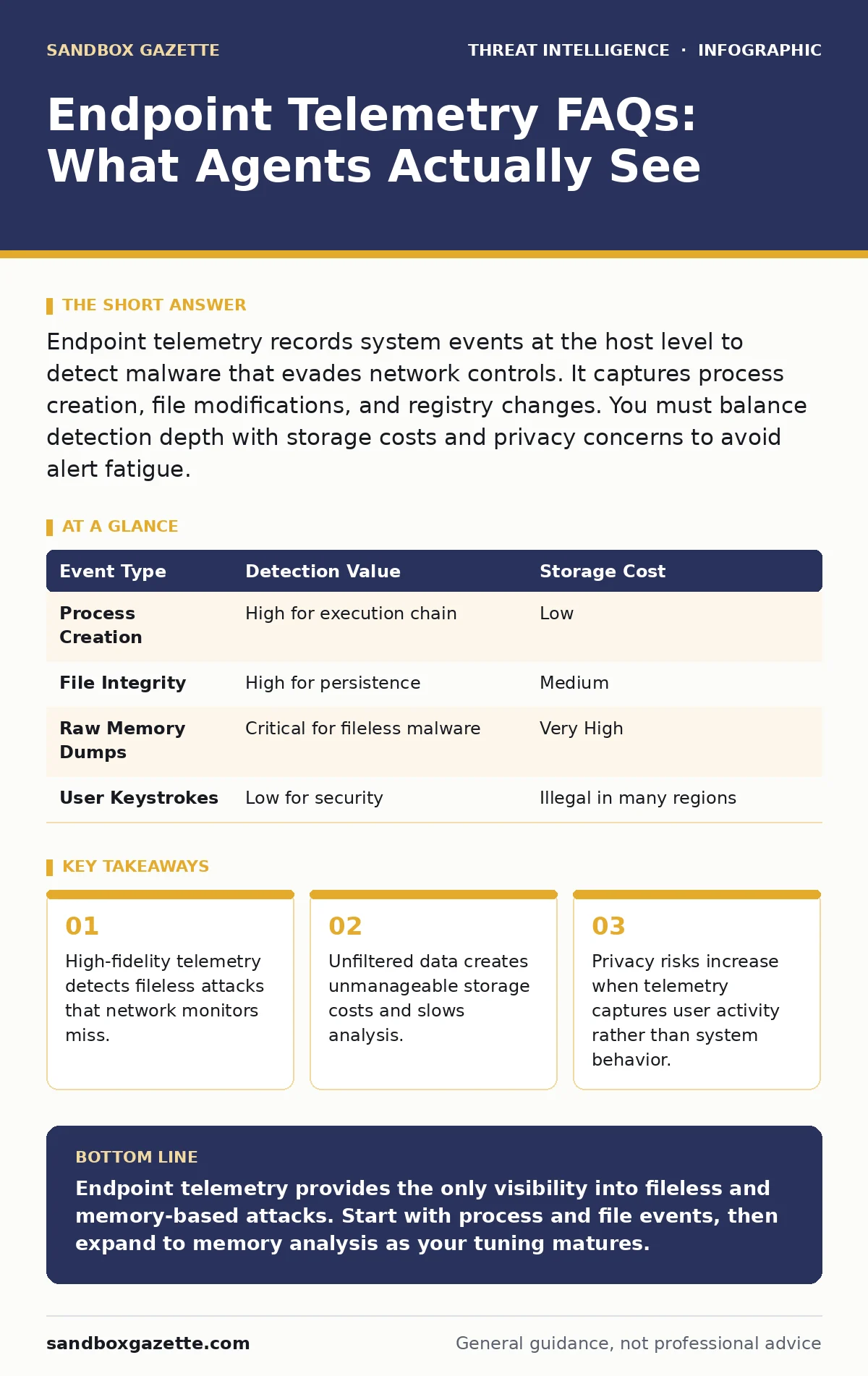
Endpoint telemetry records system events at the host level to detect malware that evades network controls. It captures process creation, file modifications, and registry changes. You must balance detection depth with storage costs and privacy concerns to avoid alert fatigue.
What exactly is endpoint telemetry?
Endpoint telemetry is the collection of data from devices about their internal state and activities. It goes beyond simple file hashes to record process creation, memory usage, and registry modifications. This data provides visibility into actions that occur entirely on the device, invisible to network perimeter tools.
Why can’t network logs replace endpoint data?
Network logs show traffic entering and leaving the device, but they cannot see what happens inside. Malware often communicates over standard ports or uses encrypted channels that look like normal traffic. Without endpoint data, you miss the execution of scripts, the injection of code into memory, or the lateral movement via local credentials.
What is the difference between EDR and telemetry?
Endpoint Detection and Response (EDR) is a product category that uses telemetry to detect and stop threats. Telemetry is the raw data stream itself, regardless of the tool collecting it. You can use telemetry from basic agents to feed a SIEM for broader correlation, or feed it into specialized detection engines for deeper analysis.
Which events should I collect first?
Start with process creation events, file system changes, and registry modifications. These three categories cover the majority of malware behaviors and persistence mechanisms. Collecting everything from the start overwhelms your storage and creates noise that hides real signals.
| Event Type | Detection Value | Storage Cost |
|---|---|---|
| Process Creation | High for execution chain | Low |
| File Integrity | High for persistence | Medium |
| Raw Memory Dumps | Critical for fileless malware | Very High |
| User Keystrokes | Low for security | Illegal in many regions |
How do I avoid storage costs spiraling?
Implement strict retention policies and tiered storage strategies. Keep high-fidelity data for active investigations, but archive or delete raw logs after a set period. Use sampling for low-risk events, such as routine software updates, while keeping full fidelity for suspicious activities.
See also: How to use YARA rules to detect hidden malware in files · SIEM Explained: How Log Aggregation Stops Silent Breaches
What are the privacy risks of endpoint data?
Telemetry can capture sensitive user information if not configured correctly. Screen captures or keylogging features often violate privacy laws and erode trust. Focus on system-level events rather than user content to maintain compliance and avoid legal exposure.
How does telemetry detect process injection?
Process injection involves writing malicious code into the memory of a legitimate process. Endpoint telemetry detects this by monitoring memory writes and unexpected API calls within trusted processes. This visibility is critical because network logs will only see the legitimate process communicating normally.
Why do I still see advanced persistent threats?
Advanced persistent threats often use legitimate tools to move laterally and exfiltrate data. If your baseline for "normal" behavior is too broad, these actions blend in. You must refine your detection rules to flag unusual process trees, such as a web browser spawning a command prompt.
How do I handle false positives?
False positives occur when benign activities trigger security alerts. Review and tune your detection rules regularly to exclude known good behaviors. Use context from other sources, such as user identity or time of day, to reduce noise and focus on genuine threats.
What is the role of DCSync attacks in endpoint data?
DCSync attacks mimic domain controller replication to steal credential hashes. Endpoint telemetry can detect these by monitoring for specific RPC calls and unusual replication requests from non-domain controllers. This detection is vital for preventing credential theft that leads to pass-the-hash attacks.
How do I correlate endpoint data with other sources?
Correlate endpoint events with network logs and identity provider records. A single event is often ambiguous, but a sequence across multiple sources reveals intent. This holistic view helps distinguish between a compromised account and a misconfigured application.
Key takeaways
- High-fidelity telemetry detects fileless attacks that network monitors miss.
- Unfiltered data creates unmanageable storage costs and slows analysis.
- Privacy risks increase when telemetry captures user activity rather than system behavior.
Endpoint telemetry provides the only visibility into fileless and memory-based attacks. Start with process and file events, then expand to memory analysis as your tuning matures.
Frequently asked questions
Does endpoint telemetry work offline?
Yes, it records events locally even when the device is disconnected from the network, syncing data when connectivity is restored.
Can I use open-source tools for endpoint telemetry?
Yes, many open-source agents and frameworks allow you to collect and ship telemetry data to your own analysis platforms.
How often should I review my telemetry retention policy?
Review it quarterly to ensure it aligns with current storage costs, legal requirements, and investigation needs.
Does telemetry prevent all malware?
No, telemetry detects and records behavior; prevention depends on your response actions and isolation capabilities.
How this guide was produced: written by the Sandbox Gazette editorial team with AI assistance, checked against the public references listed below, and reviewed when the facts change. See our editorial policy or report an error.