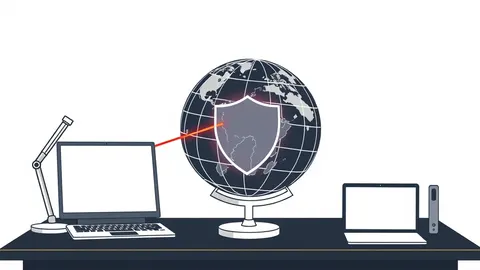
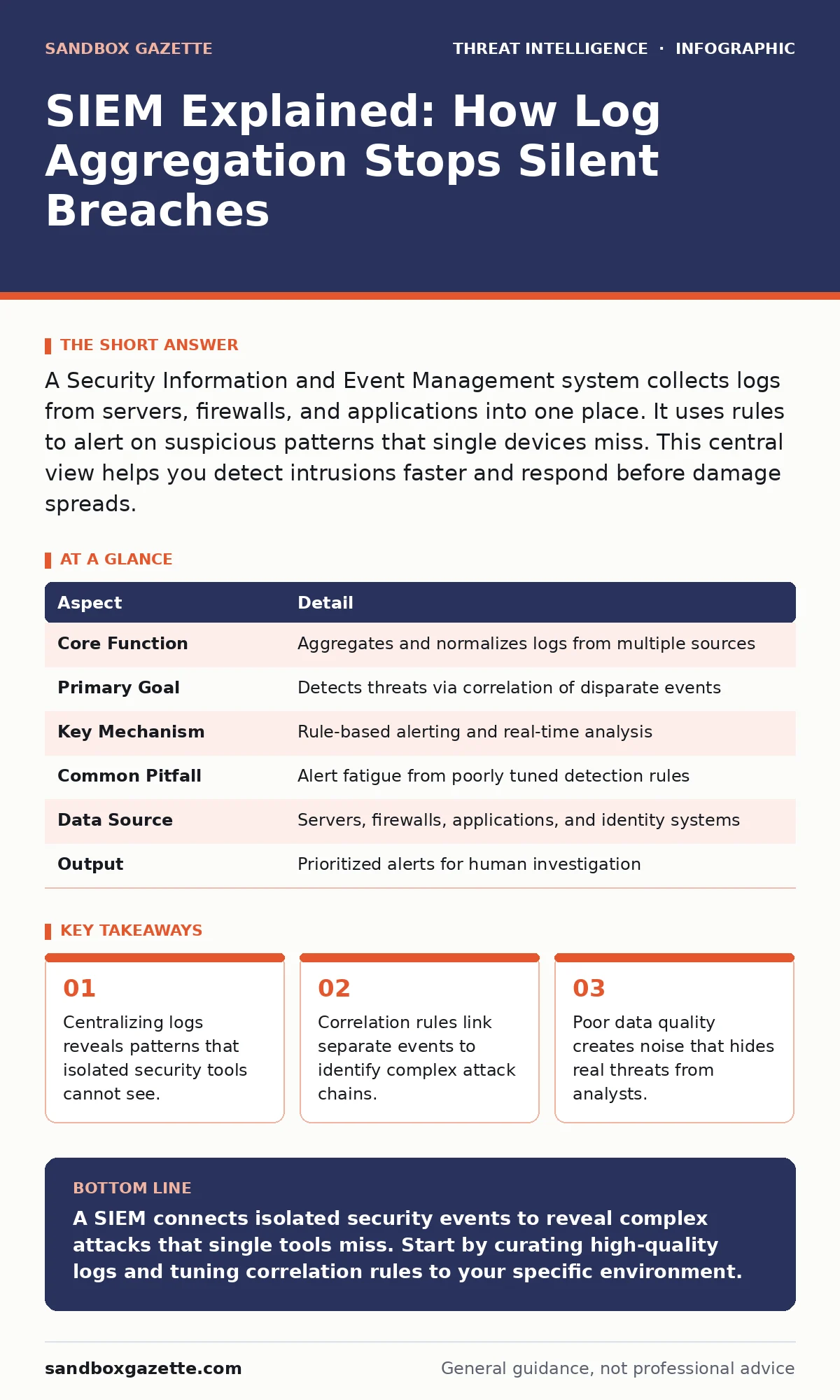
A Security Information and Event Management system collects logs from servers, firewalls, and applications into one place. It uses rules to alert on suspicious patterns that single devices miss. This central view helps you detect intrusions faster and respond before damage spreads.
The Air Traffic Control Analogy
Imagine an airport control tower. Individual radar screens track single planes, but no one screen shows the full sky. The tower combines data from every radar, radio call, and weather station to prevent collisions. A SIEM works the same way for your network.
Individual security tools like firewalls or endpoint detectors see only their own slice of traffic. They generate alerts, but they lack context. The SIEM ingests these disparate data streams to create a unified view of security events. This allows you to spot conflicts or anomalies that no single device could identify alone.
| Aspect | Detail |
|---|---|
| Core Function | Aggregates and normalizes logs from multiple sources |
| Primary Goal | Detects threats via correlation of disparate events |
| Key Mechanism | Rule-based alerting and real-time analysis |
| Common Pitfall | Alert fatigue from poorly tuned detection rules |
| Data Source | Servers, firewalls, applications, and identity systems |
| Output | Prioritized alerts for human investigation |
The Problem of Fragmented Visibility
Security tools operate in silos by design. A firewall sees network traffic. An endpoint detection agent sees process execution. An identity provider sees login attempts. None of them share their data natively. An attacker moving laterally might trigger a minor alert on the firewall and a separate alert on a server. Without connection, both look like false positives.
This fragmentation is the primary gap attackers exploit. They rely on your tools seeing only one step of their process. By correlating events across these boundaries, the SIEM reconstructs the attacker’s path. It turns isolated noise into a coherent narrative of compromise.
How Correlation Finds the Needle
The engine of a SIEM is the correlation engine. It applies predefined rules to incoming log data. These rules look for specific sequences or combinations of events. For instance, a rule might trigger if a user fails to log in five times from different countries within ten minutes.
Correlation goes beyond simple thresholds. It links events across different data types. Suppose a firewall blocks a connection from a known malicious IP. A moment later, a server logs a failed login attempt from an internal account. The SIEM connects these two events. It flags the internal account as potentially compromised, even though neither event alone was critical.
The Three Core Components
A functional SIEM relies on three distinct parts working in tandem. Understanding these helps you troubleshoot why alerts might be missing or delayed.
- Log Management: This component collects raw data. It normalizes the data into a common format. Different vendors use different log structures. Normalization ensures the system can compare a Windows event log with a Linux syslog entry.
- Event Correlation: This is the analytical layer. It applies logic to the normalized data. It looks for patterns, anomalies, and rule violations. This is where the "intelligence" happens.
- Reporting and Dashboards: This presents the findings. It provides historical context and visual trends. Analysts use this to investigate alerts and track threat activity over time.
Integration with Other Defenses
The SIEM does not replace other security tools. It sits above them as the central nervous system. It needs input from everywhere to work effectively. If your endpoint detection tool does not send logs to the SIEM, you have a blind spot.
It also connects to automated response systems. Many teams pair SIEM with SOAR (Security Orchestration, Automation, and Response). The SIEM detects the threat. The SOAR platform executes the containment playbooks. This reduces the time between detection and action.
Without integration, the SIEM is just a database. It must ingest data from identity providers, network devices, and cloud services. It should also export data to threat intelligence platforms. This bidirectional flow ensures your detection rules stay current with emerging threats.
See also: Endpoint Telemetry FAQs: What Agents Actually See · How Machine Learning Detects Cyber Threats: A Technical Breakdown
What People Usually Get Wrong
Many organizations treat SIEM as a compliance checkbox. They install it to meet regulatory requirements. They collect every log possible. This approach fails because it creates massive noise. Analysts drown in false positives. Real threats get buried under thousands of irrelevant alerts.
The mistake is assuming volume equals security. More logs do not mean better detection. They mean slower processing and higher costs. You must curate your data sources. Focus on high-fidelity logs that indicate user or system behavior. Ignore low-value logs that rarely contain threat indicators.
Another common error is neglecting rule tuning. Default rules are generic. They do not account for your specific environment. You must customize rules to reflect your business logic. A login from a new location might be normal for a traveling salesperson. It might be an attack for a back-office accountant. The SIEM needs this context to function correctly.
The Hidden Cost of Poor Data Quality
Data quality is the silent killer of SIEM effectiveness. If timestamps are misaligned, correlation fails. If user identities are not mapped correctly, you cannot track lateral movement. If logs are incomplete, you cannot reconstruct the attack.
Consider pass-the-hash attacks. The attacker steals credentials and moves to another server. If your SIEM does not receive detailed authentication logs from all servers, you miss the movement. You see a successful login, but not the stolen credential. The correlation rule never triggers.
You must invest in data hygiene. Ensure all devices have synchronized clocks. Map machine names to active directory accounts. Validate that critical logs are flowing. Regular audits of data sources prevent blind spots. A SIEM with bad data is worse than no SIEM. It gives you false confidence.
Beyond Basic Detection
Modern SIEMs include user and entity behavior analytics. This uses machine learning to establish baselines. It detects deviations from normal behavior. This helps catch advanced persistent threats that do not trigger signature-based rules.
It also helps identify process injection techniques. An attacker might inject malicious code into a legitimate process. The process name looks normal. The behavior does not. Behavioral analytics spots the anomaly in memory usage or network calls.
However, these features require training. You must feed the system clean data. You must validate its alerts. Do not rely on automation alone. Human expertise remains the final filter. The SIEM highlights the probable threats. You determine the reality.
Key takeaways
- Centralizing logs reveals patterns that isolated security tools cannot see.
- Correlation rules link separate events to identify complex attack chains.
- Poor data quality creates noise that hides real threats from analysts.
A SIEM connects isolated security events to reveal complex attacks that single tools miss. Start by curating high-quality logs and tuning correlation rules to your specific environment.
Frequently asked questions
Does a SIEM prevent attacks?
No. A SIEM detects and alerts on suspicious activity. It does not block traffic or stop malware. It provides the visibility needed for you to take action.
How is SIEM different from a firewall?
A firewall blocks network traffic based on rules. A SIEM analyzes logs from the firewall and other sources to find patterns of malicious behavior over time.
Do I need a SIEM if I have endpoint detection?
Endpoint detection protects individual devices. A SIEM provides a network-wide view. It connects endpoint events with network and identity data to see the full attack chain.
What is the biggest risk of using a SIEM?
Alert fatigue. If you do not tune your rules, analysts will ignore alerts. This causes real threats to be missed amidst the noise.
How this guide was produced: written by the Sandbox Gazette editorial team with AI assistance, checked against the public references listed below, and reviewed when the facts change. See our editorial policy or report an error.