
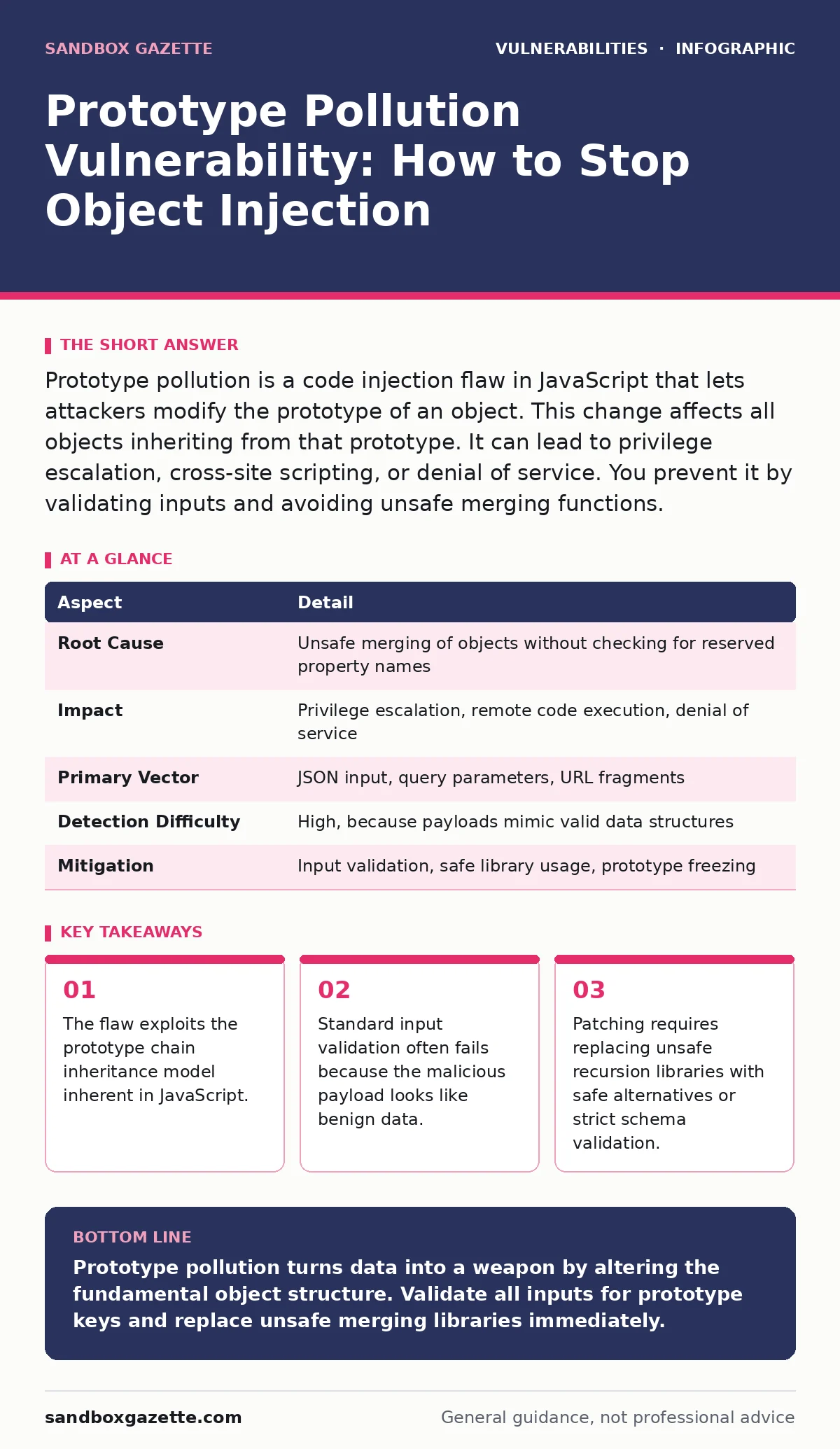
Prototype pollution is a code injection flaw in JavaScript that lets attackers modify the prototype of an object. This change affects all objects inheriting from that prototype. It can lead to privilege escalation, cross-site scripting, or denial of service. You prevent it by validating inputs and avoiding unsafe merging functions.
Prototype Pollution Vulnerability Explained
Imagine a factory assembly line where every worker receives a standard tool kit. If someone slips a counterfeit tool into the master kit, every worker who grabs a tool gets the fake. Prototype pollution works the same way in JavaScript applications. It injects properties into the base object prototype, affecting every object that inherits from it. This changes how the entire application behaves.
The vulnerability exists because JavaScript uses prototype-based inheritance. Every object has a link to a prototype object. When you access a property on an object, the engine checks the object itself. If it is not there, the engine walks up the prototype chain until it finds the property or reaches the end. An attacker can place a property on the base prototype. All subsequent objects will see that property as their own.
This mechanism turns data into code execution paths. The attacker does not need to run new code. They simply change the meaning of existing code by altering the data structure it relies on. This makes the flaw particularly dangerous in server-side JavaScript environments where the application trusts its own object structures.
| Aspect | Detail |
|---|---|
| Root Cause | Unsafe merging of objects without checking for reserved property names |
| Impact | Privilege escalation, remote code execution, denial of service |
| Primary Vector | JSON input, query parameters, URL fragments |
| Detection Difficulty | High, because payloads mimic valid data structures |
| Mitigation | Input validation, safe library usage, prototype freezing |
How the Mechanism Works
The core issue arises when an application merges two objects without validation. Developers often use recursive functions to copy properties from a source object to a target object. If the source object contains a property named __proto__ or constructor.prototype, the merge function writes to the base prototype instead of the target object. This happens because these properties are treated as special links to the inheritance chain.
Consider a function that merges user settings with default settings. The function iterates through the user input. If the input includes {"__proto__": {"isAdmin": true}}, the function sets the isAdmin property on the Object prototype. Every new object created in that application context now has isAdmin set to true. The application logic, which checks user.isAdmin, now returns true for everyone.
This bypasses access controls because the check relies on the object property, not an external database lookup. The attacker has effectively rewritten the rules of the application at runtime. The code itself is not modified on disk. The memory state of the running application is altered. This makes traditional static analysis less effective, as the source code appears correct.
Who Is Affected
Any application written in JavaScript or TypeScript that processes untrusted data is at risk. This includes Node.js backends, browser-based frontends, and hybrid mobile applications. The vulnerability is not limited to a specific framework. It exists wherever object manipulation occurs without strict boundaries.
Server-side applications face the highest risk. A successful attack on a server can lead to remote code execution or data exfiltration. The attacker can manipulate session variables, authentication tokens, and routing logic. Client-side applications are also vulnerable. An attacker can inject properties that trigger cross-site scripting or alter the behavior of single-page applications.
Microservices architectures amplify the risk. One service may pass polluted objects to another. The second service assumes the object structure is valid. The pollution spreads across service boundaries. This makes tracing the origin of the flaw difficult. The vulnerability often hides in third-party libraries that perform deep cloning or merging.
What People Usually Get Wrong
Many teams believe that sanitizing input strings prevents this flaw. They strip out script tags and special characters. This is insufficient. Prototype pollution payloads are valid JSON strings. They contain no scripts, no HTML, and no unusual characters. They look exactly like legitimate configuration data. Standard output encoding does nothing to stop the injection because the damage happens before output generation.
Another common mistake is assuming that modern frameworks are immune. While some frameworks have patched their internal utilities, developers often use external libraries for data manipulation. These libraries may not have the same security guarantees. A single unsafe merge call in a dependency can compromise the entire application. You must audit all dependencies, not just the core framework.
Teams also overlook the constructor property. Focusing only on __proto__ leaves a gap. Attackers can use constructor.prototype to achieve the same result. Some older JavaScript engines also allow pollution via __defineGetter__ or __defineSetter__. A comprehensive defense must block all known pollution vectors, not just the most famous one.
Mitigation Strategies
The primary defense is input validation. You must reject any input that contains prototype-related properties. This includes __proto__, constructor, and prototype. Validation should occur at the entry point of the application. Do not trust data from any source, including internal microservices. Use a schema validator that explicitly forbids these keys.
Replace unsafe merging functions with safe alternatives. Many popular libraries have released patched versions that ignore prototype properties. If you cannot upgrade, write a custom merge function that checks for these keys before assignment. You can also freeze the Object prototype at application startup. This prevents any further modification. Note that freezing the prototype may break some third-party code that relies on extending it.
Integrate security testing into your development pipeline. Use dynamic application security testing (DAST) tools configured to detect prototype pollution. These tools can simulate attacks and verify that your application rejects malicious payloads. Combine this with static analysis to catch unsafe library usage early. Regular updates to your vulnerability management programs ensure you stay ahead of new variants.
See also: How Coordinated Vulnerability Disclosure Fixes Broken Patch Cycles
Beyond Basic Input Validation
Input validation alone is not enough. You must also secure the data processing logic. Avoid using recursive functions that traverse object properties without depth limits. This prevents denial of service attacks that exploit the recursion. Set a maximum depth for object traversal. Reject objects that exceed this limit.
Consider using a sandboxed environment for untrusted code execution. If you must process complex data structures, do so in an isolated context. This limits the impact of a successful injection. The polluted object remains contained within the sandbox. It cannot affect the main application logic.
Monitor for unusual object properties in your logs. If you see __proto__ or similar keys appearing in application data, investigate immediately. This indicates a potential attack or a misconfiguration. Early detection allows you to respond before the attacker exploits the flaw.
Related Security Concerns
This flaw often appears alongside other injection vulnerabilities. Path traversal vulnerabilities allow attackers to access files outside the intended directory. Both flaws exploit the trust an application places in user input. Understanding how to secure one helps you secure the other.
CVE identifiers help track specific instances of this vulnerability. When a library is found to be vulnerable, a CVE is assigned. You can use these identifiers to check your dependencies. This is part of a mature vulnerability management program.
HTTP security headers provide an additional layer of defense. They can mitigate some impacts of client-side pollution, such as cross-site scripting. However, they do not prevent the server-side logic manipulation. You need both server-side fixes and client-side protections.
n-day vulnerabilities are those for which a patch exists. Prototype pollution patches are often available quickly. The risk lies in the delay between patch release and deployment. Ensure your update process is rapid and reliable.
Vulnerabilities in self-hosted GitLab have included prototype pollution flaws. This shows that even large, well-maintained projects are susceptible. You cannot assume safety based on reputation. Independent verification is always required.
Key takeaways
- The flaw exploits the prototype chain inheritance model inherent in JavaScript.
- Standard input validation often fails because the malicious payload looks like benign data.
- Patching requires replacing unsafe recursion libraries with safe alternatives or strict schema validation.
Prototype pollution turns data into a weapon by altering the fundamental object structure. Validate all inputs for prototype keys and replace unsafe merging libraries immediately.
Frequently asked questions
Is prototype pollution only a client-side issue?
No, it affects both client-side and server-side JavaScript. Server-side impacts are often more severe, allowing remote code execution.
Can I fix this by just updating my framework?
Updating helps, but you must also audit all third-party libraries. The flaw often resides in utility functions used for data manipulation.
Does HTTPS prevent prototype pollution?
No, HTTPS encrypts data in transit. It does not validate the structure of the data. The application must still check for malicious properties.
How do I know if my library is vulnerable?
Check the library documentation and security advisories. Look for mentions of `__proto__` handling in merge or clone functions.
How this guide was produced: written by the Sandbox Gazette editorial team with AI assistance, checked against the public references listed below, and reviewed when the facts change. See our editorial policy or report an error.