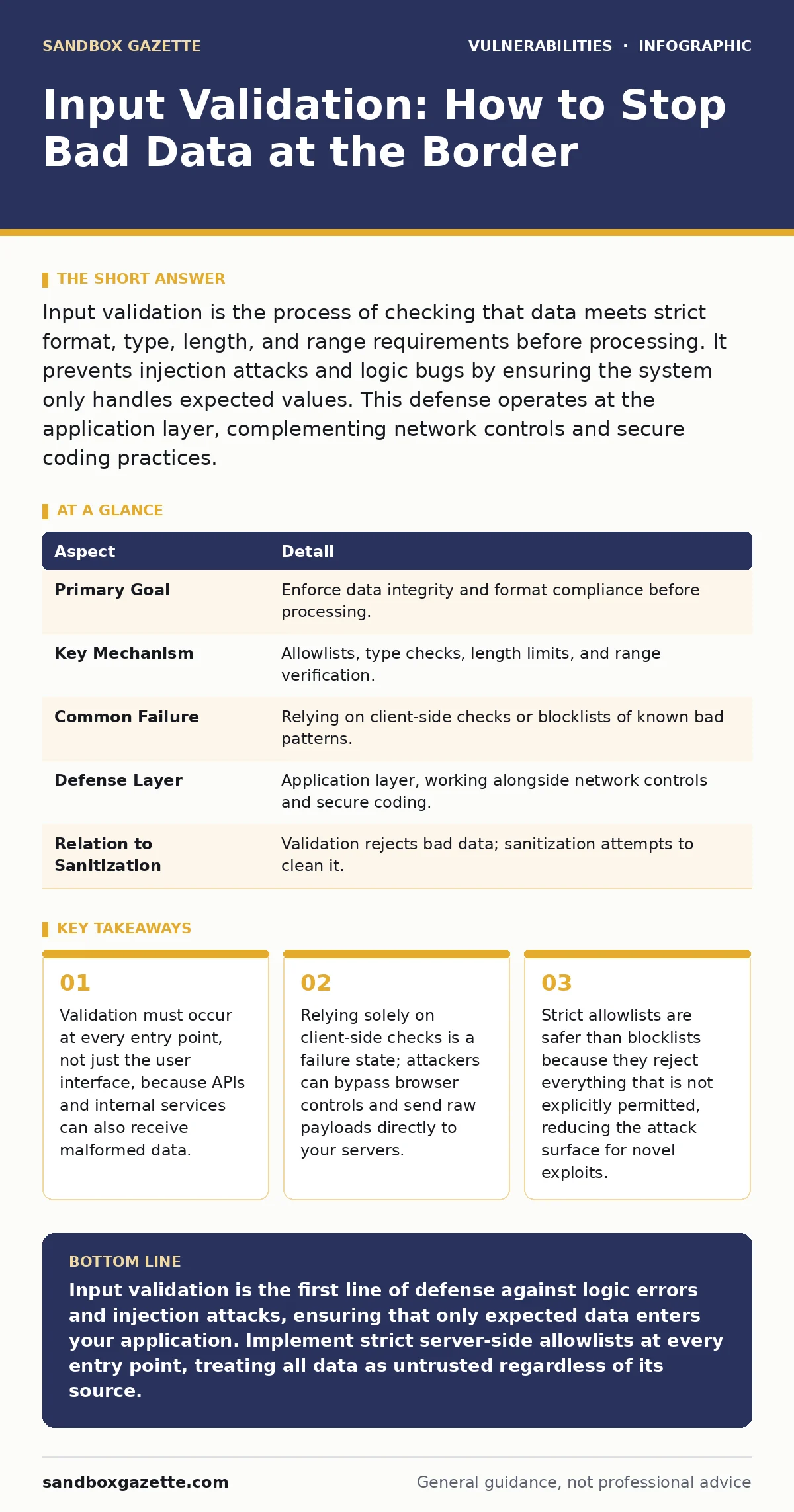
Input validation is the process of checking that data meets strict format, type, length, and range requirements before processing. It prevents injection attacks and logic bugs by ensuring the system only handles expected values. This defense operates at the application layer, complementing network controls and secure coding practices.
The Filter Metaphor
Imagine a factory that assembles complex machinery. Raw materials arrive from various suppliers, some clean and some contaminated. If the assembly line accepts every item without inspection, defective parts cause jams, break tools, or produce unsafe final products. Input validation acts as the quality control gate at the factory entrance. It inspects each item against a strict specification sheet before allowing it onto the line.
This metaphor applies directly to software systems. Applications receive data from users, other services, and external APIs. This data arrives in many forms: text strings, numbers, file uploads, and structured packets. If the application processes this data without verification, it risks executing unintended commands or crashing. Validation ensures that only data matching expected patterns enters the processing pipeline.
Defining the Mechanism
Input validation is the systematic verification of data integrity and format before an application uses it. It checks whether data conforms to predefined rules regarding type, length, range, format, and value. For example, a field expecting a numeric age should reject text input or negative numbers. This process is distinct from sanitization, which modifies data to remove harmful elements. Validation decides whether data is acceptable; sanitization tries to make bad data safe.
The goal is to enforce a strict boundary between trusted logic and untrusted input. Your application logic assumes certain conditions about the data it processes. If those conditions are false, the logic fails. Validation protects those assumptions. It forces the application to handle invalid data by rejecting it, rather than trying to interpret it.
The Core Components
Effective validation relies on several specific checks. You must verify the data type to ensure a string is not passed where an integer is expected. Type confusion can lead to unexpected behavior in weakly typed languages. Next, check the length. Buffer overflows occur when input exceeds the allocated memory space. Setting maximum length limits prevents this class of memory corruption.
Range validation ensures numeric values fall within acceptable bounds. Format validation uses patterns to verify structure, such as email addresses or date strings. Regular expressions are often used here, but they must be carefully crafted to avoid denial-of-service risks through catastrophic backtracking. Finally, value validation checks against an allowlist of permitted inputs. This is the strongest form of validation for fields with a known set of options, like country codes or status flags.
Where Validation Fits in Defense
Input validation is one layer in a deeper security architecture. It does not replace network firewalls or intrusion detection systems. Those tools filter traffic based on IP addresses and known malicious signatures. Validation operates at the application layer, understanding the semantic meaning of the data. A firewall might allow a valid HTTP request, but validation determines if the payload within that request is safe for your specific application logic.
It works closely with secure coding practices. Even with validation, developers must avoid dangerous functions that interpret input as code. Validation reduces the attack surface by eliminating many entry points for exploits. It complements configuration hardening by ensuring that even if configuration errors expose endpoints, the data entering those endpoints is still scrutinized. Proper validation also supports patch management by reducing the likelihood that minor input anomalies trigger crashes or unexpected behavior.
| Aspect | Detail |
|---|---|
| Primary Goal | Enforce data integrity and format compliance before processing. |
| Key Mechanism | Allowlists, type checks, length limits, and range verification. |
| Common Failure | Relying on client-side checks or blocklists of known bad patterns. |
| Defense Layer | Application layer, working alongside network controls and secure coding. |
| Relation to Sanitization | Validation rejects bad data; sanitization attempts to clean it. |
The Hidden Cost of Complexity
A common mistake is assuming that validation is a simple checkbox. In reality, complex applications often have dozens of entry points. These include web forms, API endpoints, file uploads, and even internal microservice calls. Each point requires specific validation rules. Maintaining these rules as the application evolves is difficult. When developers add new features, they often add new input fields without updating the validation logic. This creates gaps in the defense.
Another hidden cost is performance. Strict validation, especially with complex regular expressions or cryptographic checks, adds processing overhead. While usually negligible, heavy validation on high-throughput systems can become a bottleneck. You must balance security with performance. Overly strict rules can also degrade user experience if legitimate inputs are incorrectly rejected. False positives force users to correct their data, leading to frustration and abandonment.
What People Usually Get Wrong
Many teams believe that client-side validation is sufficient. This is a dangerous assumption. Client-side validation runs in the user's browser. Attackers can bypass it entirely by sending requests directly to the server using tools like curl or Postman. Server-side validation is the only reliable check. Every piece of data must be validated on the server, regardless of where it originated.
Another error is relying on blocklists. A blocklist attempts to filter out known bad patterns, such as specific keywords or characters. Attackers can easily circumvent blocklists by using encoding tricks, case variations, or alternative characters. Allowlists are far superior. An allowlist defines exactly what is permitted. Anything not on the list is rejected. This approach is inherently more secure because it does not rely on predicting every possible malicious input.
Finally, teams often neglect validation of data from trusted sources. They assume that data from internal systems or partner APIs is safe. This assumption fails when those internal systems are compromised or misconfigured. Every boundary between systems must be treated as a potential attack surface. Input validation must be applied consistently, regardless of the data source. This principle supports effective attack surface management by identifying and securing all data entry points.
Integrating with Broader Security
Input validation is not a standalone solution. It must work with other security measures. For instance, if an application uses parameterized queries for database access, injection attacks are mitigated. However, validation still prevents other logic errors and ensures data quality. Similarly, if you use cross-site WebSocket hijacking protections, validation ensures that the data sent over those secure channels is also valid.
Regular updates to validation rules are necessary as new attack techniques emerge. While this is not emergency patching, it is a form of proactive maintenance. You should review validation logic as part of your regular code reviews. This helps identify n-day vulnerabilities where a known weakness is exploited before a fix is applied. By keeping validation rules tight and updated, you reduce the window of opportunity for attackers.
Key takeaways
- Validation must occur at every entry point, not just the user interface, because APIs and internal services can also receive malformed data.
- Relying solely on client-side checks is a failure state; attackers can bypass browser controls and send raw payloads directly to your servers.
- Strict allowlists are safer than blocklists because they reject everything that is not explicitly permitted, reducing the attack surface for novel exploits.
Input validation is the first line of defense against logic errors and injection attacks, ensuring that only expected data enters your application. Implement strict server-side allowlists at every entry point, treating all data as untrusted regardless of its source.
Frequently asked questions
Does input validation prevent all types of attacks?
No, it primarily prevents injection attacks and logic errors caused by malformed data. It does not protect against vulnerabilities in the underlying code, such as memory corruption bugs or authentication flaws, which require other defenses like secure coding and configuration hardening.
How is input validation different from output encoding?
Input validation checks data when it enters the system to ensure it meets expected formats. Output encoding transforms data before it is displayed or sent to another system to prevent interpretation as code. Both are necessary; validation reduces the attack surface, while encoding prevents rendering issues and cross-site scripting.
Should I use regular expressions for all validation?
Regular expressions are useful for format checks, but they are not always the best tool. For simple type or range checks, built-in language functions are often clearer and less prone to errors. Complex regular expressions can also introduce performance issues or be vulnerable to denial-of-service attacks through catastrophic backtracking.
How often should I review my validation rules?
You should review validation rules during every code change that affects data input. Additionally, periodic audits are necessary to ensure that new attack vectors or changes in data formats are addressed. This practice aligns with backported security fixes, where you address known issues in your logic without waiting for a full system overhaul.
How this guide was produced: written by the Sandbox Gazette editorial team with AI assistance, checked against the public references listed below, and reviewed when the facts change. See our editorial policy or report an error.