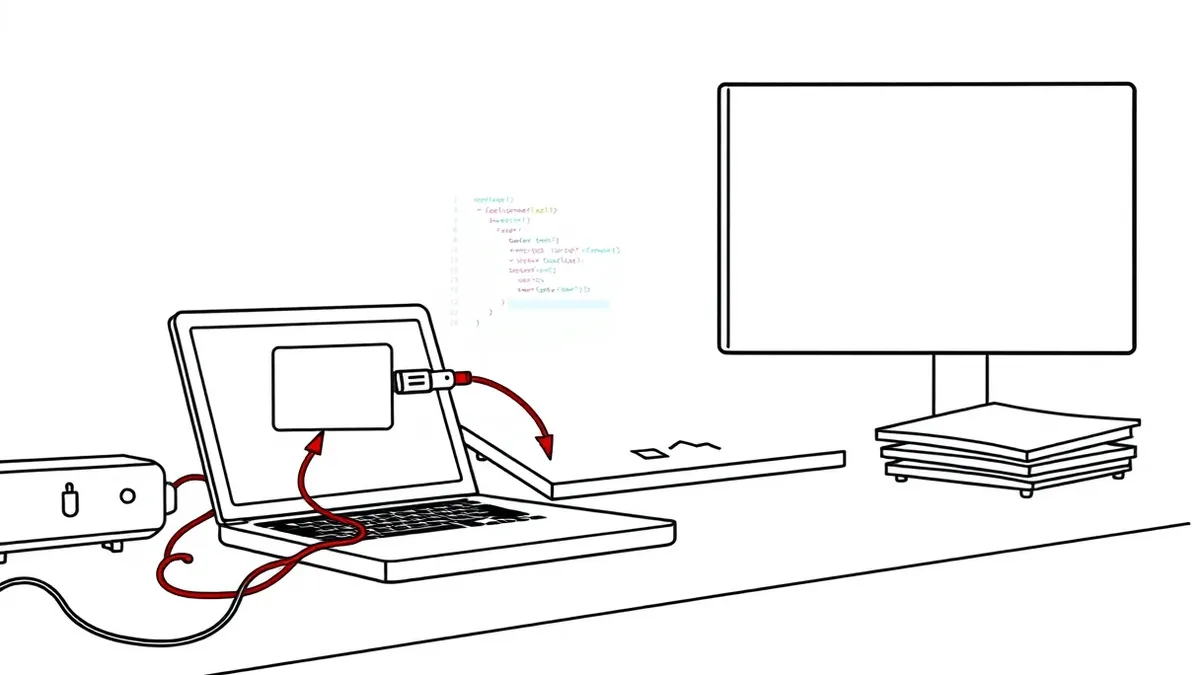
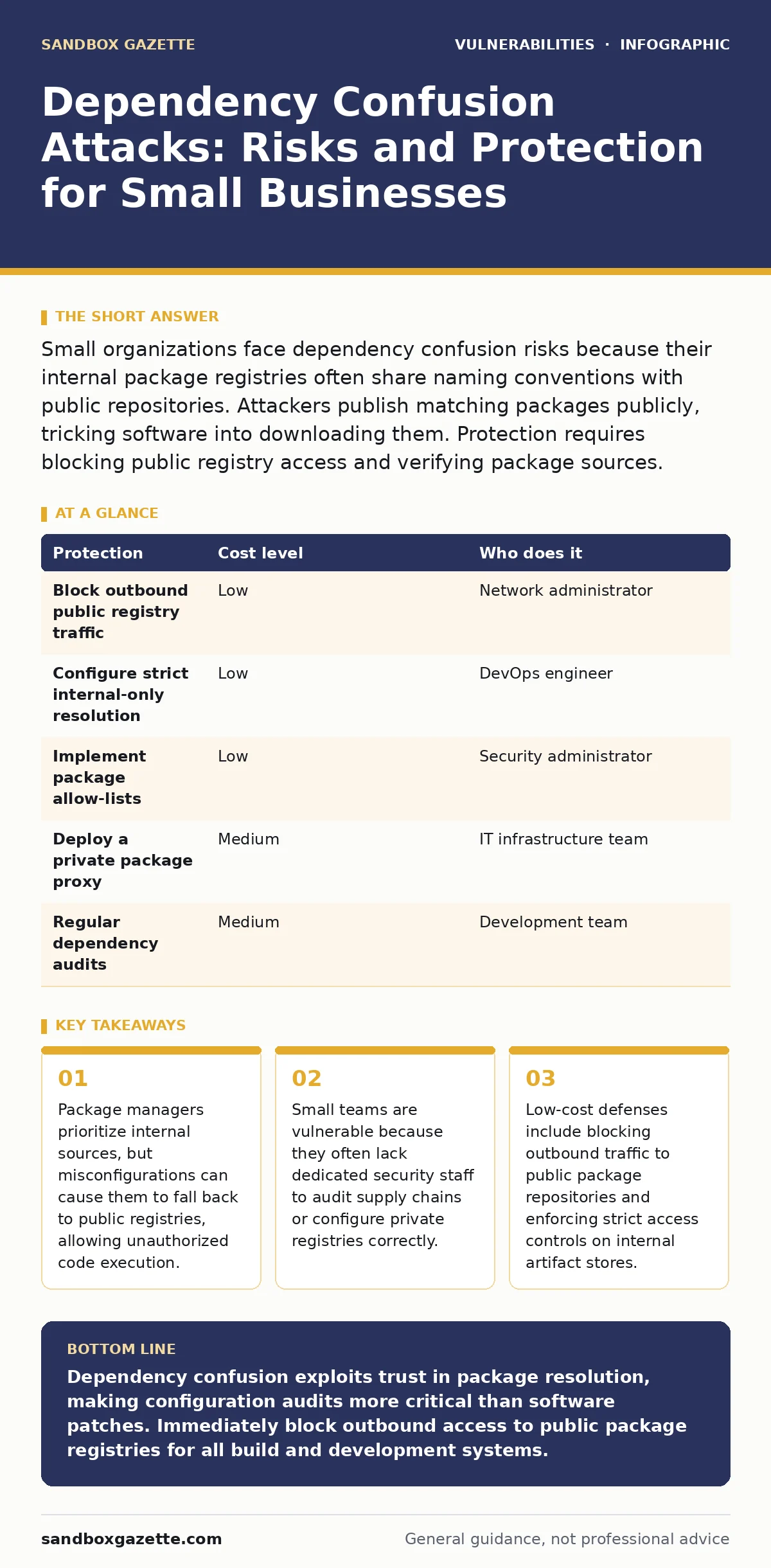
Small organizations face dependency confusion risks because their internal package registries often share naming conventions with public repositories. Attackers publish matching packages publicly, tricking software into downloading them. Protection requires blocking public registry access and verifying package sources.
The Mechanics of Supply Chain Deception
Dependency confusion attacks exploit the resolution logic of package managers. Most modern development environments rely on package managers to download libraries and dependencies. These tools are designed to check an internal, private registry first. If the package is not found there, they fallback to a public registry like npm or PyPI. Attackers monitor public registries for names that match internal packages. They then publish a malicious package with that exact name. When a build server or development machine checks for updates, it finds the public package and installs it, assuming it is legitimate.
This technique bypasses traditional perimeter defenses. The connection to the public registry is outbound traffic, which firewalls often allow by default. The attack does not require exploiting a software bug in the application itself. It relies on the configuration of the build infrastructure. The attacker gains code execution by tricking the system into trusting a source it should not trust. This makes the attack vector subtle and difficult to detect with standard intrusion detection systems.
Why Small Organizations Face Higher Exposure
Small organizations often lack the infrastructure complexity that large enterprises use to segment their networks. Large companies frequently use dedicated, isolated networks for build servers. Small teams often run development and production environments on the same network or use shared cloud resources. This lack of segmentation means that a compromised build process can immediately affect production systems.
Resource constraints also play a significant role. Small IT teams rarely have dedicated security engineers. They rely on default configurations for their tools. Default settings often allow fallback to public registries for convenience. This convenience creates a security gap. Without regular audits of package dependencies, small teams remain unaware of their exposure. The assumption that internal packages are never published publicly is a dangerous one. Attackers actively search for these naming collisions, making small, overlooked targets attractive opportunities.
The Hidden Cost of Default Configurations
The primary driver of this vulnerability is the path of least resistance. Setting up a private package registry requires effort. Configuring it to strictly reject unknown packages requires further effort. Many organizations choose the easier path, allowing their tools to check public sources as a backup. This decision seems harmless until an attacker exploits it.
Imagine a scenario where a developer pushes a new feature. The build pipeline runs automatically. It checks the internal registry, fails to find a specific version, and then checks the public registry. It finds the package and proceeds. The malicious code runs in the context of the build user. This user often has elevated privileges to deploy code. The attacker now has a foothold in the system. The cost of this misconfiguration is not just a failed build. It is a full compromise of the software supply chain.
Low-Cost Protections for Limited Budgets
You do not need expensive security tools to mitigate this risk. The most effective protections are configuration changes. Blocking outbound traffic to known public package repositories is a primary defense. Configure your firewall or network security groups to deny connections to these domains. This forces all package resolution to occur within your internal registry. If a package is not in your internal store, the build fails. This failure is safer than a silent compromise.
Implementing allow-lists for package sources is another low-cost measure. Define exactly which repositories your tools are allowed to query. Explicitly forbid all others. This approach reduces the attack surface significantly. It requires initial setup but minimal ongoing maintenance. You must balance security with developer productivity. Blocking all public access might break workflows that rely on open-source libraries. In such cases, use a proxy or mirror that caches public packages and serves them internally. This maintains the convenience of public packages while removing the direct connection to the public internet.
| Protection | Cost level | Who does it |
|---|---|---|
| Block outbound public registry traffic | Low | Network administrator |
| Configure strict internal-only resolution | Low | DevOps engineer |
| Implement package allow-lists | Low | Security administrator |
| Deploy a private package proxy | Medium | IT infrastructure team |
| Regular dependency audits | Medium | Development team |
What to Ask Your IT Provider
If you outsource your IT or development infrastructure, you must verify their security posture. You cannot assume that standard hosting includes supply chain security. Ask specific questions to uncover gaps. Do not accept vague assurances. You need concrete details about how they manage package dependencies.
- How do you configure package managers to resolve dependencies?
- Do you block outbound traffic to public package repositories by default?
- What is your process for auditing internal package names against public registries?
- How do you handle updates for open-source libraries used in internal projects?
- Can you provide evidence of regular configuration hardening for build servers?
These questions reveal whether your provider understands the supply chain risk. If they cannot answer clearly, they may not be protecting your assets adequately. You need a partner who proactively manages these configurations. Relying on manual checks is insufficient for dynamic development environments. Automated enforcement is necessary to maintain security over time.
See also: How Coordinated Vulnerability Disclosure Fixes Broken Patch Cycles
Integrating with Broader Security Practices
Dependency confusion is one part of a larger supply chain security strategy. It intersects with vulnerability management programs that track known flaws in software components. If you ignore dependency confusion, your vulnerability management efforts are incomplete. You must also consider patch management procedures. When a new version of a library is released, your systems must update securely.
This risk also relates to open redirect vulnerabilities in how applications handle external resources. While different, both exploit trust boundaries. You should review your HTTP security headers to ensure your web applications do not inadvertently load scripts from untrusted sources. This layered approach reduces the impact of any single failure. Even if an attacker injects code, proper headers and strict transport policies can limit what that code can do.
Monitoring and Continuous Improvement
Security is not a one-time fix. You must monitor your environment for changes. Package managers and build tools update frequently. New versions may introduce new default behaviors. Regular reviews of your configurations are necessary. Include dependency security in your regular security audits. Treat it with the same seriousness as network security.
Consider implementing dynamic application security testing (DAST) in your CI/CD pipeline. While DAST primarily checks for runtime vulnerabilities, it can help identify unusual behavior in deployed applications. This adds another layer of detection. If a malicious package executes, DAST might detect the anomalous network calls or code injections. This allows you to respond quickly before the attacker gains deeper access.
Final Steps for Implementation
Start by identifying all package managers in use. List every project that uses them. Check the configuration of each. Disable public fallbacks immediately. Communicate these changes to your development team. Explain why the changes are necessary. Training reduces resistance and helps developers understand the risk.
Review your firewall rules. Ensure that outbound traffic to public registries is blocked for build servers. Test your builds to confirm they still work. If they fail, investigate why. You may need to add missing packages to your internal registry. This process strengthens your internal supply chain. It makes your organization more resilient against supply chain attacks.
Key takeaways
- Package managers prioritize internal sources, but misconfigurations can cause them to fall back to public registries, allowing unauthorized code execution.
- Small teams are vulnerable because they often lack dedicated security staff to audit supply chains or configure private registries correctly.
- Low-cost defenses include blocking outbound traffic to public package repositories and enforcing strict access controls on internal artifact stores.
Dependency confusion exploits trust in package resolution, making configuration audits more critical than software patches. Immediately block outbound access to public package registries for all build and development systems.
Frequently asked questions
Can dependency confusion attacks affect Windows systems?
Yes, any system using package managers that support fallback resolution is at risk. Windows systems using tools like Chocolatey or NuGet can be vulnerable if misconfigured.
Do I need to buy a new security tool to stop this?
No, you can mitigate the risk by changing existing network and package manager configurations. Blocking public registry access is the most effective free defense.
How do I know if I have been attacked?
Look for unexpected package installations or build failures. Review logs for connections to public registries from internal build servers that should not have them.
Is this risk limited to code repositories?
No, it affects any system that automatically downloads software components. This includes servers, containers, and development workstations.
How this guide was produced: written by the Sandbox Gazette editorial team with AI assistance, checked against the public references listed below, and reviewed when the facts change. See our editorial policy or report an error.