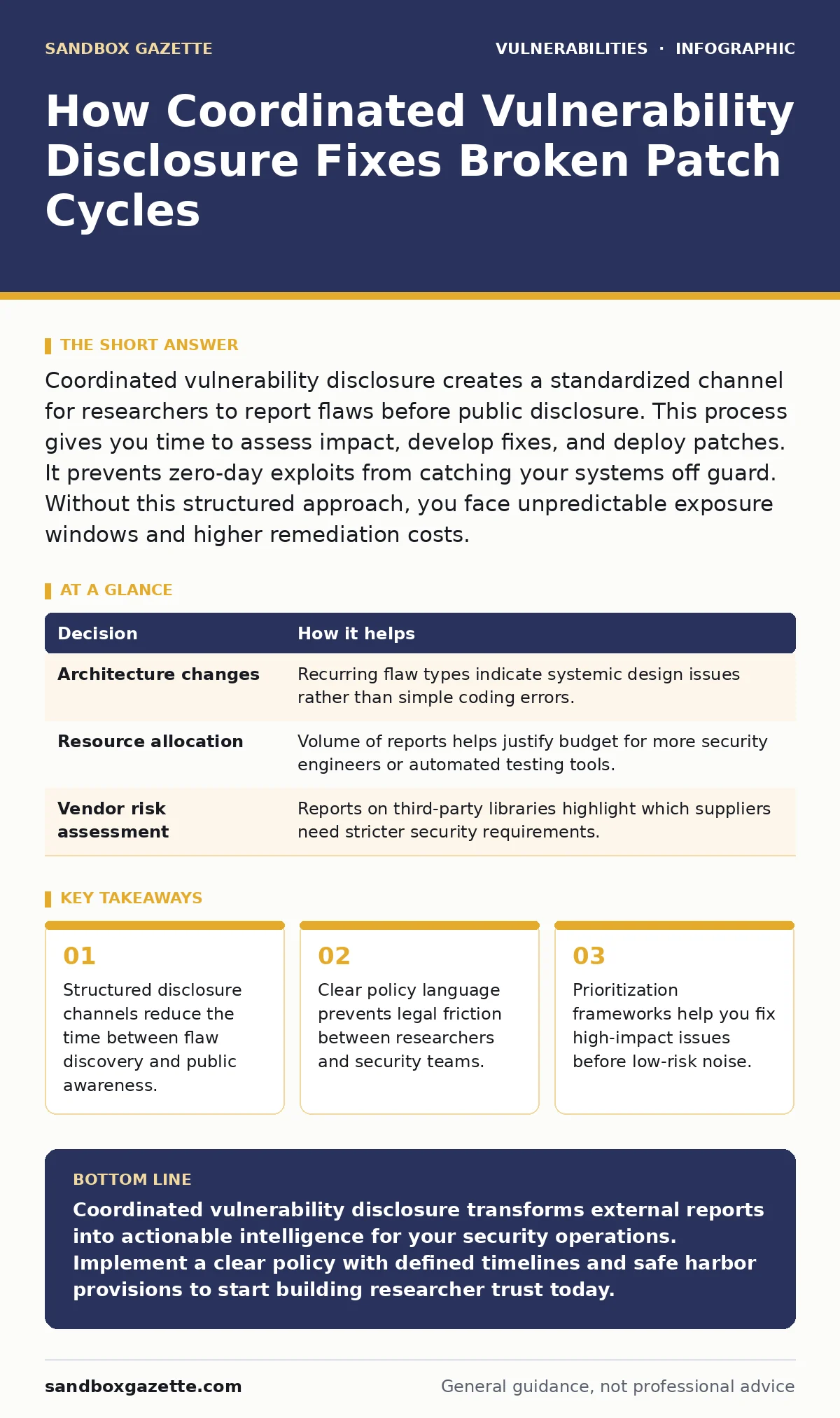
Coordinated vulnerability disclosure creates a standardized channel for researchers to report flaws before public disclosure. This process gives you time to assess impact, develop fixes, and deploy patches. It prevents zero-day exploits from catching your systems off guard. Without this structured approach, you face unpredictable exposure windows and higher remediation costs.
The Cost of Unstructured Reporting
Imagine a researcher finds a flaw in your application. They email the generic support address. The ticket sits in a queue for weeks. Meanwhile, the researcher grows impatient. They post details on a public forum. Your team wakes up to active exploitation. This scenario illustrates why ad-hoc reporting fails. You lose control of the narrative. You lose time to prepare.
Coordinated vulnerability disclosure (CVD) replaces this chaos with a defined process. You publish a policy that tells researchers exactly how to contact you. You promise a response within a set timeframe. You agree to keep details private until a fix is ready. This agreement builds trust. Researchers prefer reporting to teams that listen. They avoid targeting organizations that ignore them or threaten legal action.
Decisions Informed by Disclosure Data
CVD provides data that informs critical technical and operational decisions. You cannot prioritize fixes if you do not know what is broken. You cannot measure improvement if you do not track trends. The process feeds directly into your vulnerability management programs. It highlights gaps in your input validation logic. It reveals weaknesses in your dependency confusion attacks defenses.
| Decision | How it helps |
|---|---|
| Architecture changes | Recurring flaw types indicate systemic design issues rather than simple coding errors. |
| Resource allocation | Volume of reports helps justify budget for more security engineers or automated testing tools. |
| Vendor risk assessment | Reports on third-party libraries highlight which suppliers need stricter security requirements. |
What Goes Wrong Without It
Without a CVD policy, you operate in the dark. Researchers still find flaws. They just do not tell you first. You discover vulnerabilities through customer complaints or news alerts. This reactive posture is expensive. Emergency patches require overtime and rushed testing. Rushed testing introduces new bugs. You create a cycle of instability.
Legal ambiguity also creates friction. Researchers worry about liability if they probe your systems. Without a safe harbor clause in your policy, they may hesitate to report. They might choose not to engage at all. This silence is dangerous. It means fewer eyes are looking for problems on your behalf. You lose the benefit of external scrutiny. Your security posture becomes complacent.
How Teams Use the Process
Effective teams treat CVD as an operational workflow, not a PR exercise. The process starts with intake. A dedicated email address or web form collects reports. Triage staff assess severity using a standard framework. They assign a severity score. They notify the relevant engineering team. This step ensures that critical issues get immediate attention.
Next comes the collaboration phase. You communicate with the researcher. You ask for proof of concept code. You share your findings. You agree on a disclosure timeline. This transparency prevents misunderstandings. It keeps the researcher engaged. They feel valued as partners in security. This relationship encourages future reporting.
Integrating with Testing Strategies
CVD complements automated testing tools. Dynamic application security testing (DAST) scans for known patterns. It misses logic flaws and business rule violations. Researchers find these complex issues. Their reports highlight areas where your automated tools fall short. You use these insights to tune your DAST configurations. You add custom checks for the specific logic flaws found.
This integration closes the gap between automated and manual testing. You rely on DAST for broad coverage. You rely on CVD for deep, contextual findings. Together, they provide a more complete view of your attack surface. You address both known vulnerability signatures and novel exploitation techniques. This dual approach reduces the likelihood of unexpected breaches.
See also: Dependency Confusion Attacks: Risks and Protection for Small Businesses · Detect Web Cache Poisoning: Signals, Tools, and Hidden Blind Spots
Handling Edge Cases and Misuse
Not all reports are valid. Some are false positives. Some are intentional probes from bad actors. Your policy must define what constitutes a valid report. You specify which systems are in scope. You exclude systems that are not your responsibility. This clarity reduces noise. It prevents your team from wasting time on irrelevant alerts.
You must also handle reports that contain sensitive data. Researchers may inadvertently capture customer information during testing. Your policy should instruct them to redact such data. You provide guidance on safe testing practices. This protects your users. It also protects the researcher from legal exposure. Clear boundaries make the process safer for everyone involved.
Building Long-Term Trust
Trust is the currency of CVD. If you miss your response deadlines, researchers will talk. The security community shares information quickly. A reputation for being unresponsive hurts your standing. Researchers will prioritize other targets. You lose the early warning system that CVD provides.
Consistency builds reliability. Respond on time. Fix issues promptly. Disclose publicly when agreed. Thank the researchers. This positive reinforcement encourages continued engagement. Over time, you build a network of skilled testers who watch your systems. They become an extension of your security team. This external support is invaluable for maintaining a strong defense.
Measuring Success and Improvement
You must measure your CVD program to improve it. Track the time to acknowledge. Track the time to resolve. Track the severity distribution of reports. These metrics show your operational efficiency. They highlight bottlenecks in your patch management process.
Compare these metrics over time. Are you responding faster? Are you fixing issues quicker? Are you receiving fewer low-severity reports? These trends indicate program maturity. They show that your defenses are improving. You use this data to refine your policies. You adjust your scope. You update your communication templates. Continuous improvement ensures the process remains effective.
Key takeaways
- Structured disclosure channels reduce the time between flaw discovery and public awareness.
- Clear policy language prevents legal friction between researchers and security teams.
- Prioritization frameworks help you fix high-impact issues before low-risk noise.
Coordinated vulnerability disclosure transforms external reports into actionable intelligence for your security operations. Implement a clear policy with defined timelines and safe harbor provisions to start building researcher trust today.
Frequently asked questions
How long should I wait before disclosing a vulnerability publicly?
Most teams agree on a window of 90 days from initial report. This allows time for development, testing, and deployment. You should negotiate this timeline with the researcher based on severity.
What if a researcher refuses to share details privately?
You cannot force cooperation. You can only offer incentives and clear processes. If they publish without coordination, you must respond swiftly with public mitigation guidance.
Should I pay bounties for every report?
Bug bounties are optional. Many teams use recognition or swag instead. Bounties can attract more reports but also increase noise. Choose a model that fits your budget and volume.
How do I handle reports about third-party dependencies?
Forward the report to the vendor immediately. Copy the researcher on the communication. Coordinate with the vendor on a joint disclosure timeline. You remain responsible for patching your instance.
How this guide was produced: written by the Sandbox Gazette editorial team with AI assistance, checked against the public references listed below, and reviewed when the facts change. See our editorial policy or report an error.