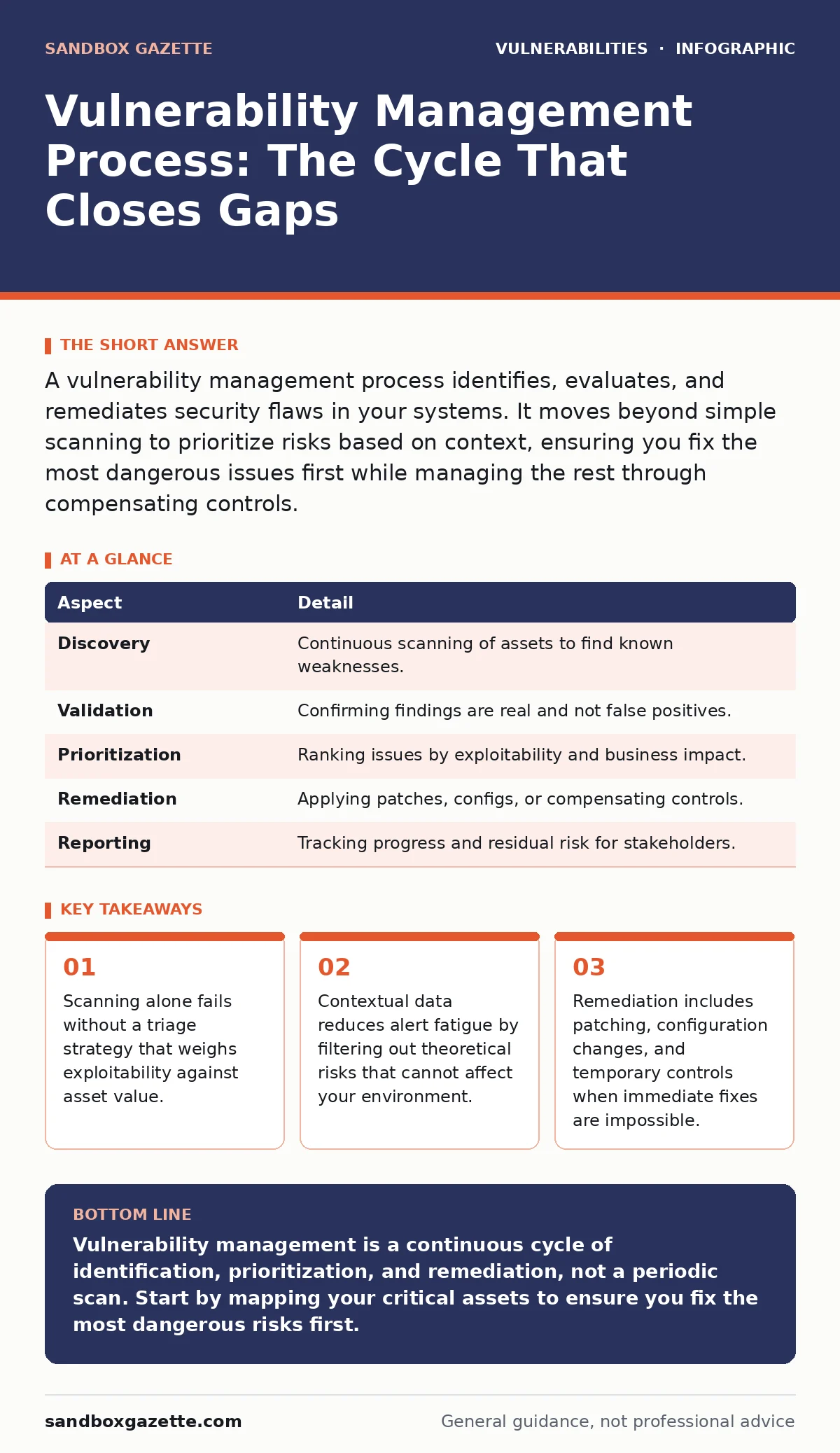
A vulnerability management process identifies, evaluates, and remediates security flaws in your systems. It moves beyond simple scanning to prioritize risks based on context, ensuring you fix the most dangerous issues first while managing the rest through compensating controls.
Why Scanning Is Not Management
Imagine a house with 100 windows. Finding every window is easy. Deciding which one to board up first when a storm hits requires knowing which rooms hold valuables and which windows face the wind. Most organizations treat finding flaws as the end of the job. This approach creates a backlog of unaddressed issues that grows faster than the team can fix them.
A vulnerability management process is the structured cycle of identifying, assessing, prioritizing, and remediating security weaknesses. It turns a static list of flaws into a dynamic risk reduction engine. The process does not promise zero risk. It promises that you address the highest risks first.
| Aspect | Detail |
|---|---|
| Discovery | Continuous scanning of assets to find known weaknesses. |
| Validation | Confirming findings are real and not false positives. |
| Prioritization | Ranking issues by exploitability and business impact. |
| Remediation | Applying patches, configs, or compensating controls. |
| Reporting | Tracking progress and residual risk for stakeholders. |
How The Vulnerability Management Process Works
The cycle begins with discovery. Tools scan networks, endpoints, and cloud instances for known weaknesses. These tools match system signatures against databases of CVE identifiers, which are standard codes for public security flaws. The scanner produces a list. This list is rarely useful in its raw form. It contains thousands of items, many of which are irrelevant to your specific setup.
The next step is validation. You must confirm the finding exists. Automated scanners often report theoretical vulnerabilities. A server might report a flaw because it runs an old library, but that library is not exposed to the network. Validation prevents wasted effort on ghosts.
Prioritization is the core of the process. Not all flaws are equal. A critical flaw on an isolated printer poses less risk than a medium flaw on a public web server. You must weigh the severity of the flaw against the value of the asset and the likelihood of exploitation. This step requires context. Without context, you are guessing.
Remediation follows. You apply a fix. If a patch is available, you deploy it. If not, you might apply a configuration hardening change to disable the vulnerable feature. If neither is possible, you implement a compensating control, such as a firewall rule that blocks access to the vulnerable service.
Finally, you report. You track which issues are fixed and which remain. This data informs future decisions and proves that risk is decreasing over time.
Who It Affects And Why Context Matters
The process affects every system that connects to your network. This includes servers, workstations, mobile devices, and cloud services. It also affects the people who manage these systems. Developers need to know which flaws to fix in their code. Operations teams need to know which patches to deploy. Executives need to know the overall risk posture.
Context determines priority. A flaw in a path traversal vulnerabilities category might be critical if the affected server hosts user uploads. It might be low risk if the server only serves static images. You must understand how the application works and how data flows through it.
Consider the concept of n-day vulnerabilities. These are flaws for which public patches exist but have not yet been applied. Attackers often target these quickly. Your process must have a fast lane for n-day issues on exposed systems. Ignoring the time factor leads to breaches.
The process also affects vendor relationships. You may find flaws in third-party software. You need a mechanism to report these and track vendor response times. If a vendor is slow, you must decide whether to replace the software or accept the risk.
What To Do About Prioritization
Prioritization is where most programs fail. Severity scores from scanners are not enough. They do not account for your environment. You must add your own data.
Start by mapping your critical assets. Identify which systems handle sensitive data or support core business functions. Tag these assets in your management platform. When a scan finds a flaw on a critical asset, it automatically jumps to the top of the list.
Next, assess exploitability. Is the flaw easy to exploit? Are there known exploits in the wild? Tools can provide this data. Some flaws require complex conditions to trigger. These are lower priority than flaws that can be triggered with a simple web request.
Use input validation principles to assess application flaws. If an application properly validates input, many potential flaws become moot. Document these controls. They reduce the effective risk score.
Finally, set service level agreements. Define how quickly you must fix flaws based on their risk level. Critical flaws on public servers might require a fix within 48 hours. Low-risk flaws on internal systems might have a 90-day window. These deadlines create urgency without causing panic.
What People Usually Get Wrong
Many teams treat vulnerability management as a monthly checklist. They scan, report, and forget. This approach ignores the continuous nature of threats. New flaws appear daily. New assets are added constantly. Your process must run continuously, not periodically.
Another common error is focusing only on patching. Patching is the ideal fix, but it is not always possible. Some systems cannot be patched due to compatibility issues or downtime constraints. These teams fail to implement compensating controls. They leave gaps open because they did not plan for the "no patch" scenario.
Teams also ignore the vulnerability lifecycle. A flaw exists from discovery to remediation. Each stage has risks. A flaw that is known but not yet patched is the most dangerous. Your process must track the age of open vulnerabilities. Old vulnerabilities indicate a broken process.
Finally, many teams work in silos. Security finds the flaws. Operations fixes them. Developers write the code. Without communication, errors occur. Operations might break a system by applying a patch too quickly. Developers might reintroduce a flaw in a new release. Break down the silos. Share responsibility.
See also: CVE Identifiers Explained: How Vulnerability Tracking Actually Works · How Coordinated Vulnerability Disclosure Fixes Broken Patch Cycles
Integrating With Other Security Practices
Vulnerability management does not exist in a vacuum. It must integrate with other security practices. Patch management is the execution arm of vulnerability management. Vulnerability management identifies what to patch. Patch management handles the logistics of deployment. These two processes must align.
Configuration standards also play a role. Many vulnerabilities stem from poor configuration. Enforcing baseline configurations reduces the attack surface. This is not a one-time task. Drift occurs. Systems change over time. Continuous monitoring ensures configurations stay secure.
Application security teams must be involved. HTTP security headers can mitigate some web vulnerabilities. Proper session management prevents others. Security must be built into the application from the start. Finding flaws after deployment is expensive and risky.
Threat intelligence feeds into prioritization. If a new exploit is circulating, you must adjust your priorities immediately. Static lists become obsolete quickly. Dynamic data keeps your process relevant.
Building A Sustainable Program
Sustainability requires automation and clear ownership. Automate the scanning and reporting steps. Human effort should focus on analysis and decision-making. Let tools handle the noise.
Define clear roles. Who owns the scanning tool? Who owns the remediation process? Who approves exceptions? Ambiguity leads to delays. Document the responsibilities. Train the teams.
Measure success by risk reduction, not just closure rates. Closing 1,000 low-risk flaws is less valuable than closing 10 high-risk ones. Track the mean time to remediate for critical issues. Track the number of open vulnerabilities by age. These metrics show if your process is improving.
Review the process regularly. Technology changes. Threats change. Your process must evolve. Conduct post-mortems on incidents. Did the vulnerability management process fail? Why? Use the lessons to improve.
The goal is not perfection. The goal is resilience. You will always have open vulnerabilities. The question is whether you are managing the risk effectively. A strong process ensures that the most dangerous gaps are closed first.
Key takeaways
- Scanning alone fails without a triage strategy that weighs exploitability against asset value.
- Contextual data reduces alert fatigue by filtering out theoretical risks that cannot affect your environment.
- Remediation includes patching, configuration changes, and temporary controls when immediate fixes are impossible.
Vulnerability management is a continuous cycle of identification, prioritization, and remediation, not a periodic scan. Start by mapping your critical assets to ensure you fix the most dangerous risks first.
Frequently asked questions
How often should we run vulnerability scans?
Run scans continuously or at least weekly for external assets and monthly for internal assets. Critical systems should be scanned after every change.
What is the difference between vulnerability management and patch management?
Vulnerability management identifies and prioritizes risks. Patch management is the technical process of deploying software updates to fix those risks.
How do we handle systems that cannot be patched?
Apply compensating controls such as network segmentation, firewall rules, or intrusion detection systems to mitigate the risk until a fix is possible.
Should we prioritize based on CVSS scores?
CVSS scores are a starting point. You must adjust them based on your environment, asset criticality, and exploit availability to get accurate prioritization.
How this guide was produced: written by the Sandbox Gazette editorial team with AI assistance, checked against the public references listed below, and reviewed when the facts change. See our editorial policy or report an error.