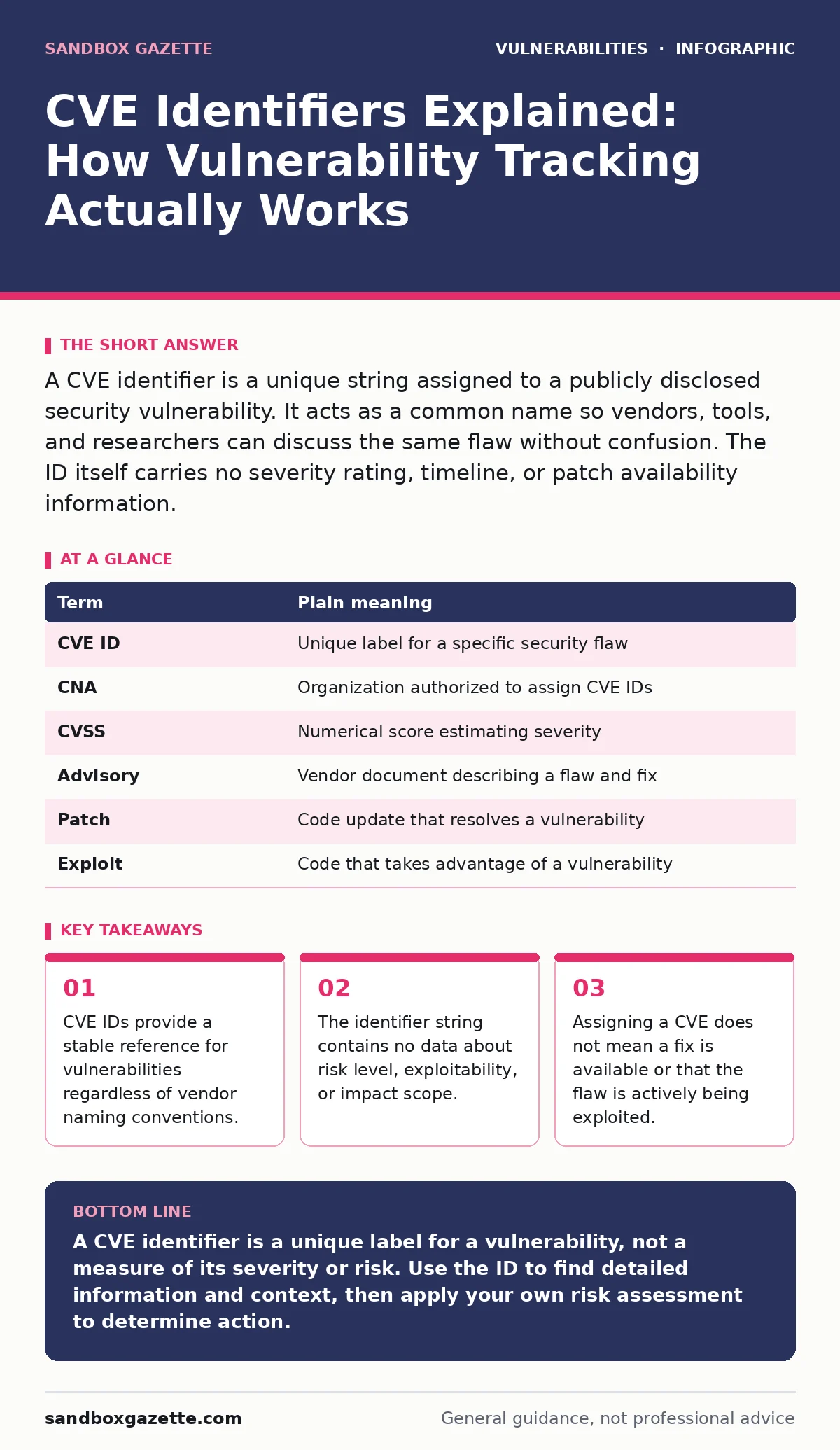
A CVE identifier is a unique string assigned to a publicly disclosed security vulnerability. It acts as a common name so vendors, tools, and researchers can discuss the same flaw without confusion. The ID itself carries no severity rating, timeline, or patch availability information.
The Library Card System
Imagine a vast public library where every book has a unique call number. This number tells you where the book sits on the shelf, but it says nothing about whether the story is thrilling, boring, or dangerous. A book with a high number is not necessarily more important than one with a low number. It simply arrived later in the cataloging process.
CVE identifiers function exactly like these call numbers. They provide a stable, unique label for a specific security flaw so that different organizations can refer to the same issue without ambiguity. When a researcher finds a bug, they request a CVE ID from a Numbering Authority. Once assigned, that ID stays with the vulnerability forever, even if the vendor changes the name of the product or the description of the flaw.
This system prevents chaos in security operations. Without standardized identifiers, teams would waste time trying to match vague descriptions like "buffer overflow in module X" against vendor advisories. The CVE ID serves as the primary key in the database of known flaws, allowing automation tools to correlate alerts with technical details.
Decoding the String
The format of a CVE identifier is rigid and predictable. It always begins with the letters CVE, followed by a hyphen, a four-digit year, another hyphen, and a sequence number. The year component helps teams quickly identify the age of the flaw, which can inform prioritization decisions during patch management cycles.
However, the sequence number is purely administrative. It reflects the order in which the Numbering Authority assigned the ID, not the order in which the flaw was discovered or exploited. A CVE ending in 99999 is not worse than one ending in 00001. This is a common misconception that leads to misprioritization. Teams often assume higher numbers indicate newer or more critical threats, but the number is just a counter.
The year component is the only temporal data embedded in the ID. If you see a CVE from several years ago, it does not mean the flaw is obsolete. Legacy systems may still be vulnerable. Conversely, a very recent CVE might affect software that no one in your environment uses. The ID itself provides no context about prevalence or exploitability.
What the ID Does Not Tell You
The most dangerous assumption you can make is that a CVE ID contains severity information. It does not. The CVE schema is designed for identification, not assessment. To understand the risk, you must look at the Common Vulnerability Scoring System (CVSS) score associated with the CVE. These are separate systems that work together but serve different purposes.
A CVE ID tells you what the flaw is. The CVSS score tells you how bad it might be. You can have a CVE with a critical CVSS score that requires immediate attention, or a CVE with a low score that can wait for the next maintenance window. Confusing the two leads to alert fatigue. If you treat every new CVE as an emergency, you will eventually ignore real emergencies.
This separation is intentional. Severity depends on context. A flaw in a web server is critical if that server faces the internet, but it might be low risk if the server is isolated in a disconnected lab. The CVE ID remains the same in both cases. The risk assessment must come from your own environment analysis, not the identifier string.
| Term | Plain meaning |
|---|---|
| CVE ID | Unique label for a specific security flaw |
| CNA | Organization authorized to assign CVE IDs |
| CVSS | Numerical score estimating severity |
| Advisory | Vendor document describing a flaw and fix |
| Patch | Code update that resolves a vulnerability |
| Exploit | Code that takes advantage of a vulnerability |
The Assignment Process
Not everyone can assign a CVE ID. Only approved Numbering Authorities can issue them. These authorities are typically vendors, research groups, or national bodies. When a researcher discovers a flaw, they contact the relevant CNA. The CNA validates the finding and assigns the ID. This process ensures that the identifier is unique and accurate.
Sometimes, multiple CNAs might be involved. A flaw in a third-party library used by several vendors might result in one CVE ID shared across multiple advisories. This is efficient because it prevents duplicate entries for the same underlying code issue. However, it can confuse teams that track vulnerabilities by vendor rather than by component.
The assignment process can take time. A CVE ID might be assigned months before a public disclosure or a patch is released. This lag is normal. It allows for responsible disclosure practices where vendors have time to develop fixes before the world knows about the flaw. During this period, the CVE ID might exist in internal tracking systems but not in public databases.
Common Points of Confusion
One frequent error is assuming that a CVE ID means a patch is available. It does not. The ID marks the existence of the flaw, not the solution. Some vulnerabilities have no known fix. Others have workarounds that reduce risk but do not eliminate the flaw. You must check the vendor advisory for remediation status.
Another confusion is the belief that all vulnerabilities get CVE IDs. They do not. Only publicly disclosed or widely known flaws receive IDs. Private research or internal findings might never get a CVE. This means your internal vulnerability scanner might miss issues that do not have a public identifier. Relying solely on CVE-based scanning leaves blind spots in your attack surface management.
Finally, do not confuse CVE IDs with CWE IDs. CWE stands for Common Weakness Enumeration. While a CVE identifies a specific instance of a flaw, a CWE identifies the class of flaw. For example, a buffer overflow is a CWE class. A specific buffer overflow in a specific program is a CVE instance. Understanding this distinction helps you address root causes rather than just symptoms.
See also: Detect Web Cache Poisoning: Signals, Tools, and Hidden Blind Spots
Try This Now
- Select a recent CVE from your monitoring feed and look up its CVSS score. Compare the severity rating with the CVE ID to ensure you are not prioritizing based on the ID number.
- Check your asset inventory for systems that might be affected by the CVE. Determine if the affected component is present and exposed in your environment.
- Review the vendor advisory for remediation options. Note whether a patch, workaround, or mitigation is available and plan your response accordingly.
Beyond the Identifier
CVE identifiers are the foundation of modern vulnerability management, but they are only the starting point. You must integrate CVE data with contextual information about your own infrastructure. This includes asset criticality, exposure status, and existing compensating controls.
For deeper insights into how to handle known vulnerabilities after disclosure, review the guide on n-day vulnerabilities. Understanding the timeline between disclosure and patching helps you prioritize effectively. Additionally, consider reading about input validation to understand how many common CVEs originate from poor code hygiene.
Key takeaways
- CVE IDs provide a stable reference for vulnerabilities regardless of vendor naming conventions.
- The identifier string contains no data about risk level, exploitability, or impact scope.
- Assigning a CVE does not mean a fix is available or that the flaw is actively being exploited.
A CVE identifier is a unique label for a vulnerability, not a measure of its severity or risk. Use the ID to find detailed information and context, then apply your own risk assessment to determine action.
Frequently asked questions
Does a higher CVE number mean a more severe vulnerability?
No. The number is an administrative sequence assigned by a Numbering Authority and has no correlation to severity or impact.
Can a single vulnerability have multiple CVE IDs?
Generally no. A specific flaw should have one unique CVE ID, though related flaws in the same component might have separate IDs.
Do all security flaws get a CVE ID?
No. Only publicly disclosed or widely recognized vulnerabilities receive CVE IDs. Private or obscure flaws may not have one.
How do I find the severity of a CVE?
Look for the associated CVSS score in the vulnerability database or vendor advisory. The CVE ID itself does not contain severity data.
How this guide was produced: written by the Sandbox Gazette editorial team with AI assistance, checked against the public references listed below, and reviewed when the facts change. See our editorial policy or report an error.