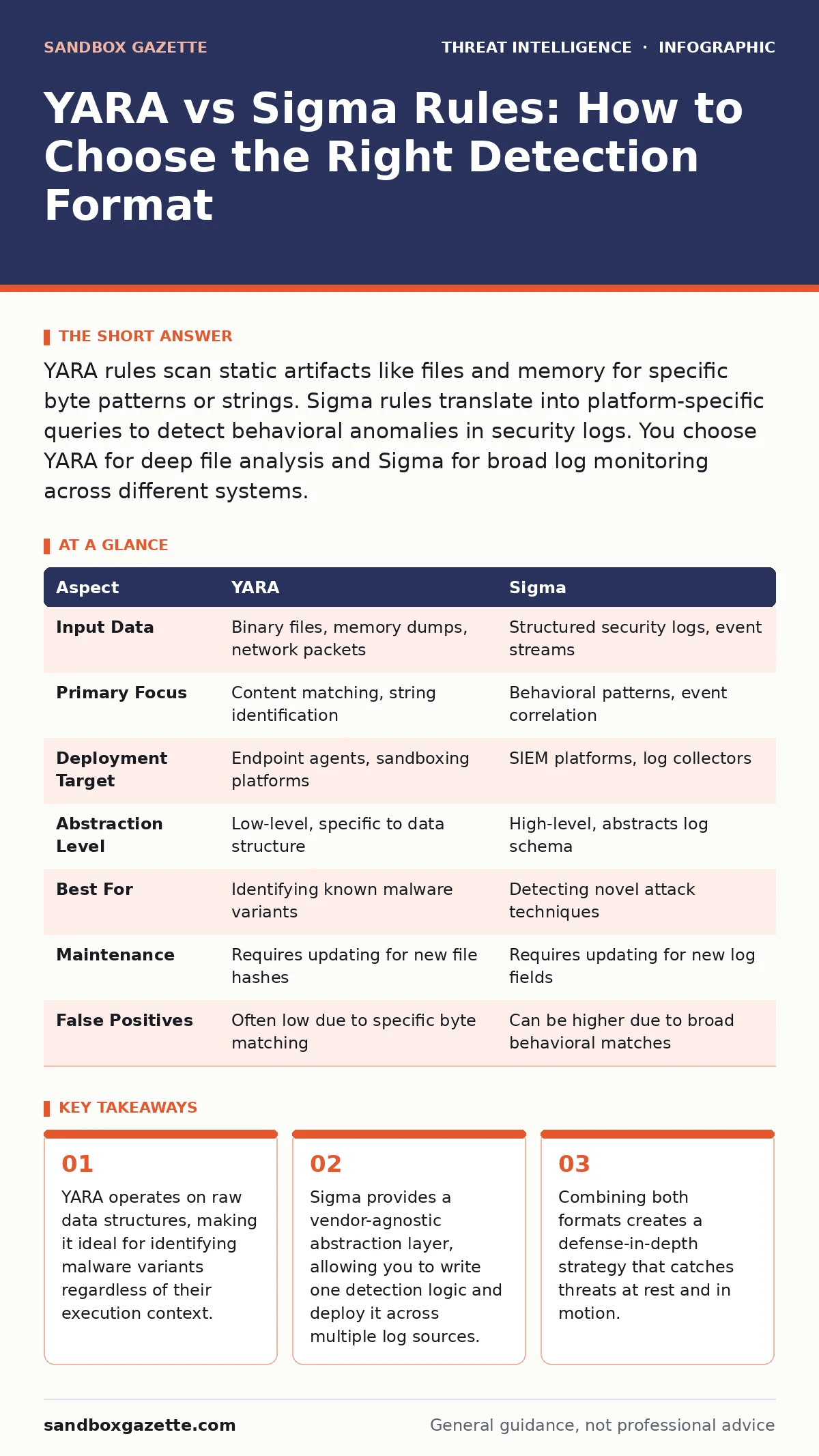
YARA rules scan static artifacts like files and memory for specific byte patterns or strings. Sigma rules translate into platform-specific queries to detect behavioral anomalies in security logs. You choose YARA for deep file analysis and Sigma for broad log monitoring across different systems.
The Core Distinction
YARA and Sigma serve different stages of the threat detection lifecycle. YARA focuses on static analysis, examining the actual content of files, memory dumps, or network streams. It looks for specific sequences of bytes, strings, or structural characteristics within those artifacts. Sigma, by contrast, operates on structured data. It defines detection logic based on fields and values found in security logs, such as event IDs or process names.
This difference dictates where each tool lives in your infrastructure. You use YARA when you have a file or a memory snapshot and need to know what it is. You use Sigma when you have a stream of events and need to find suspicious behavior. Understanding this separation prevents the common mistake of trying to force file-scanning logic into a log-monitoring framework.
What Is YARA?
YARA is a tool that helps malware researchers identify and classify malware samples. It uses a flexible syntax to describe patterns found in files or memory. A YARA rule consists of a metadata section and a condition section. The condition can check for the presence of specific strings, hexadecimal byte sequences, or file headers.
Because YARA works at the binary level, it is highly precise. It can distinguish between a benign document and a malicious one that uses the same file format but contains different embedded code. This makes it effective for identifying specific malware families, even if they are slightly modified. However, YARA requires access to the actual artifact. It cannot detect a threat if the file is never written to disk or if the memory is not captured.
What Is Sigma?
Sigma is a generic signature format for intrusion detection systems. It abstracts the underlying data model of various security information and event management (SIEM) platforms. Instead of writing native queries for every log source, you write a Sigma rule. A translation layer then converts this rule into the specific query language required by your SIEM, such as Splunk SPL or Microsoft KQL.
This abstraction solves the problem of vendor lock-in. You can develop a detection for a specific behavior, such as a privilege escalation attempt, and deploy it across Windows Event Logs, Linux audit logs, and firewall logs. Sigma rules focus on the "what" and "who" of an action, rather than the "how" of the file structure. This makes them ideal for detecting lateral movement or configuration changes.
Point-by-Point Comparison
| Aspect | YARA | Sigma |
|---|---|---|
| Input Data | Binary files, memory dumps, network packets | Structured security logs, event streams |
| Primary Focus | Content matching, string identification | Behavioral patterns, event correlation |
| Deployment Target | Endpoint agents, sandboxing platforms | SIEM platforms, log collectors |
| Abstraction Level | Low-level, specific to data structure | High-level, abstracts log schema |
| Best For | Identifying known malware variants | Detecting novel attack techniques |
| Maintenance | Requires updating for new file hashes | Requires updating for new log fields |
| False Positives | Often low due to specific byte matching | Can be higher due to broad behavioral matches |
Where They Overlap
The overlap between YARA and Sigma is minimal but significant in modern detection engineering. Both are text-based rule formats that require a parser to execute. Both rely on community-driven repositories for rule sharing. More importantly, both aim to reduce the time between threat identification and detection implementation.
In some advanced setups, YARA results are logged. When a YARA scan identifies a suspicious file, it generates an event. You can then use a Sigma rule to detect that specific YARA alert in your SIEM. This creates a feedback loop where static analysis informs behavioral monitoring. For example, if YARA detects a known downloader, a Sigma rule can monitor for subsequent commands executed by that process.
See also: Is Port Scanning Illegal? Legal Boundaries and Technical Risks · Remote Desktop Abuse: The Configuration Mistakes That Hand Over Control
Choose YARA When
- You are analyzing suspicious files in a sandbox or quarantine folder.
- You need to identify specific malware variants by their unique code signatures.
- You are performing memory forensics on a compromised system.
- You want to detect packed or obfuscated executables based on their structural anomalies.
- You are integrating deep inspection into an endpoint detection and response solution.
Choose Sigma When
- You need to monitor for specific attack techniques across multiple operating systems.
- You are dealing with log-based threats like pass-the-hash attacks or DCSync attacks.
- You want to standardize detection logic across different SIEM vendors.
- You are investigating remote desktop abuse or other lateral movement techniques.
- You need to correlate multiple events to identify advanced persistent threats.
Integrating Into Your Stack
To maximize coverage, you should integrate both formats into your security operations. Use YARA for deep inspection of artifacts that reach your endpoints or sandboxes. Use Sigma for continuous monitoring of system and security logs. This dual approach ensures you catch threats that hide in files and those that hide in behavior.
Consider how this fits with your broader strategy. Strategic threat intelligence can inform the creation of both rule types. When intelligence indicates a new campaign, you can write YARA rules for the tools they use and Sigma rules for the tactics they employ. This synergy strengthens your overall detection posture.
Final Considerations
Neither format provides complete protection on its own. YARA misses fileless attacks that never write to disk. Sigma misses threats that do not generate distinctive log entries. You must combine them with other controls, such as network segmentation and least privilege access.
Regularly update your rules to reflect the changing threat environment. Attackers constantly modify their tools to evade detection. By maintaining a diverse set of YARA and Sigma rules, you increase the likelihood of catching these modifications early.
Key takeaways
- YARA operates on raw data structures, making it ideal for identifying malware variants regardless of their execution context.
- Sigma provides a vendor-agnostic abstraction layer, allowing you to write one detection logic and deploy it across multiple log sources.
- Combining both formats creates a defense-in-depth strategy that catches threats at rest and in motion.
Frequently asked questions
Can YARA rules detect fileless malware?
Standard YARA rules analyze static files, so they cannot detect purely fileless malware. However, YARA can scan memory dumps, which may contain fileless code if the memory is captured correctly.
Do I need a SIEM to use Sigma rules?
Sigma rules are designed to be translated into SIEM queries. While you can use them with simple log parsers, a SIEM provides the necessary context and scale for effective behavioral detection.
How do I handle false positives in YARA?
Refine your rules by adding more specific conditions, such as requiring multiple strings or checking file headers. Regularly test rules against a corpus of benign files to identify and adjust overly broad matches.
Can Sigma rules detect network-based attacks?
Yes, if your network devices log relevant events. Sigma rules can analyze firewall logs, proxy logs, or IDS alerts to detect suspicious network activity, such as port scanning or unusual data transfers.
How this guide was produced: written by the Sandbox Gazette editorial team with AI assistance, checked against the public references listed below, and reviewed when the facts change. See our editorial policy or report an error.