
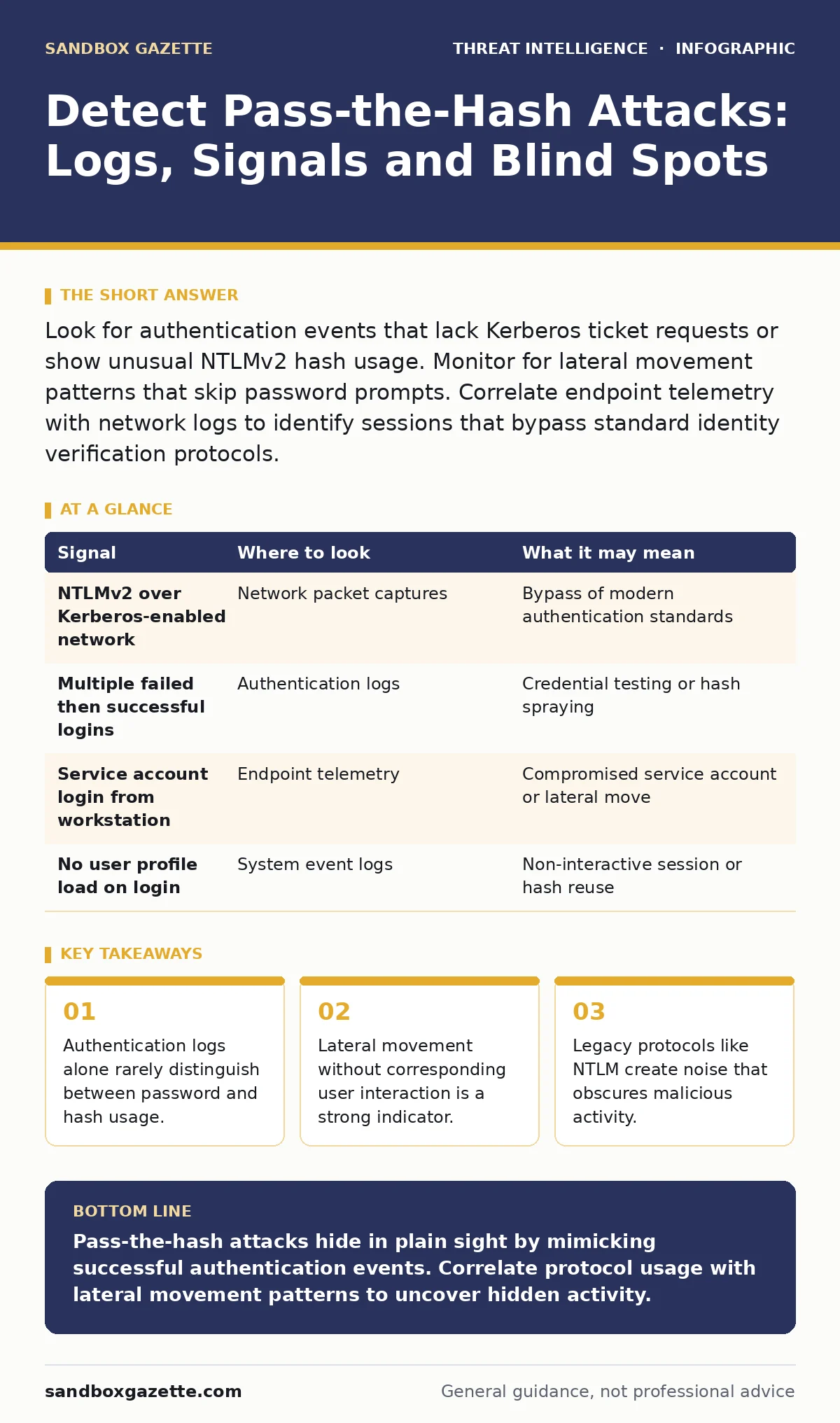
Look for authentication events that lack Kerberos ticket requests or show unusual NTLMv2 hash usage. Monitor for lateral movement patterns that skip password prompts. Correlate endpoint telemetry with network logs to identify sessions that bypass standard identity verification protocols.
The Authentication Gap in Standard Logs
Most security teams assume that a successful login entry proves legitimate user intent. This assumption fails when an attacker uses a stolen cryptographic hash instead of the actual password. The operating system validates the hash directly, bypassing the need for the plaintext secret.
Standard authentication logs record the outcome of the validation, not the method. You see a successful sign-in, but the log entry rarely specifies whether the user typed a password or presented a cached hash. This creates a blind spot in your detection strategy.
You must look beyond the success flag. The absence of certain preparatory steps, such as ticket requests, becomes the primary signal. Without these contextual clues, the event looks identical to normal administrative work.
Identifying Protocol Anomalies
Kerberos is the default authentication protocol in modern Windows environments. It relies on tickets issued by a domain controller rather than transmitting credentials over the network. Pass-the-hash attacks typically rely on NTLM, an older challenge-response protocol.
When you see NTLM authentication on a network segment that should exclusively use Kerberos, raise an alert. This mismatch indicates that the client could not obtain a ticket or is deliberately bypassing it.
Imagine a scenario where a server authenticates to a file share using NTLM. If that server has no reason to fall back to legacy protocols, the connection is suspicious. This fallback often occurs when an attacker injects a stolen hash into the authentication process.
Lateral Movement Patterns
Attackers rarely stay on the initial compromised host. They move laterally to gather more data or escalate privileges. This movement leaves a trail of connections that can be analyzed for anomalies.
Look for a single source IP initiating connections to multiple destinations within a short timeframe. Normal users do not typically authenticate to dozens of servers in rapid succession.
Process injection often facilitates this movement. An attacker may inject code into a legitimate process to execute the authentication command. This hides the malicious activity under the guise of a trusted application. Refer to our guide on process injection for deeper analysis of these techniques.
Signal Correlation Table
Isolating single events is rarely effective. You need to correlate data from different sources to build a complete picture. The table below outlines key signals and their implications.
| Signal | Where to look | What it may mean |
|---|---|---|
| NTLMv2 over Kerberos-enabled network | Network packet captures | Bypass of modern authentication standards |
| Multiple failed then successful logins | Authentication logs | Credential testing or hash spraying |
| Service account login from workstation | Endpoint telemetry | Compromised service account or lateral move |
| No user profile load on login | System event logs | Non-interactive session or hash reuse |
Endpoint Telemetry Nuances
Endpoint detection platforms provide visibility into process creation and command-line arguments. These logs can reveal the tools used to execute the attack.
Look for commands that invoke remote management utilities with specific flags. These flags often indicate that the tool is using a cached credential rather than prompting the user.
However, attackers can modify tools to strip identifying features. This is where endpoint telemetry becomes critical for detecting behavioral anomalies rather than specific file hashes. If a remote management tool runs without a visible console window, investigate the origin.
See also: Remote Desktop Abuse: The Configuration Mistakes That Hand Over Control · Understanding Autonomous System Numbers in Threat Intelligence
Common Blind Spots and Misconfigurations
Many organizations disable NTLM to reduce risk, but legacy applications often require it. This creates a persistent noise floor that makes detection difficult.
Another blind spot is the use of service accounts. These accounts often have broad permissions and are less monitored than user accounts. When a service account authenticates to a new host, it may be flagged as normal activity.
Remote desktop abuse often accompanies these attacks. Attackers use stolen hashes to initiate remote sessions without knowing the password. Check our guide on remote desktop abuse for signs of unauthorized remote access.
Advanced Detection Strategies
To detect these attacks effectively, you must integrate data from multiple sources. A SIEM platform can correlate network logs with endpoint alerts.
Look for sequences where an NTLM authentication is followed by file access or privilege escalation. This chain of events suggests that the authentication was not just a test but part of a larger operation.
Advanced persistent threats often use this technique to maintain low visibility. They move slowly and blend in with normal traffic. Understanding the behavior of advanced persistent threats helps you tune your alerts for slower, more subtle indicators.
Mitigating the Risk
Detection is only half the battle. Reducing the attack surface limits the effectiveness of these techniques.
Enforce Kerberos pre-authentication and disable NTLM where possible. Use Group Policy to restrict which systems can authenticate via legacy protocols.
Monitor for port scanning activity that precedes authentication attempts. Attackers often scan for open ports before launching pass-the-hash attacks. Combining network discovery logs with authentication data provides early warning.
Remember that no single control stops this attack. You need a layered approach that combines protocol enforcement, behavioral monitoring and log correlation.
Key takeaways
- Authentication logs alone rarely distinguish between password and hash usage.
- Lateral movement without corresponding user interaction is a strong indicator.
- Legacy protocols like NTLM create noise that obscures malicious activity.
Pass-the-hash attacks hide in plain sight by mimicking successful authentication events. Correlate protocol usage with lateral movement patterns to uncover hidden activity.
Frequently asked questions
Can I detect pass-the-hash using only firewall logs?
No, firewall logs show connection metadata but not authentication methods. You need endpoint or network packet data to see the protocol used.
Does disabling NTLM prevent all hash attacks?
It significantly reduces the attack surface. However, attackers may still use Kerberoasting or other techniques if Kerberos is misconfigured.
How do I distinguish between a legitimate admin and an attacker?
Look for context. Legitimate admins usually have predictable access patterns. Attackers often access multiple unrelated systems in rapid succession.
Are service accounts more vulnerable to these attacks?
Yes, because they often have persistent credentials and broad permissions. They are prime targets for lateral movement once compromised.
How this guide was produced: written by the Sandbox Gazette editorial team with AI assistance, checked against the public references listed below, and reviewed when the facts change. See our editorial policy or report an error.