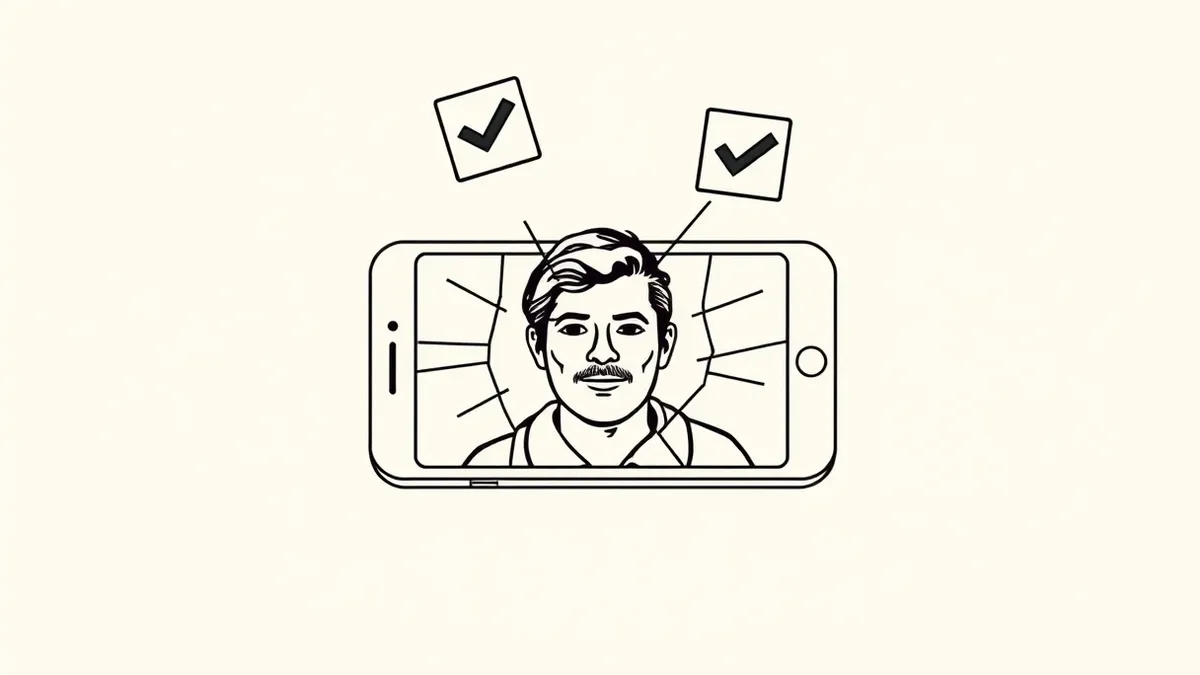
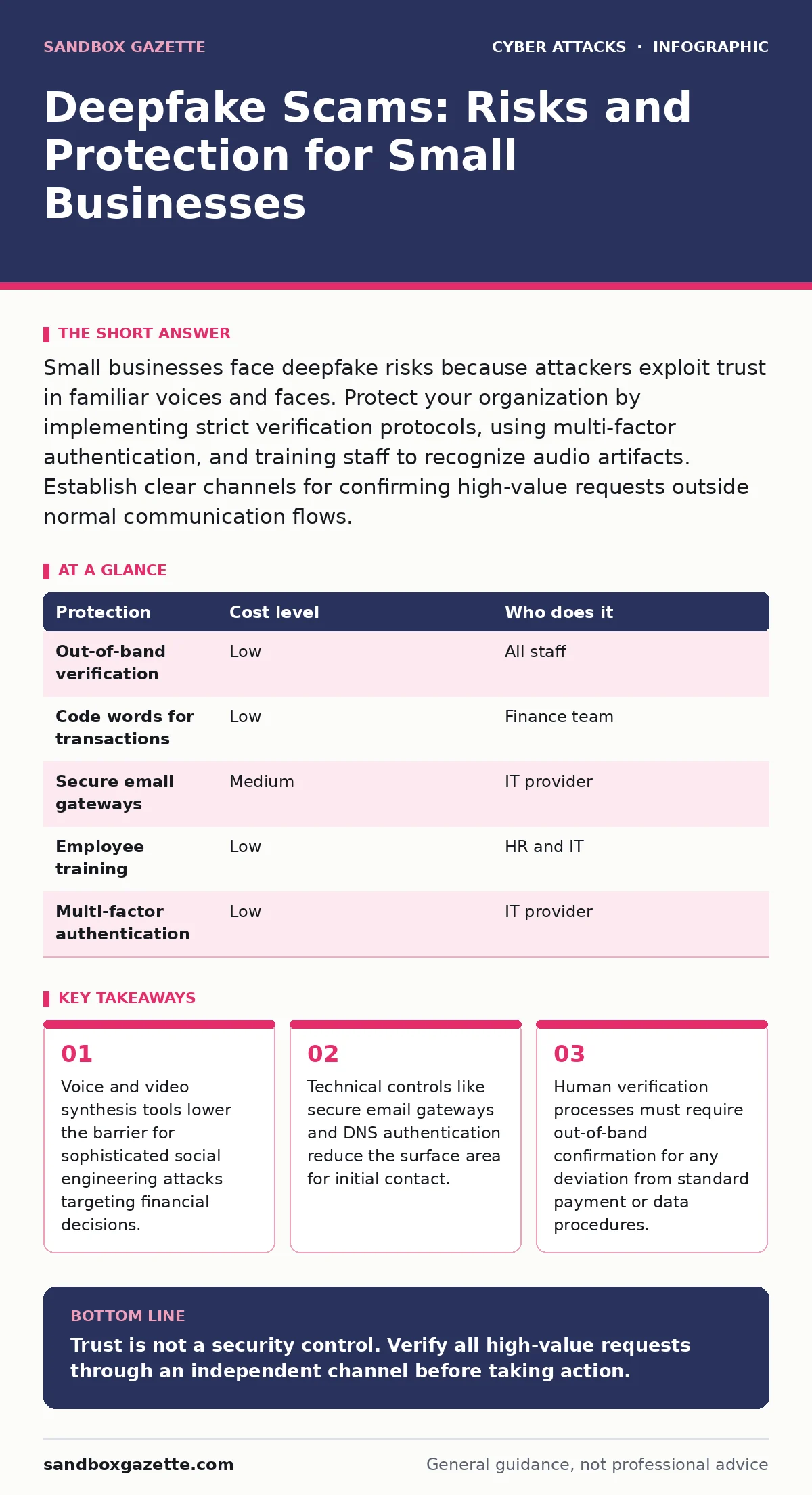
Small businesses face deepfake risks because attackers exploit trust in familiar voices and faces. Protect your organization by implementing strict verification protocols, using multi-factor authentication, and training staff to recognize audio artifacts. Establish clear channels for confirming high-value requests outside normal communication flows.
Why Small Organizations Are Exposed
Small businesses often lack the specialized security operations centers that large enterprises maintain. Attackers target these organizations because the average loss from a successful breach is high relative to the company’s size. A single successful deepfake scam can drain operating capital. Trust is the primary vulnerability. Employees expect clear communication from leadership. When a deepfake mimics a known executive, the psychological cue of familiarity overrides skepticism.
The cost of entry for creating convincing synthetic media has dropped significantly. Attackers no longer need state-level resources. They use consumer-grade software to clone voices from short audio clips found on social media. This accessibility means that any public-facing employee is a potential target. The attack vector is not a technical exploit but a social one. It relies on the urgency of the request and the authority of the source.
Small teams often have flatter hierarchies. This structure speeds up decision-making but reduces the number of checks and balances. In a large corporation, a payment request might pass through three different departments. In a small business, the request might go directly to the person who can approve it. This speed is a business advantage but a security liability. The lack of redundant verification steps makes it easier for a fraudulent request to succeed.
The Mechanics of Synthetic Media
Deepfakes are not just video. Audio cloning is often more effective and harder to detect. Text-to-speech engines can generate realistic voices with minimal input. Attackers harvest voice samples from public interviews, podcast appearances, or voicemails. They train a model on these samples to replicate the target’s intonation, pace, and accent.
Video deepfakes are more resource-intensive but increasingly common. They map a source face onto a target body in real-time. This allows an attacker to impersonate an executive during a video conference. The latency in video calls can hide artifacts. Poor lighting or low resolution masks the unnatural movements of the synthetic face. Employees often accept these visual imperfections as technical glitches rather than signs of fraud.
The sophistication of these tools continues to improve. Detection methods that rely on visual artifacts become obsolete as the generation algorithms evolve. Relying on human perception to spot a deepfake is an ineffective strategy. The human eye is not trained to notice subtle inconsistencies in pixel rendering. You must assume that any digital media can be fabricated. Trust must be placed in cryptographic proofs, not sensory input.
Low-Cost Protections for Verification
You can implement strong verification protocols without significant financial investment. The core principle is out-of-band confirmation. This means verifying a request through a different channel than the one used for the request. If you receive a video call asking for a payment, call the executive back on a known, trusted phone number. Do not use the number provided in the video call or email.
Establish a code word or phrase for high-value transactions. This phrase should be known only to the individuals involved in financial decisions. If the person on the call cannot provide the code word, the request is rejected. This simple step adds a layer of authentication that deepfakes cannot replicate. The attacker may have the voice and face, but they do not have the secret knowledge.
Document all exceptions to standard procedures. If a payment is made outside the normal workflow, require a written memo explaining the deviation. This creates an audit trail. It also forces the requester to slow down and justify the action. Urgency is a common tactic in scams. Documentation introduces friction that disrupts the attack’s momentum. It gives time for second thoughts and verification.
| Protection | Cost level | Who does it |
|---|---|---|
| Out-of-band verification | Low | All staff |
| Code words for transactions | Low | Finance team |
| Secure email gateways | Medium | IT provider |
| Employee training | Low | HR and IT |
| Multi-factor authentication | Low | IT provider |
Technical Controls to Reduce Exposure
Technical controls reduce the likelihood of a successful initial contact. Secure email gateways filter out malicious emails before they reach the user. They analyze the sender’s reputation, the content of the message, and the attachments. This reduces the volume of phishing attempts that can serve as precursors to deepfake attacks. Attackers often use email to gather information or establish a narrative.
Domain-based Message Authentication, Reporting, and Conformance (DMARC) policies prevent email spoofing. These policies ensure that emails claiming to come from your domain actually originate from authorized servers. This reduces the effectiveness of brand impersonation attacks. Attackers cannot easily mimic your company’s email address if you have strict DMARC policies in place. This forces them to use different tactics, which may be less convincing.
Login alerts provide immediate notification of unauthorized access attempts. If an attacker gains access to an executive’s email account, they can harvest voice samples or monitor communications. Login alerts allow the organization to detect and respond to this compromise quickly. Multi-factor authentication adds another layer of security. It ensures that even if credentials are stolen, the attacker cannot access the account without the second factor.
Be aware of MFA fatigue attacks. These attacks bombard the victim with authentication requests until they approve one by mistake. This technique can bypass multi-factor authentication. Users must be trained to reject unexpected requests. IT providers should configure rate limiting on authentication requests. This slows down the attack and gives the user time to recognize the pattern.
What to Ask an IT Provider
Your IT provider plays a critical role in protecting your organization. You need to understand their capabilities and limitations. Ask specific questions about their approach to synthetic media threats. Do not accept vague assurances. You need concrete details about their monitoring and response procedures.
- How do you monitor for unusual login activity or data exfiltration?
- What tools do you use to detect brand impersonation and invoice fraud?
- How do you handle DNS spoofing attempts that redirect users to fake sites?
- What is your process for verifying the identity of users requesting sensitive actions?
- How do you keep staff informed about new threats like business email compromise?
These questions reveal the depth of their security posture. A provider that focuses only on technical fixes may overlook the human element. You need a partner that understands the interplay between technology and behavior. They should offer regular training and simulation exercises. These exercises help staff recognize the signs of a deepfake scam.
See also: Brand Impersonation in Cyber Security: How Attackers Clone Trust · Tech Support Scams: Warning Signs and Immediate Response
Training and Behavioral Changes
Technology alone cannot stop deepfake scams. You must train your staff to recognize the signs of manipulation. Focus on the context of the request rather than just the medium. Is the request urgent? Does it bypass normal procedures? Is it asking for secrecy? These are red flags that warrant further investigation.
Encourage a culture of verification. Staff should feel comfortable questioning requests, even from senior leadership. Make it clear that verifying a request is a professional duty, not a sign of distrust. Leaders should model this behavior by verifying requests themselves. This sets the tone for the entire organization.
Regularly update your training materials. The tactics used by attackers evolve. What was effective last year may not work today. Stay informed about the latest developments in synthetic media. Share this information with your team. Keep the conversation ongoing. Security is not a one-time event but a continuous process.
Key takeaways
- Voice and video synthesis tools lower the barrier for sophisticated social engineering attacks targeting financial decisions.
- Technical controls like secure email gateways and DNS authentication reduce the surface area for initial contact.
- Human verification processes must require out-of-band confirmation for any deviation from standard payment or data procedures.
Trust is not a security control. Verify all high-value requests through an independent channel before taking action.
Frequently asked questions
Can software detect deepfake videos in real-time?
Current detection tools are not reliable enough for real-time use. They often produce false positives and miss sophisticated fakes. Human verification remains the most effective control.
How do I verify a request if the executive is traveling?
Use a pre-established code word or phrase. Alternatively, contact another trusted member of the leadership team to confirm the request. Do not rely on a single point of contact.
What is the difference between a deepfake and a standard phishing email?
A deepfake uses synthetic media to impersonate a specific person. A phishing email typically uses text to impersonate a brand or service. Deepfakes are more personalized and harder to detect visually.
Should I disable video conferencing to prevent deepfake attacks?
No. Video conferencing is a valuable business tool. Instead, implement strict verification protocols for any sensitive discussions or requests made during video calls.
How this guide was produced: written by the Sandbox Gazette editorial team with AI assistance, checked against the public references listed below, and reviewed when the facts change. See our editorial policy or report an error.