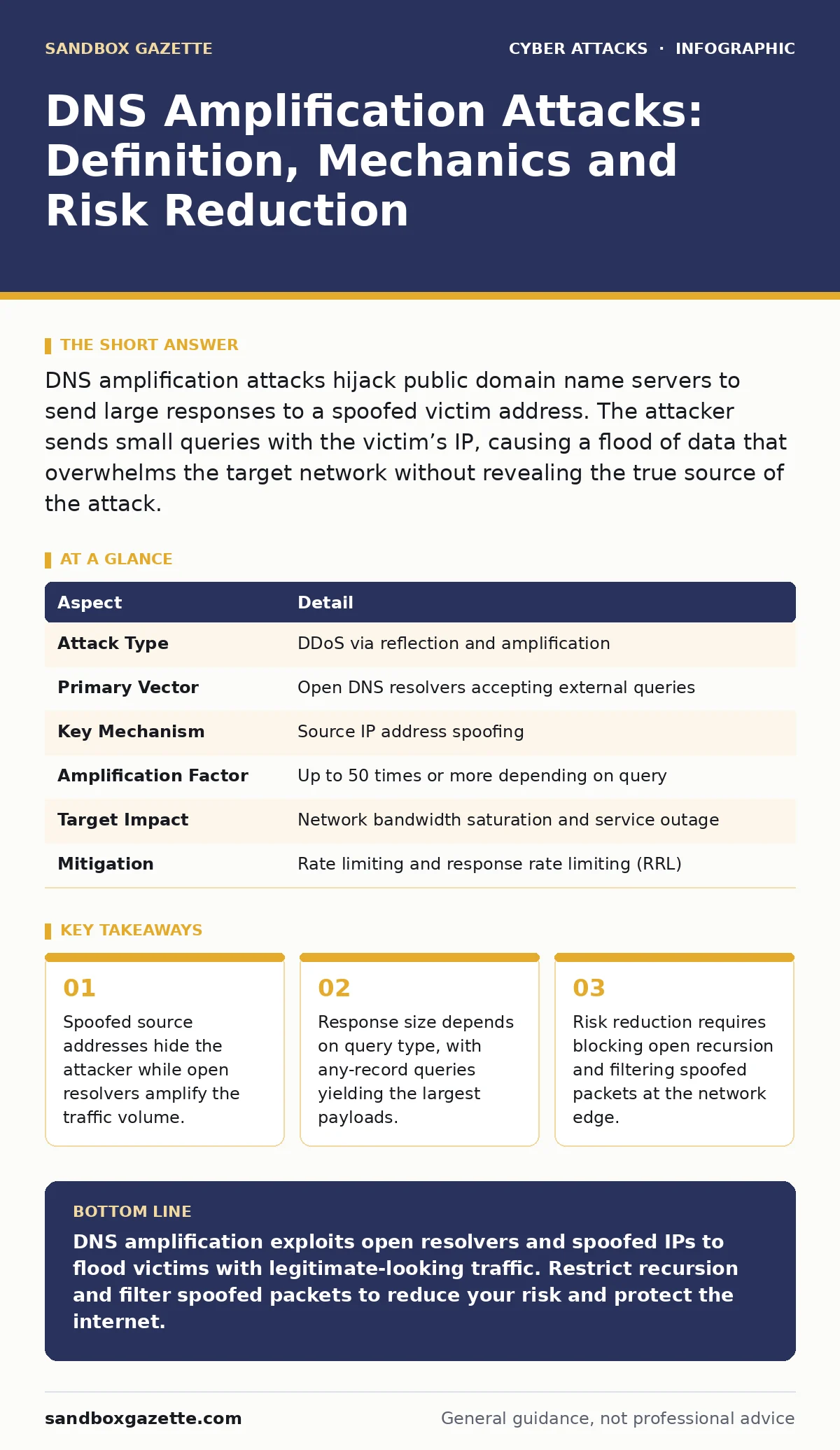
DNS amplification attacks hijack public domain name servers to send large responses to a spoofed victim address. The attacker sends small queries with the victim’s IP, causing a flood of data that overwhelms the target network without revealing the true source of the attack.
The Mechanics of Reflection and Amplification
Imagine you send a small letter to a post office, but the post office sends back a crate of supplies to your neighbor. DNS amplification attacks use this reflection principle to overwhelm a target. The attacker sends a small request to a public domain name server. The request appears to come from the victim’s IP address. This is called source IP spoofing. The server processes the request and sends a large response to the victim. The victim receives data they never asked for.
The attack relies on two conditions. First, the domain name server must accept queries from any source. These are open resolvers. Second, the network must allow packets with fake source addresses. Most modern networks filter these, but legacy systems often do not. The ratio of request size to response size determines the amplification factor. A small query can trigger a response hundreds of times larger. This volume consumes bandwidth and processing power.
| Aspect | Detail |
|---|---|
| Attack Type | DDoS via reflection and amplification |
| Primary Vector | Open DNS resolvers accepting external queries |
| Key Mechanism | Source IP address spoofing |
| Amplification Factor | Up to 50 times or more depending on query |
| Target Impact | Network bandwidth saturation and service outage |
| Mitigation | Rate limiting and response rate limiting (RRL) |
How the Attack Sequence Unfolds
The attacker identifies open resolvers by scanning the internet. These servers respond to queries from anyone, not just their intended users. The attacker crafts a DNS query. The query asks for a record that generates a large response. The source IP in the packet header is set to the victim’s address. The packet travels to the resolver. The resolver trusts the packet and looks up the data. It sends the result to the IP in the header.
The victim receives the response. The victim’s firewall or server sees legitimate-looking DNS traffic. The traffic comes from a trusted DNS server, not the attacker. The attacker repeats this process thousands of times per second. Multiple resolvers send data to the victim simultaneously. The victim’s connection fills up. Legitimate users cannot connect. The attacker controls the flow with minimal bandwidth. The true source remains hidden behind the spoofed addresses.
Common Forms and Query Types
Not all DNS queries create equal noise. The attack effectiveness depends on the record type requested. The ANY query asks for all available records for a domain. This often returns the largest amount of data. Many modern servers ignore ANY queries, reducing their utility. Attackers then shift to other record types.
Text records (TXT) are a common alternative. These records store large strings of text. They are used for domain verification and email security. A TXT query can return several kilobytes of data. Attackers also target DNS security extensions (DNSSEC). DNSSEC adds cryptographic signatures to DNS records. These signatures increase the response size significantly. A query for a signed domain returns the data plus the proof of authenticity. This adds weight to the amplification effect.
Some attacks use zone transfers. A zone transfer requests the entire DNS database for a domain. This is rarely allowed for public queries. However, misconfigured servers may permit it. A zone transfer response can be megabytes in size. This creates a massive amplification factor. Security teams must monitor for unusual query patterns. Large responses to simple queries indicate potential abuse.
Who Bears the Cost
The victim suffers immediate service disruption. Web servers, email systems and internal tools become unreachable. The network link reaches capacity. Packets are dropped. The organization loses revenue and reputation. The cost extends beyond downtime. Incident response teams must analyze traffic to identify the source. This takes time and resources.
The open resolver operators also bear costs. Their servers are used as weapons. They may face legal liability or loss of trust. Internet service providers must filter traffic. They deploy scrubbing services to clean malicious packets. This costs money. The broader internet suffers from congestion. Legitimate traffic slows down during large attacks. The ecosystem shares the burden.
What People Usually Get Wrong
Many assume DNS amplification is a new technique. It has existed for decades. The mechanics remain the same. The scale changes with internet growth. Another mistake is blaming the victim’s firewall. The firewall cannot stop spoofed packets easily. The source IP is valid. The traffic looks legitimate. The problem is upstream.
Some believe closing port 53 stops the attack. This stops outbound queries. It does not stop inbound responses. The responses still arrive. You must filter inbound traffic. Rate limiting is more effective than blocking. Another error is ignoring open resolvers. If your server is open, you are part of the problem. You help attackers flood others. You must restrict recursion to authorized users only.
People often confuse this with DNS spoofing. Spoofing changes the answer to redirect users. Amplification floods the victim with noise. They are different goals. Spoofing aims for deception. Amplification aims for denial of service. Understanding the difference guides your defense. You need different controls for each. See our guide on DNS spoofing for details on cache poisoning.
See also: Can Password Managers Be Hacked? Risks and Mitigation · How to Avoid Email Spoofing: Stop Forged Messages at the Gate
How to Reduce the Risk
Start with your own infrastructure. Ensure your DNS servers do not act as open resolvers. Configure them to serve only internal clients. This prevents your servers from being used in attacks. Use response rate limiting (RRL). RRL caps the number of responses sent to a single IP. It stops one IP from consuming all resources.
Filter spoofed packets at your network edge. Implement BCMP 3861. This standard defines best practices for inbound and outbound filtering. It blocks packets with invalid source IPs. Work with your internet service provider. Ask them to filter outbound spoofed traffic. They can stop your network from participating in attacks.
Monitor your DNS traffic. Look for spikes in response size. Alert on large responses to simple queries. Use an cyber incident response team to handle incidents. Have a plan ready. Know how to contact upstream providers. They can null-route traffic during an attack. This redirects malicious traffic away from your network. It restores service for legitimate users.
The Hidden Costs of Mitigation
Mitigation adds complexity. Rate limiting can affect legitimate high-volume users. You must tune thresholds carefully. Too strict, and you block real traffic. Too loose, and you fail to stop attacks. This requires constant adjustment. Logging large volumes of DNS traffic consumes storage. You must retain logs for analysis. This increases infrastructure costs.
Filtering spoofed packets requires coordination. You must work with multiple providers. Each has different capabilities. Some may not support filtering. You must accept some risk. No single control stops all attacks. You must layer defenses. This adds operational overhead. Your team must understand DNS deeply. Training takes time. The cost of inaction is higher.
Related threats evolve alongside defenses. Attackers shift to other protocols. They use NTP or SSDP for amplification. You must watch for new vectors. See our guide on typosquatting for domain-level risks. See login alerts for user-facing warnings. See MFA fatigue attacks for social engineering. See account takeover for credential risks. See deepfake scams for media manipulation. See DKIM for email authentication. These topics complement DNS security.
Key takeaways
- Spoofed source addresses hide the attacker while open resolvers amplify the traffic volume.
- Response size depends on query type, with any-record queries yielding the largest payloads.
- Risk reduction requires blocking open recursion and filtering spoofed packets at the network edge.
DNS amplification exploits open resolvers and spoofed IPs to flood victims with legitimate-looking traffic. Restrict recursion and filter spoofed packets to reduce your risk and protect the internet.
Frequently asked questions
Can a DNS amplification attack be traced back to the attacker?
Tracing is difficult because the source IP is spoofed. Investigators must analyze traffic patterns and coordinate with ISPs. The open resolvers provide clues, but the final source is often hidden behind multiple hops.
How do I know if my DNS server is open?
Use public DNS checker tools. They query your server from external locations. If it answers queries for domains it does not host, it is open. Configure it to only resolve for local clients.
Is rate limiting enough to stop an attack?
Rate limiting reduces the impact but does not stop all attacks. It must be combined with spoofed packet filtering. You also need upstream provider support to null-route traffic during large floods.
Do DNS amplification attacks steal data?
No, the goal is service disruption, not data theft. The victim receives unwanted traffic. The attacker does not access the victim’s data. The damage is operational and financial, not confidential.
How this guide was produced: written by the Sandbox Gazette editorial team with AI assistance, checked against the public references listed below, and reviewed when the facts change. See our editorial policy or report an error.