
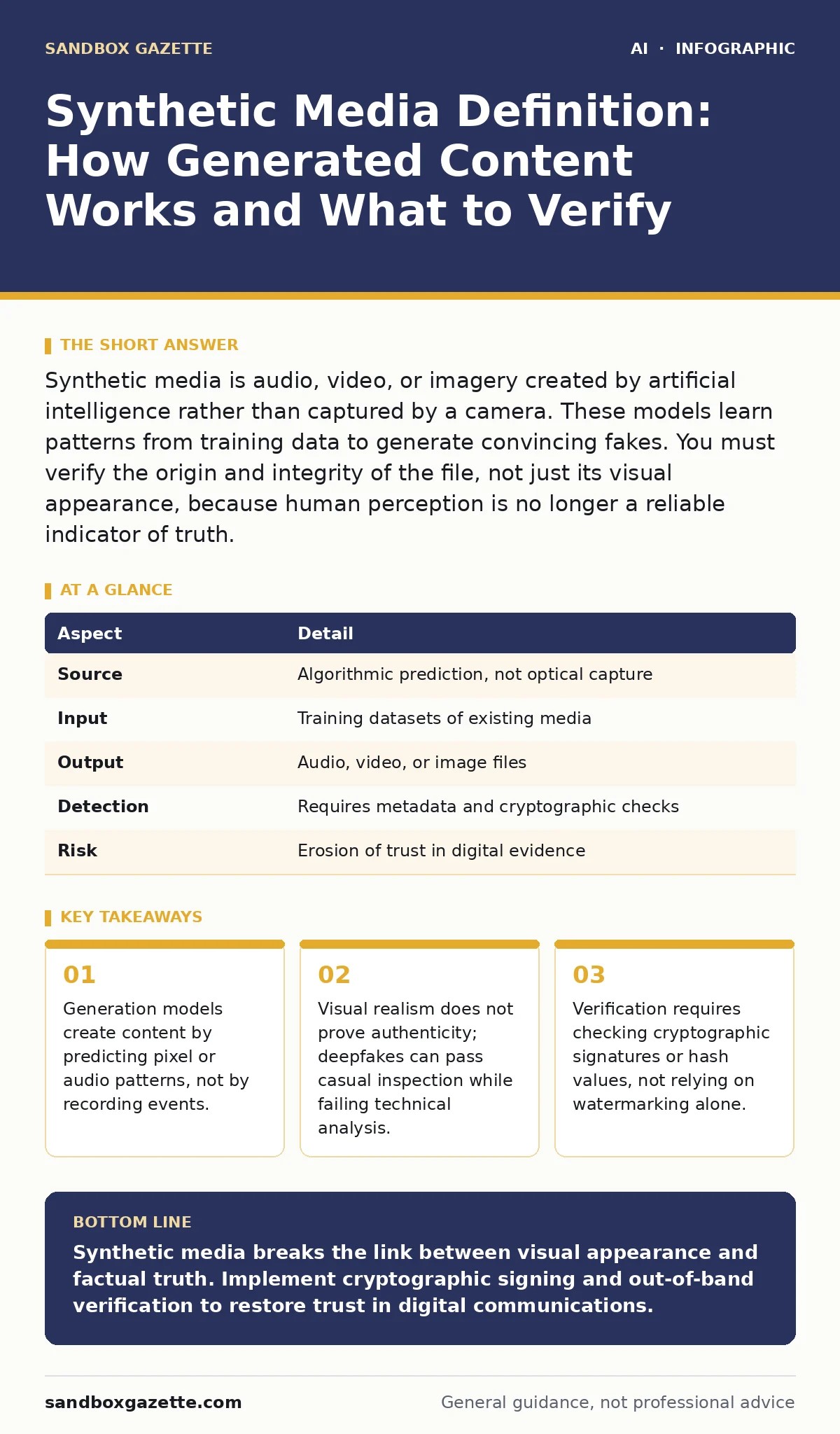
Synthetic media is audio, video, or imagery created by artificial intelligence rather than captured by a camera. These models learn patterns from training data to generate convincing fakes. You must verify the origin and integrity of the file, not just its visual appearance, because human perception is no longer a reliable indicator of truth.
An Everyday Analogy for Generated Content
Imagine a painter who has studied ten thousand portraits. You ask this painter to create a picture of a person who does not exist. The painter mixes colors and shapes based on learned patterns of faces, eyes, and lighting. The result looks like a photograph of a real person. No camera was used. No subject stood for the portrait. The image is a synthesis of learned data. This is the core mechanism behind synthetic media.
The brain expects images to be records of light hitting a sensor. Synthetic media breaks this assumption. It presents constructed reality as captured reality. Security teams must adjust their verification workflows to account for this shift. The medium itself is no longer proof of the event.
synthetic media definition
Synthetic media definition refers to any audio, video, or image content that is generated or significantly altered by artificial intelligence algorithms. This content is not recorded from the physical world. Instead, it is constructed by models that predict what pixels or sound waves should appear next. The term covers everything from fully generated faces to altered voice recordings. It excludes simple edits like cropping or color correction. The defining feature is the algorithmic creation of new information that mimics reality.
This definition matters for evidence handling. If a video is synthetic, it cannot serve as proof that an event occurred. It can only serve as proof that a model generated it. Distinguishing between captured footage and generated footage is the first step in any investigation.
| Aspect | Detail |
|---|---|
| Source | Algorithmic prediction, not optical capture |
| Input | Training datasets of existing media |
| Output | Audio, video, or image files |
| Detection | Requires metadata and cryptographic checks |
| Risk | Erosion of trust in digital evidence |
How Generation Models Construct Reality
Generative models learn statistical relationships in data. A text-to-image model maps words to visual features. It does not understand the words. It understands that the word "cat" correlates with specific shapes and textures. When you request an image, the model starts with random noise. It iteratively refines the noise to match the statistical probability of the requested subject. This process is called diffusion or denoising.
Voice cloning works differently. It analyzes the spectral characteristics of a source voice. It builds a model of how that person produces sounds. It can then generate new speech using that voice model. The result sounds like the original speaker. It does not require the original speaker to be present. It requires only enough sample data to build the acoustic profile.
These models do not create truth. They create plausibility. They output what is statistically likely, not what actually happened. This distinction is critical for security operations. Plausible content can be weaponized to bypass human verification.
Who It Affects and Where Trust Breaks
Every organization that relies on digital communication is affected. Financial institutions verify identities through video. Governments use video evidence for legal proceedings. Corporate security teams monitor remote access. Synthetic media undermines the baseline trust in these processes.
The impact extends beyond high-profile targets. Small businesses receive phishing emails with synthesized voice messages. Employees are tricked into revealing credentials. The cost is not just financial. It is the erosion of procedural trust. Teams begin to doubt legitimate communications. This leads to operational delays. It creates a paradox where truth requires more effort to verify than falsehood.
Security operations must treat all incoming media as untrusted. The burden of proof shifts from the recipient to the sender. You must verify the origin before acting on the content. This applies to internal communications as much as external threats.
What People Usually Get Wrong
Many assume that visual artifacts reveal synthetic media. This is incorrect. Early deepfakes had tell-tale signs like flickering or bad lip-sync. Modern models produce high-fidelity output. These artifacts are absent. Relying on human inspection is a failed strategy.
Another common error is trusting watermarks. Generative models can remove or alter watermarks. Attackers can strip metadata that indicates the source. A lack of watermark does not prove authenticity. A presence of watermark does not guarantee it. Watermarks are easily forged or removed. They are not a security control.
The biggest mistake is assuming that detection tools are sufficient. Detection models are in an arms race with generation models. As generation improves, detection becomes harder. False positives increase. Legitimate content is flagged as fake. This creates noise in security operations. You cannot rely on a single detection tool for final verification.
See also: How Exposed AI Model Servers Work: A Step-by-Step Breakdown · Access Controls for AI Agents: A Practical Implementation Checklist
Verification Strategies for Security Teams
You must implement a chain of trust. This starts with cryptographic signing. Content creators sign their media with a digital key. Receivers verify the signature. If the signature is valid, the content is authentic. If it is missing or invalid, the content is treated as untrusted. This is the only reliable method.
Metadata analysis provides secondary evidence. Check the file creation time, device ID, and software version. Synthetic media often lacks consistent metadata. It may have gaps or inconsistencies. However, attackers can fabricate metadata. Metadata supports the decision, but it does not drive it.
For internal communications, use out-of-band verification. If a video request seems unusual, verify it through a separate channel. Use a pre-established secure chat or phone call. Do not rely on the same medium for verification. This breaks the attack chain. The attacker controls the synthetic media. They do not control the out-of-band channel.
Related Topics and Further Reading
Synthetic media is part of a broader shift in AI security. Understanding AI-assisted threat detection helps you see how defenders use similar models to find anomalies. However, defenders face the same data quality issues.
AI content detection tools are evolving, but they have limitations. They often flag legitimate content. You must tune these tools to reduce false positives. Over-reliance on automated detection can blind you to novel attacks.
AI bias in training data affects the output of synthetic media. Models may reinforce stereotypes or fail to represent certain groups accurately. This is not just an ethical issue. It is a security issue. Biased models produce predictable output. Attackers can exploit these patterns.
MITRE ATLAS provides a framework for understanding AI attack techniques. It maps how adversaries abuse AI models. Referencing this framework helps you structure your defense. It moves you from reactive patching to proactive resilience.
AI model monitoring is necessary to detect drift. As models change, their output changes. You must monitor for unexpected behavior. This applies to your own models and those you consume.
Sensitive data leaks through AI chatbots often involve synthetic content. Users may paste private data into prompts. The model learns this data. It may later generate it in response to other queries. This creates a leakage path. You must control input and output.
AI in security operations requires new skills. Analysts must understand the limitations of AI. They must know when to override automated decisions. Training is critical.
Shadow AI refers to unauthorized AI tools used within an organization. These tools bypass security controls. They may generate synthetic content that enters your systems. You must inventory all AI tools in use. Unmanaged AI is a significant risk.
Key takeaways
- Generation models create content by predicting pixel or audio patterns, not by recording events.
- Visual realism does not prove authenticity; deepfakes can pass casual inspection while failing technical analysis.
- Verification requires checking cryptographic signatures or hash values, not relying on watermarking alone.
Synthetic media breaks the link between visual appearance and factual truth. Implement cryptographic signing and out-of-band verification to restore trust in digital communications.
Frequently asked questions
Can I trust my eyes to spot a deepfake?
No. Modern generative models produce high-fidelity output that passes casual human inspection. Visual artifacts are increasingly rare. You must rely on technical verification methods instead of sensory perception.
Is watermarking enough to prove authenticity?
No. Watermarks can be removed, altered, or forged by AI tools. They provide a weak signal. Cryptographic signatures are required for reliable proof of origin and integrity. Watermarks are not a security control.
How do I verify a video from an unknown sender?
Check for cryptographic signatures in the file metadata. Verify the sender's identity through an out-of-band channel. Do not act on the content until the origin is confirmed. Treat unsigned media as untrusted.
What is the difference between editing and synthetic media?
Editing modifies existing captured footage. Synthetic media generates new content from algorithmic predictions. Editing preserves the original source. Synthetic media creates a new source. The distinction matters for evidence handling.
How this guide was produced: written by the Sandbox Gazette editorial team with AI assistance, checked against the public references listed below, and reviewed when the facts change. See our editorial policy or report an error.