
N-day vulnerabilities are known security flaws for which a patch exists but has not been deployed. Attackers exploit these gaps because organizations delay updates due to stability concerns or complexity. Defending against them requires reducing the attack surface and validating inputs rather than relying solely on patch management.
The Gap Between Knowledge and Remediation
Security vulnerabilities are rarely secret for long. Once a flaw is disclosed, vendors release patches to fix the code. This creates a window where the weakness is known, but the fix is not yet applied everywhere. This period defines an n-day vulnerability. The "n" represents the number of days since the patch became available.
You might assume that once a patch exists, the threat is neutralized. This assumption is incorrect. Many organizations delay applying updates to avoid breaking complex systems. This delay creates a predictable target for attackers who scan for unpatched software.
The existence of a known fix does not guarantee protection. If your network contains systems that cannot be updated immediately, you remain exposed. Understanding this gap is the first step in managing the risk.
The Lifecycle of an Exploit
An n-day attack follows a specific sequence. It begins with reconnaissance, where attackers identify systems running vulnerable versions of software. They then select an exploit that targets the known flaw. Finally, they deliver the payload to execute their intent.
This process is mechanical and scalable. Automated tools can scan the internet for open ports or specific service banners that indicate a vulnerable version. Once identified, the attack proceeds regardless of whether the organization is aware of the risk.
The speed of this lifecycle matters. Attackers often automate the scanning and exploitation phases. This means the window between discovery and compromise can be very short. Your defense must account for this speed.
Stage 1: Identification and Scanning
Attackers use automated scanners to find systems with known vulnerabilities. These tools check for specific version numbers or configurations that match public databases. The goal is to build a list of targets that have not yet applied the available fix.
This stage relies on information that is already public. There is no need to discover a new zero-day flaw. The attacker simply looks for systems that are behind on updates. This makes the attack highly efficient and low-cost.
Stage 2: Payload Selection
Once a target is identified, the attacker selects an exploit. They may use a generic exploit from a public repository or modify it to evade detection. The choice depends on the target’s security controls and the complexity of the vulnerability.
Some exploits are fragile and fail if the environment differs slightly from the test case. Others are robust and work across many configurations. Attackers often choose the latter to maximize their success rate. This selection process is critical for the attack’s success.
Stage 3: Delivery and Execution
The final stage involves delivering the exploit to the target system. This can happen through a web request, an email attachment, or a network packet. The goal is to trigger the vulnerability and execute arbitrary code.
If the exploit succeeds, the attacker gains control. They may install malware, steal data, or move laterally within the network. The initial compromise is just the beginning of a larger operation.
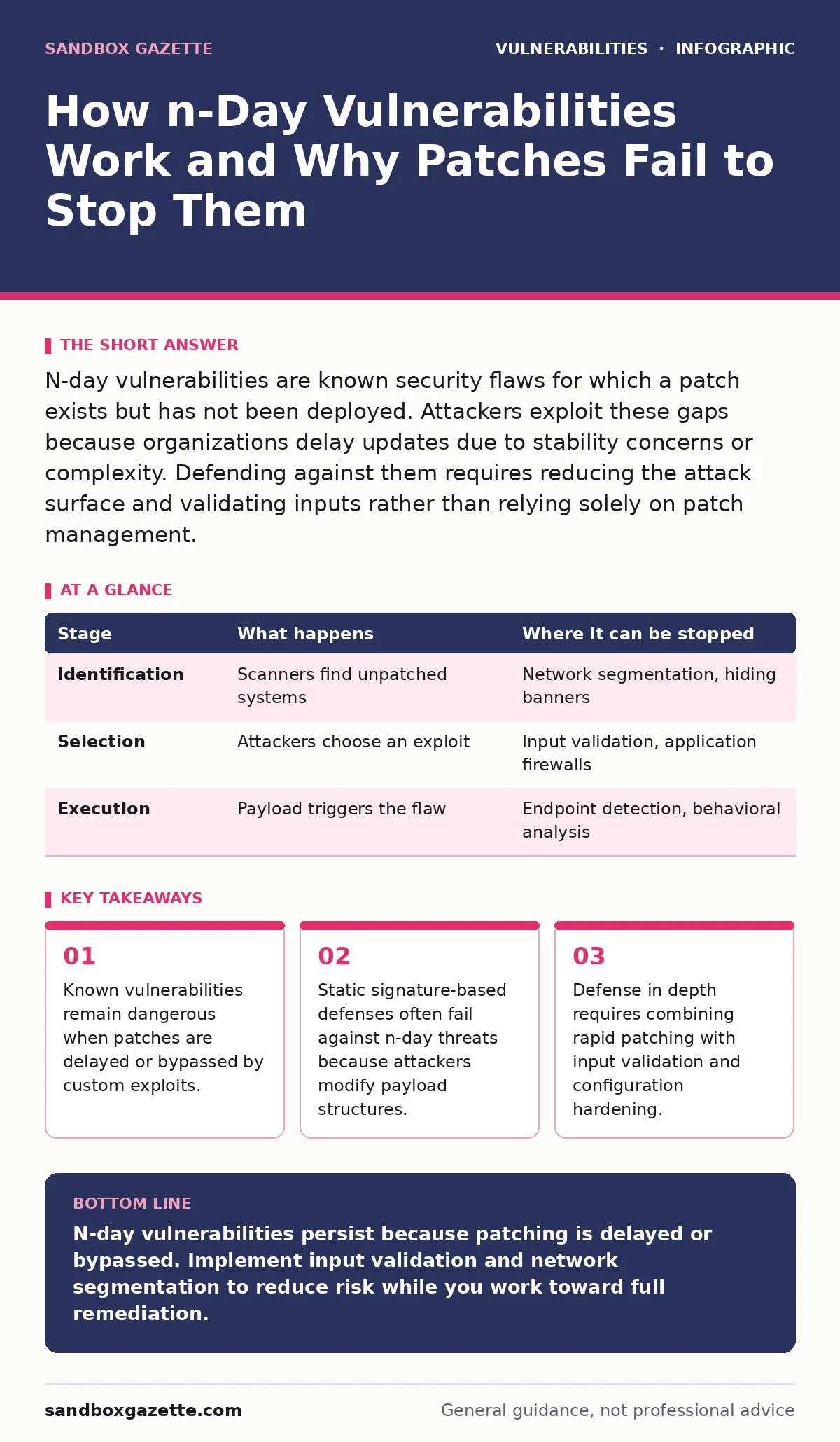
| Stage | What happens | Where it can be stopped |
|---|---|---|
| Identification | Scanners find unpatched systems | Network segmentation, hiding banners |
| Selection | Attackers choose an exploit | Input validation, application firewalls |
| Execution | Payload triggers the flaw | Endpoint detection, behavioral analysis |
Why Patches Are Not Enough
Applying patches is the primary defense against n-day vulnerabilities. However, patch management is complex. Some systems cannot be updated without downtime. Others require extensive testing to ensure compatibility.
This complexity creates persistent gaps. Attackers know this and target systems that are difficult to patch. They focus on legacy systems or critical infrastructure that must remain online.
You must accept that some systems will remain vulnerable. This acceptance requires additional controls. Relying solely on patching leaves you exposed during the maintenance window.
The Role of Defense in Depth
To protect against n-day threats, you need layers of defense. Each layer should stop the attack at a different stage. This approach reduces the likelihood of a successful compromise.
Input validation is one such layer. By ensuring that data entering your systems is valid, you can prevent many exploits from triggering. This control works even if the underlying software is vulnerable.
Configuration hardening is another critical layer. By disabling unnecessary features and restricting access, you reduce the attack surface. This makes it harder for attackers to find a viable path to your systems.
Reading and Applying Vulnerability Data
Understanding vulnerability data is key to prioritizing your defenses. CVE identifiers provide a standard way to reference specific flaws. You can use these identifiers to track patches and assess risk.
However, not all vulnerabilities are equal. Some are easier to exploit than others. Some require user interaction, while others are remote. You must assess the context of each vulnerability to determine its impact.
This assessment helps you decide which patches to apply first. It also helps you identify systems that need additional controls. By focusing on the most critical risks, you can optimize your security efforts.
See also: Dependency Confusion Attacks: Risks and Protection for Small Businesses · Detect Web Cache Poisoning: Signals, Tools, and Hidden Blind Spots
Mitigation Strategies for Persistent Risks
When patching is not immediately possible, you must use compensating controls. These controls reduce the risk without fixing the underlying flaw. They are not a substitute for patching but a temporary measure.
Network segmentation is one effective control. By isolating vulnerable systems, you limit the impact of a compromise. This prevents attackers from moving laterally within your network.
Behavioral monitoring is another useful control. By detecting unusual activity, you can identify compromises that bypass other defenses. This allows you to respond quickly and contain the damage.
The Hidden Cost of Delay
Delaying patches has a hidden cost. It increases the complexity of your security posture. You must maintain additional controls to mitigate the risk. These controls require resources to implement and manage.
This cost accumulates over time. The more unpatched systems you have, the more complex your defense becomes. Eventually, the cost of maintaining these controls exceeds the cost of patching.
You must weigh the cost of patching against the cost of risk. In many cases, the cost of a breach far exceeds the cost of maintenance. This calculation should drive your patching strategy.
Integrating Attack Surface Management
Effective defense requires a holistic view of your environment. Attack surface management helps you identify and prioritize risks. It provides a map of your systems and their vulnerabilities.
By integrating attack surface management with your patching process, you can ensure that critical systems are protected. This approach allows you to focus your resources on the most important risks.
This integration also helps you detect new vulnerabilities quickly. By continuously monitoring your attack surface, you can identify changes that may increase your risk. This proactive approach reduces the window of exposure.
The Limits of Signature Detection
Traditional security tools rely on signature detection. These tools look for known patterns in network traffic or files. However, n-day attacks often evade these signatures.
Attackers modify their payloads to avoid detection. This technique, known as polymorphism, changes the signature of the exploit. As a result, signature-based tools may fail to detect the threat.
You must supplement signature detection with behavioral analysis. This approach looks for unusual activity rather than known patterns. It is more effective at detecting novel or modified exploits.
Backported Fixes and Compatibility
Some vendors release backported security fixes. These fixes apply the security patch to older versions of software without updating the entire codebase. This allows organizations to patch legacy systems without breaking compatibility.
Backported fixes are a valuable tool for managing n-day risks. They allow you to protect systems that cannot be updated to the latest version. However, they are not always available for every vulnerability.
You must check whether backported fixes are available for your systems. If they are, you can apply them to reduce your risk. This approach balances security and stability.
Key takeaways
- Known vulnerabilities remain dangerous when patches are delayed or bypassed by custom exploits.
- Static signature-based defenses often fail against n-day threats because attackers modify payload structures.
- Defense in depth requires combining rapid patching with input validation and configuration hardening.
N-day vulnerabilities persist because patching is delayed or bypassed. Implement input validation and network segmentation to reduce risk while you work toward full remediation.
Frequently asked questions
How do I know if a system is vulnerable to an n-day attack?
Check the software version against public vulnerability databases like CVE identifiers to see if a patch exists and if it has been applied.
Can firewalls stop n-day exploits?
Traditional firewalls may block known malicious traffic, but they often fail against modified payloads. Application firewalls and behavioral analysis are more effective.
What is the difference between n-day and zero-day?
Zero-day vulnerabilities are unknown to the vendor, so no patch exists. N-day vulnerabilities are known, and a patch is available but not yet deployed.
Should I delay patches to test them?
Testing is important, but long delays increase risk. Use a staging environment to test patches quickly and deploy them as soon as they are verified.
How this guide was produced: written by the Sandbox Gazette editorial team with AI assistance, checked against the public references listed below, and reviewed when the facts change. See our editorial policy or report an error.