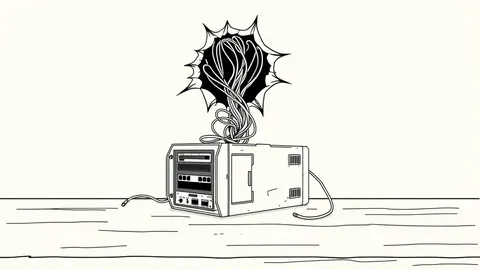
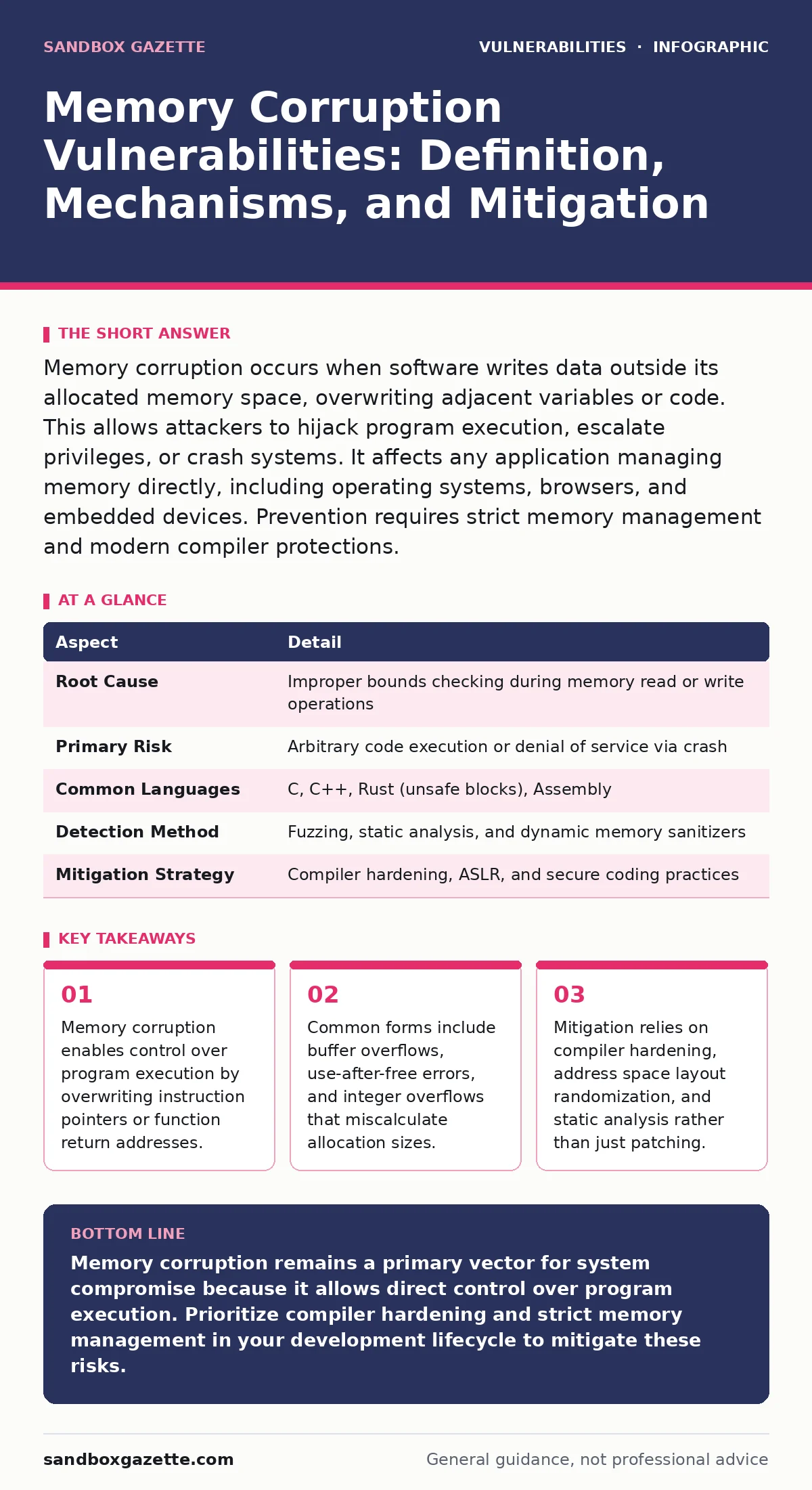
Memory corruption occurs when software writes data outside its allocated memory space, overwriting adjacent variables or code. This allows attackers to hijack program execution, escalate privileges, or crash systems. It affects any application managing memory directly, including operating systems, browsers, and embedded devices. Prevention requires strict memory management and modern compiler protections.
The Concept of Memory Corruption
Imagine a library where each book has a specific shelf. If a librarian places a large encyclopedia on a shelf meant for a single pamphlet, the encyclopedia spills over, damaging the books on adjacent shelves. In computing, memory corruption happens when a program writes data beyond the boundary of its allocated memory buffer. This overflow corrupts neighboring memory regions, which may contain critical program state, control data, or other variables.
The consequence is not merely data loss. The corruption can alter how the program behaves. If the overwritten memory controls program flow, an attacker can redirect execution to malicious code. This mechanism turns a logic error into a security breach. The vulnerability exists because many programming languages allow direct memory manipulation without automatic boundary checks.
| Aspect | Detail |
|---|---|
| Root Cause | Improper bounds checking during memory read or write operations |
| Primary Risk | Arbitrary code execution or denial of service via crash |
| Common Languages | C, C++, Rust (unsafe blocks), Assembly |
| Detection Method | Fuzzing, static analysis, and dynamic memory sanitizers |
| Mitigation Strategy | Compiler hardening, ASLR, and secure coding practices |
How Memory Corruption Occurs
Memory corruption arises from two main mechanisms: writing too much data and accessing freed memory. The first mechanism, buffer overflow, happens when input exceeds the fixed size of a memory buffer. The program copies the input without verifying length. The excess data overwrites adjacent memory. If that adjacent memory holds a return address, the program jumps to the attacker’s chosen location when the function ends.
The second mechanism, use-after-free, occurs when a program continues to use a memory pointer after that memory has been released back to the system. The freed memory may be reallocated for a different purpose. If the original program writes to the old pointer, it corrupts the new data structure. This can lead to type confusion, where the program treats a benign object as a malicious one.
Common Forms of Memory Errors
Buffer overflows are the most recognized form. They affect any function that copies data into a fixed-size array. Stack-based overflows corrupt the call stack, allowing control flow hijacking. Heap-based overflows corrupt the heap manager’s metadata, enabling more complex exploits that manipulate memory allocation patterns.
Use-after-free errors are increasingly common in complex applications like browsers. They exploit the timing between memory deallocation and reallocation. Double-free errors occur when a program frees the same memory block twice, causing the heap manager to enter an inconsistent state. Integer overflows cause a calculation to wrap around, resulting in a smaller memory allocation than expected. Subsequent writes then overflow the small buffer.
Type confusion errors happen when a program assumes a memory block contains one data type but it actually contains another. This often stems from incorrect casting or missing type checks. Null pointer dereferences cause crashes but rarely lead to code execution. They are still dangerous because they indicate broken logic that might mask more severe corruption bugs.
Who Is Affected by These Flaws
Any software that manages memory manually is vulnerable. This includes operating systems, device drivers, and embedded firmware. These components run with high privileges, making them attractive targets. A corruption bug in a driver can grant kernel-level access, bypassing user-space security controls.
Application software is also at risk. Web browsers, email clients, and media players process untrusted input constantly. They are frequent targets because they run on user devices and handle complex file formats. Even high-level languages can suffer if they interface with native code libraries. Java or Python applications using C extensions inherit the risks of those extensions.
Organizations with poor asset inventory for patching are disproportionately affected. If you do not know what software runs on your network, you cannot prioritize fixes for critical memory bugs. Legacy systems that no longer receive updates remain exposed indefinitely. The risk extends to supply chains, where a vulnerable library in one product affects all products that depend on it.
What People Usually Get Wrong
Many assume that using high-level languages eliminates memory corruption risks. This is false if the application links to native libraries. A Python script calling a C library for image processing can still crash or be exploited if the library has a buffer overflow. The vulnerability lives in the native code, regardless of the host language.
Another misconception is that fuzzing alone solves the problem. Fuzzing finds bugs by feeding random input, but it cannot cover every code path. It misses logic errors that require specific state sequences. Static analysis tools also struggle with complex pointer arithmetic. Both methods are necessary but insufficient. You need a combination of automated testing, code review, and compiler protections.
See also: Vulnerability Management Process: The Cycle That Closes Gaps · How n-Day Vulnerabilities Work and Why Patches Fail to Stop Them
Reducing Risk Through Engineering
Compiler hardening is the first line of defense. Modern compilers offer protections like stack canaries, which detect stack overflows before they execute. They also enable Address Space Layout Randomization (ASLR), which randomizes memory locations. ASLR makes it harder for attackers to predict where to jump. Data Execution Prevention (DEP) marks memory regions as non-executable, preventing code injection.
Static analysis tools scan source code for potential corruption patterns. They identify unsafe function usage, such as strcpy without length limits. Integrating these tools into the build pipeline catches bugs early. Dynamic analysis tools, like AddressSanitizer, detect errors at runtime during testing. They pinpoint the exact line of code causing the corruption.
Secure coding practices are mandatory. Developers must use safe alternatives to dangerous functions. They must verify all input lengths. They must handle memory allocation failures gracefully. Code reviews should focus on memory management logic. The goal is to minimize the attack surface by reducing direct memory manipulation.
The Role of Patch Management
Finding vulnerabilities is only half the battle. Deploying fixes is equally critical. Memory corruption bugs often become n-day vulnerabilities once disclosed. Attackers exploit them quickly if patches are not applied. Organizations must maintain a rigorous patch management process. This includes testing patches for compatibility and deploying them promptly.
Coordinated vulnerability disclosure ensures that vendors have time to fix bugs before public release. This reduces the window of exposure. Bug bounty triage helps prioritize fixes based on severity. However, reliance on external reporting is reactive. Proactive engineering reduces the need for emergency patches. Regular updates to dependencies ensure you benefit from security improvements in third-party libraries.
Integration with Other Security Controls
Memory corruption protection works best when combined with other security measures. For instance, open redirect vulnerabilities can be used to lure users into downloading malicious files that trigger memory bugs. Prototype pollution in JavaScript applications can lead to logic errors that bypass security checks. Regular expression denial of service (ReDoS) attacks can consume resources, masking other activities.
A layered defense strategy is necessary. Network segmentation limits the impact of a compromised system. Least privilege principles ensure that even if code execution occurs, the attacker has limited rights. Monitoring for anomalous behavior can detect exploitation attempts. You must correlate memory safety with broader security hygiene to reduce overall risk.
Key takeaways
- Memory corruption enables control over program execution by overwriting instruction pointers or function return addresses.
- Common forms include buffer overflows, use-after-free errors, and integer overflows that miscalculate allocation sizes.
- Mitigation relies on compiler hardening, address space layout randomization, and static analysis rather than just patching.
Memory corruption remains a primary vector for system compromise because it allows direct control over program execution. Prioritize compiler hardening and strict memory management in your development lifecycle to mitigate these risks.
Frequently asked questions
Does using Rust eliminate memory corruption vulnerabilities?
Rust prevents many common memory errors at compile time, but unsafe blocks and complex logic can still introduce vulnerabilities. It reduces risk but does not eliminate it entirely.
Can memory corruption occur in managed languages like Java?
Yes, if the application uses native libraries or JNI interfaces. The managed runtime protects its own heap, but native code attached to the application remains vulnerable.
How do I detect memory corruption in production?
Use crash dump analysis and monitoring for unexpected process terminations. Implement logging for memory access violations. Deploy runtime application self-protection tools if possible.
Is ASLR sufficient to prevent exploitation?
No, ASLR only randomizes addresses. It does not prevent the corruption itself. Attackers can use information leaks to bypass ASLR. It is a mitigation, not a fix.
How this guide was produced: written by the Sandbox Gazette editorial team with AI assistance, checked against the public references listed below, and reviewed when the facts change. See our editorial policy or report an error.