
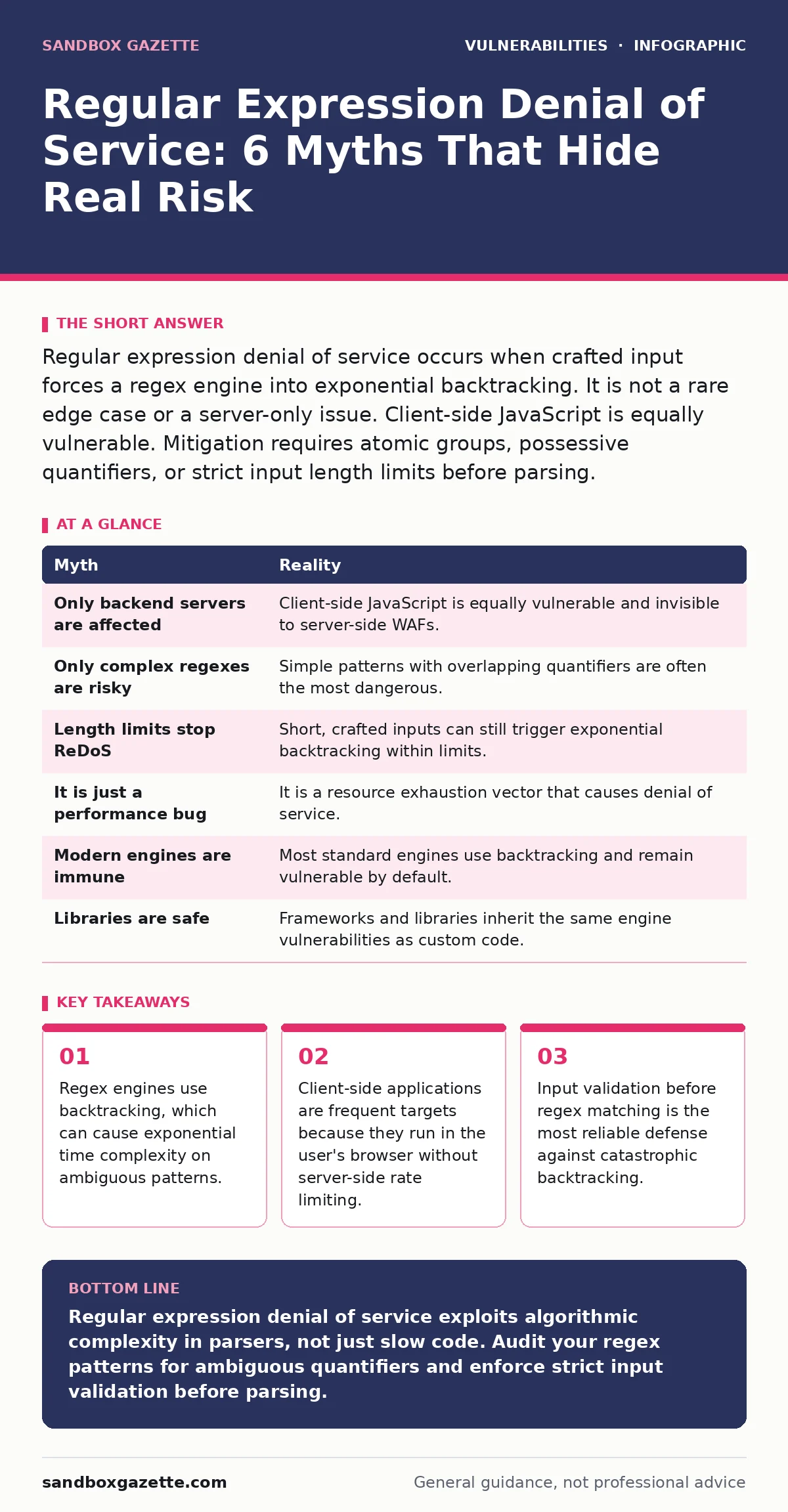
Regular expression denial of service occurs when crafted input forces a regex engine into exponential backtracking. It is not a rare edge case or a server-only issue. Client-side JavaScript is equally vulnerable. Mitigation requires atomic groups, possessive quantifiers, or strict input length limits before parsing.
Myth: Regular expression denial of service only affects backend servers
Reality: Regular expression denial of service attacks frequently target client-side applications. Developers often assume that server-side firewalls or rate limiters protect them. This assumption fails when the vulnerable code runs in the user's browser. JavaScript engines in browsers execute regex with the same backtracking behavior as server-side engines.
An attacker sends a malicious payload via a URL parameter or form field. The victim's browser consumes CPU cycles parsing the string. This degrades the user experience or freezes the tab entirely. The server may never even process the request if the validation happens before submission. You must audit client-side validation logic with the same rigor as server-side code.
Imagine a web application that validates email addresses in the browser before sending data to the API. An attacker crafts a string that triggers catastrophic backtracking in that email regex. The victim's browser hangs. The server sees no load. The attack succeeds without touching your infrastructure. This shifts the burden of defense to the client. You cannot rely on server-side protections to mask client-side vulnerabilities.
Myth: Only complex regular expressions are vulnerable to ReDoS
Reality: Simple patterns are often the most dangerous. Developers tend to scrutinize long, complex regexes for security flaws. They ignore short patterns used for basic checks like usernames or numeric IDs. A pattern like (a+)+ appears harmless. It matches one or more 'a' characters, grouped together. When fed a string of 'a's followed by a non-matching character, the engine explores every possible division of the string. The number of paths grows exponentially with input length. A 20-character input can take minutes to fail. A 30-character input can take hours. Complexity does not correlate with risk. Ambiguity does. Overlapping quantifiers create the trap. You must test even the simplest patterns for pathological inputs.
Suppose you use a regex to validate a simple product code consisting of digits. You write \d+. This is safe. But if you add optional separators, like (\d+-?)+, you introduce ambiguity. The engine does not know if the hyphen belongs to the previous group or starts the next. This uncertainty drives the backtracking. Simple does not mean safe. It means easier to overlook.
Myth: Input length limits completely prevent regular expression denial of service
Reality: Length limits reduce the attack surface but do not eliminate the risk. An attacker can craft a payload within standard length constraints to trigger exponential behavior. If your limit is 100 characters, a carefully constructed string of 50 characters can still cause significant delay. The complexity curve is steep.
Doubling the input length can square the processing time. A limit of 1000 characters might seem safe. It is not. The engine still explores all combinatorial paths within that limit. You must combine length limits with regex simplification. Length limits are a blunt instrument. They stop large payloads. They do not fix the underlying algorithmic flaw in the pattern.
Imagine you set a maximum input length of 256 characters. An attacker sends a 200-character string designed to maximize backtracking. The regex engine spends seconds processing it. If your application processes 100 requests per second, this single request can block a worker thread. The other 99 requests queue up. The system appears to hang. The length limit was respected. The attack still succeeded. You need to address the pattern structure, not just the input size.
Myth: Regular expression denial of service is a performance issue, not a security vulnerability
Reality: Regular expression denial of service is a denial of service vector. It consumes CPU resources until the service becomes unresponsive. This is indistinguishable from other DoS attacks in its impact. The difference is the trigger. A network flood sends packets. ReDoS sends a string. The result is the same: service interruption.
Classifying it as a performance bug allows developers to deprioritize fixes. They treat it as an optimization task. This leaves the application open to targeted attacks. An attacker needs only one vulnerable endpoint. They can disable a feature or slow down the entire application. You must treat ReDoS as a critical security flaw. It requires the same remediation urgency as memory corruption vulnerabilities.
Myth: Modern regex engines are immune to catastrophic backtracking
Reality: Most standard regex engines use backtracking by design. This is a feature, not a bug. It allows for complex pattern matching and capture groups. The trade-off is security. Engines like PCRE, Java, .NET, and JavaScript V8 all support backtracking. They are all vulnerable to ReDoS if the pattern is ambiguous.
Some engines offer "linear" modes or atomic grouping. These are opt-in features. They are not the default. You must explicitly configure them. Assuming your engine is safe because it is modern is a false sense of security. The underlying algorithm remains the same. The risk persists unless you change how you write patterns or how you configure the engine.
Suppose you migrate from an older language runtime to a newer one. You assume the new runtime is faster and safer. It is faster. It is not necessarily safer against ReDoS. The new engine may still use backtracking. You must verify the engine's behavior. Do not trust marketing claims. Test the engine with known pathological inputs. Confirm that it fails fast or uses linear matching.
Myth: Using a library or framework prevents regular expression denial of service
Reality: Libraries and frameworks often include regex-based validation by default. They do not audit every pattern for ReDoS risk. Frameworks use standard regex engines. They inherit the same vulnerabilities. A library might provide a "safe" email validator. It might still use a backtracking pattern. You cannot outsource security to a dependency. You must review the regex patterns in your dependencies.
This includes third-party libraries and internal shared modules. Dependency confusion attacks highlight the risk of trusting external packages. ReDoS highlights the risk of trusting their internals. You must scan your codebase for vulnerable patterns. Use static analysis tools that detect catastrophic backtracking. Do not assume a library is secure just because it is popular.
Summary Table
| Myth | Reality |
|---|---|
| Only backend servers are affected | Client-side JavaScript is equally vulnerable and invisible to server-side WAFs. |
| Only complex regexes are risky | Simple patterns with overlapping quantifiers are often the most dangerous. |
| Length limits stop ReDoS | Short, crafted inputs can still trigger exponential backtracking within limits. |
| It is just a performance bug | It is a resource exhaustion vector that causes denial of service. |
| Modern engines are immune | Most standard engines use backtracking and remain vulnerable by default. |
| Libraries are safe | Frameworks and libraries inherit the same engine vulnerabilities as custom code. |
Key takeaways
- Regex engines use backtracking, which can cause exponential time complexity on ambiguous patterns.
- Client-side applications are frequent targets because they run in the user's browser without server-side rate limiting.
- Input validation before regex matching is the most reliable defense against catastrophic backtracking.
Regular expression denial of service exploits algorithmic complexity in parsers, not just slow code. Audit your regex patterns for ambiguous quantifiers and enforce strict input validation before parsing.
Frequently asked questions
How do I test my code for ReDoS vulnerabilities?
Use static analysis tools that detect catastrophic backtracking in regex patterns. Supplement this with dynamic testing using pathological inputs designed to trigger exponential time complexity.
Can I fix ReDoS without rewriting my regex?
You can mitigate risk by adding strict input length limits and validating character sets before regex matching. However, rewriting the pattern to use atomic groups or possessive quantifiers is the most reliable fix.
Does threat modeling help prevent ReDoS?
Yes, threat modeling for applications helps you identify where user input is processed. Including regex parsing in your data flow diagrams ensures you assess the risk of input validation logic.
Are JWT vulnerabilities related to ReDoS?
While distinct, both involve input processing flaws. JWT vulnerabilities often stem from improper signature verification. ReDoS stems from improper pattern matching. Both require careful input handling.
How this guide was produced: written by the Sandbox Gazette editorial team with AI assistance, checked against the public references listed below, and reviewed when the facts change. See our editorial policy or report an error.