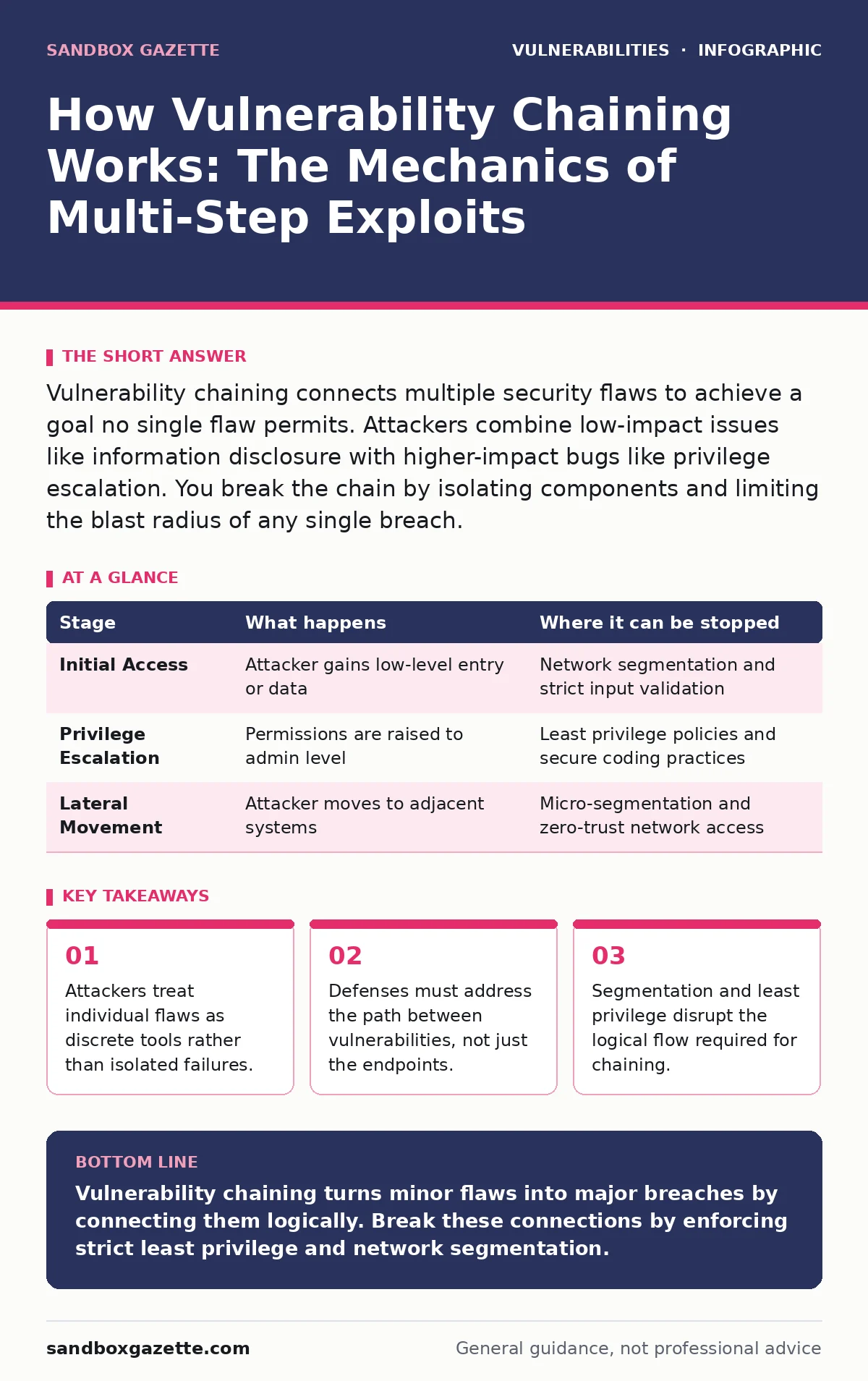
Vulnerability chaining connects multiple security flaws to achieve a goal no single flaw permits. Attackers combine low-impact issues like information disclosure with higher-impact bugs like privilege escalation. You break the chain by isolating components and limiting the blast radius of any single breach.
Understanding the Atomic Flaw
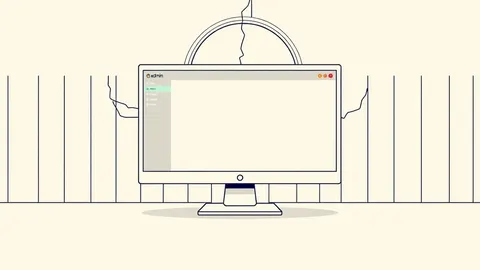
Most security discussions focus on individual bugs in isolation. This approach misses how attackers actually operate in the field. An atomic flaw is a single weakness in code or configuration. It might allow reading a file or crashing a service. On its own, it rarely grants full control. You must understand that attackers view these flaws as building blocks. They do not need one perfect exploit. They need a sequence of imperfect ones that work together. This shifts the focus from patching every bug to breaking the logical connection between them.
Stage 1: Initial Access and Reconnaissance
The chain begins with entry. The attacker gains a foothold through a low-severity issue. This might be an open redirect vulnerability that tricks a user into visiting a malicious site. Or it could be a misconfigured API endpoint that reveals internal IP addresses. The goal here is not control. The goal is information. The attacker gathers details about the environment. They identify running services, user roles, and network topology. This data is fuel for the next stage. Without this reconnaissance, the attacker cannot select the right next flaw to exploit.
Stage 2: Privilege Escalation
The attacker now moves inward. They use the initial access to elevate their permissions. This often involves memory corruption vulnerabilities or logic errors in authentication modules. The attacker might exploit a heap overflow vulnerabilities issue to overwrite function pointers. This allows them to execute code with higher privileges. The key insight here is the transition. The attacker moves from an untrusted user to a trusted service account. This step is often silent. It leaves no obvious trace of external intrusion. It looks like normal internal activity.
Stage 3: Lateral Movement
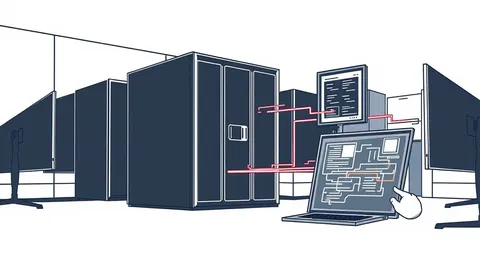
With elevated privileges, the attacker expands their reach. They move from the compromised host to adjacent systems. This stage relies on trust relationships. If one server trusts another, the attacker walks across that trust. They might use stolen credentials to log into a database server. Or they might exploit a shared network segment to sniff traffic. This movement increases the attack surface. It gives the attacker more options. It also makes detection harder. The activity spreads across multiple hosts, diluting the signal.
| Stage | What happens | Where it can be stopped |
|---|---|---|
| Initial Access | Attacker gains low-level entry or data | Network segmentation and strict input validation |
| Privilege Escalation | Permissions are raised to admin level | Least privilege policies and secure coding practices |
| Lateral Movement | Attacker moves to adjacent systems | Micro-segmentation and zero-trust network access |
Stage 4: Persistence and Execution
The chain culminates in action. The attacker establishes a durable presence. They install backdoors or create new accounts. They ensure they can return even if the initial entry point is closed. This stage turns a transient exploit into a long-term compromise. The attacker might modify system binaries. Or they might use scheduled tasks to maintain access. This persistence is the ultimate goal of the chain. It renders the initial flaws irrelevant. The attacker no longer needs the original bug to stay inside.
Reading the Chain for Defense
You cannot defend against chaining by patching bugs in isolation. You must map the dependencies. Look for paths that connect low-impact flaws to high-impact targets. Ask how a minor information leak could lead to privilege escalation. This requires a holistic view. It aligns with strong vulnerability management programs that prioritize risk over severity scores. You must consider the context. A flaw in a public-facing web server is riskier than the same flaw in an isolated offline system. Context determines the chain's viability.
The Hidden Cost of Complexity
Chaining exploits thrive in complex environments. Every integration adds a potential bridge. Every API call adds a trust relationship. The more complex your architecture, the more ways an attacker can link flaws. This creates a hidden cost. You pay for complexity in security debt. Simplifying your environment reduces the number of possible chains. Removing unnecessary services cuts off lateral movement paths. This is often overlooked. Teams focus on adding controls. They forget that removing complexity is a powerful defense.
Applying Chain Analysis
To apply this, start with your critical assets. Map the paths to those assets. Identify which flaws could serve as stepping stones. This is similar to analyzing vulnerabilities in industrial control systems where physical safety depends on logical isolation. You must isolate critical components. Use CVE identifiers to track known flaws, but look beyond the score. A low-score bug might be a critical chain link. Focus on the flow. Break the flow by limiting permissions. Ensure that no single compromised host can reach the crown jewels.
Disrupting the Logical Flow
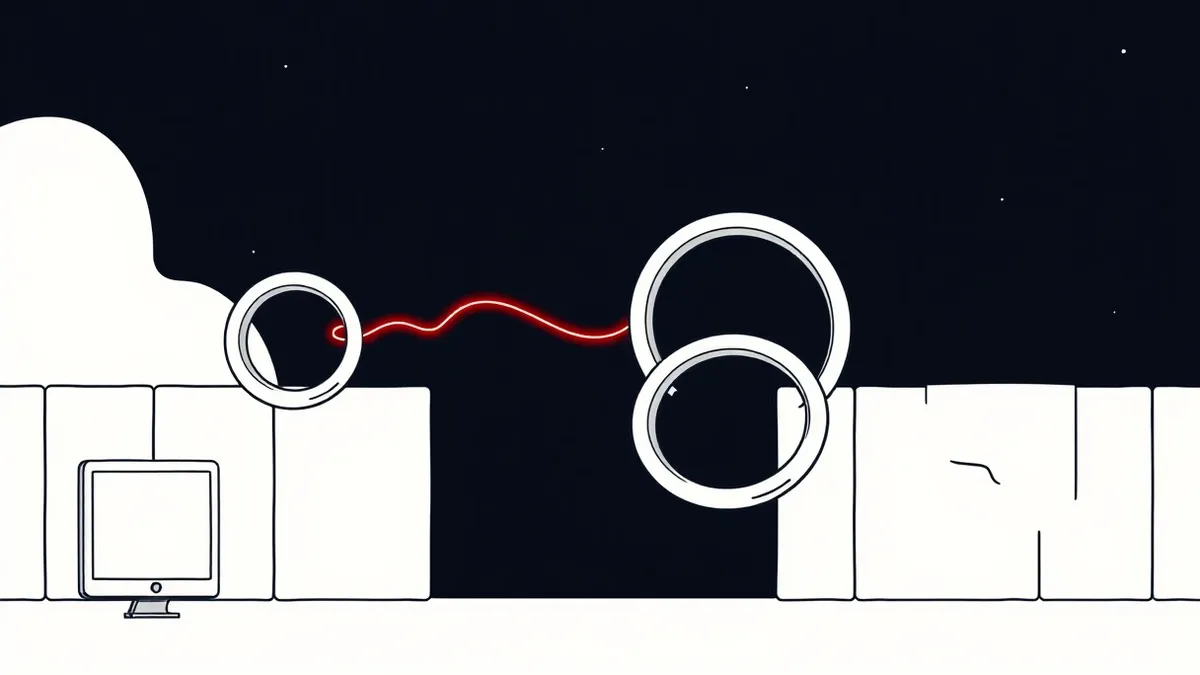
The most effective defense is architectural. You must break the logical flow. This means enforcing the principle of least privilege everywhere. It means segmenting networks so that lateral movement is impossible. It means monitoring for abnormal privilege changes. You must detect the transition from user to admin. This detection is vital. It catches the chain in progress. You also need to monitor for data exfiltration. This often happens in the final stage. Catching the output is as important as catching the entry.
The Role of Secure Development
You must stop flaws before they reach production. This involves secure coding practices. You must avoid out-of-bounds write vulnerabilities and other memory errors. Code reviews should look for logic errors that enable chaining. This includes checking for proper input validation. It includes verifying that permissions are checked at every step. This proactive approach reduces the pool of available building blocks. It makes chaining harder. It forces attackers to find more complex, rarer flaws.
Integrating with Existing Frameworks
This approach complements existing frameworks. It adds depth to your security posture. You must integrate chain analysis into your risk assessments. You must update your vulnerability management programs to consider chaining potential. This means prioritizing patches based on connectivity, not just severity. It means looking at the big picture. You must understand that security is a system. Weaknesses in one part affect the whole. You must defend the system, not just the parts.
Conclusion of Mechanics
Vulnerability chaining is a methodical process. It relies on connecting dots. You must connect your own dots to defend. Map your assets. Map your flaws. Map the paths between them. Break those paths. Limit permissions. Isolate systems. Monitor for movement. This comprehensive approach reduces risk. It makes your environment harder to attack. It forces attackers to start over. It raises the cost of compromise. This is the essence of modern defense. You must think like a chain builder to stop one.
Key takeaways
- Attackers treat individual flaws as discrete tools rather than isolated failures.
- Defenses must address the path between vulnerabilities, not just the endpoints.
- Segmentation and least privilege disrupt the logical flow required for chaining.
Vulnerability chaining turns minor flaws into major breaches by connecting them logically. Break these connections by enforcing strict least privilege and network segmentation.
Frequently asked questions
How do you detect vulnerability chaining in real time?
You detect chaining by monitoring for abnormal privilege escalations and lateral movement patterns. Look for a single account accessing multiple disparate systems in a short time. This behavior signals a chain in progress.
Is vulnerability chaining common in cloud environments?
Yes, cloud environments often have complex trust relationships that facilitate chaining. Misconfigured roles and permissions are frequent entry points. Attackers chain these misconfigurations to move between services and steal data.
Does zero trust prevent vulnerability chaining?
Zero trust significantly reduces chaining by requiring verification at every step. It limits lateral movement by not trusting any user or device by default. This breaks the logical flow attackers rely on to move deeper.
How do you prioritize patching for chaining risks?
Prioritize patching flaws that serve as bridges between network segments. Focus on vulnerabilities in systems with high connectivity. A low-severity bug in a central server is riskier than a high-severity bug in an isolated workstation.
How this guide was produced: written by the Sandbox Gazette editorial team with AI assistance, checked against the public references listed below, and reviewed when the facts change. See our editorial policy or report an error.