
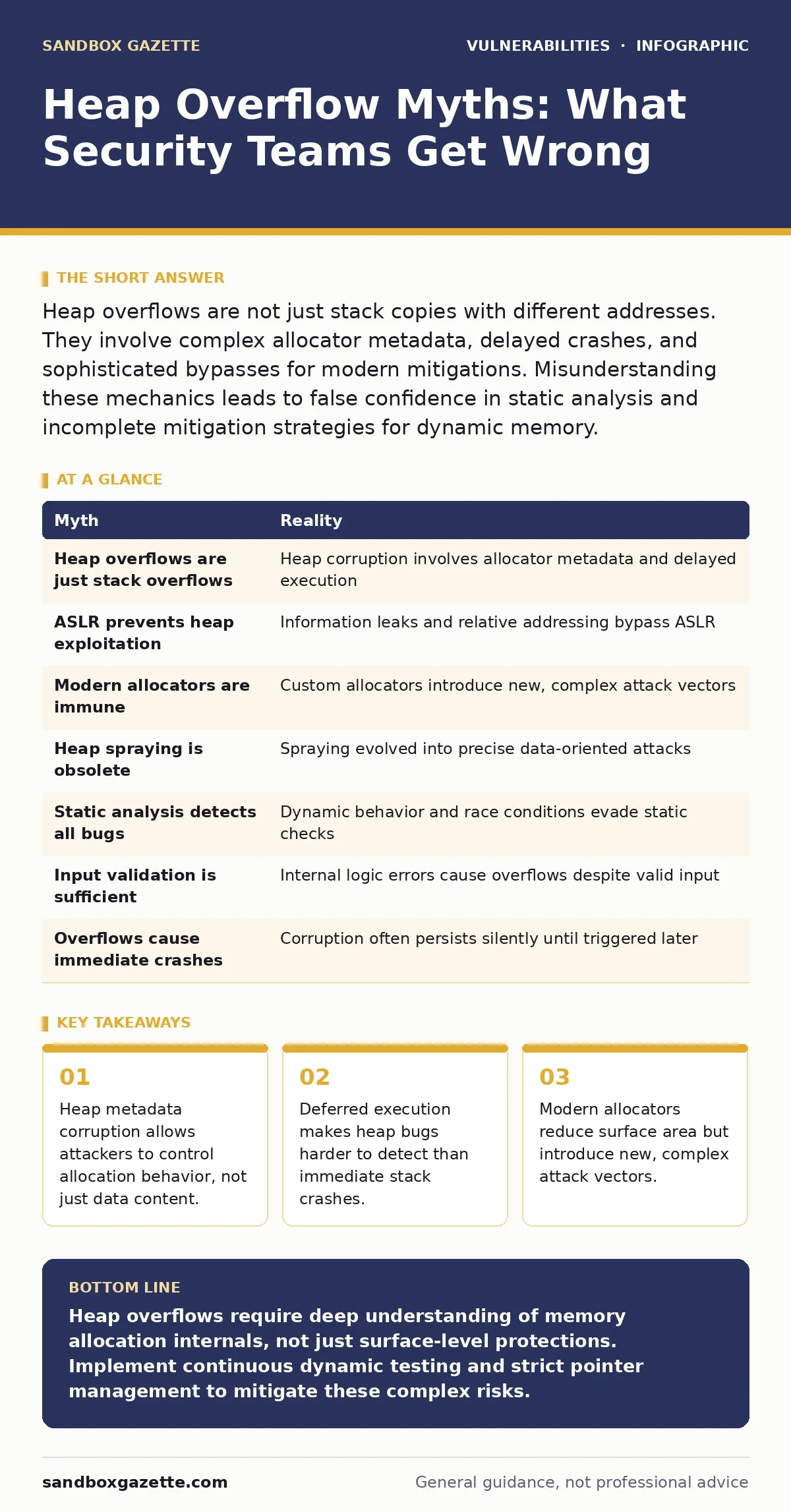
Heap overflows are not just stack copies with different addresses. They involve complex allocator metadata, delayed crashes, and sophisticated bypasses for modern mitigations. Misunderstanding these mechanics leads to false confidence in static analysis and incomplete mitigation strategies for dynamic memory.
Myth: Heap overflows are just stack overflows in a different memory region
Reality: The mechanics of heap corruption differ fundamentally from stack-based attacks because the heap is managed by an allocator, not the call stack. Stack overflows overwrite return addresses directly. Heap overflows require manipulating allocator metadata to redirect control flow. The heap grows dynamically. The stack grows and shrinks with function calls. Treating them as identical leads to ineffective defense strategies. You must understand the allocator’s internal state to secure the heap.
Myth: Address Space Layout Randomization (ASLR) prevents heap exploitation
Reality: ASLR randomizes memory locations, but it does not eliminate information leaks or relative addressing. Attackers can leak pointers from the heap to calculate base addresses. Once a base is known, ASLR provides no protection. Heap structures often contain pointers to other heap objects. These relative references remain valid even after randomization. You can bypass ASLR by exploiting allocator linearity. Randomization shifts the target, it does not hide it completely.
Myth: Modern allocators like jemalloc or tcmalloc are immune to corruption
Reality: Custom allocators reduce some attack surfaces, but they introduce new complexity and potential bugs. Standard libc allocators have well-known vulnerability patterns. Custom allocators have undocumented or less-tested behaviors. Attackers adapt to the specific allocator used by the target. A vulnerability in one allocator may not exist in another, but a new one likely does. You cannot assume safety based on the choice of library. The complexity of free-list management always presents risks.
Myth: Heap spraying is obsolete due to modern memory protections
Reality: Heap spraying evolved rather than disappeared. Early spraying relied on predictable memory layouts. Modern techniques use data-oriented programming and precise allocation control. Attackers do not need to fill the heap with shellcode. They can place specific data patterns to corrupt structures or bypass checks. The goal shifted from execution to state manipulation. You must defend against data corruption, not just code injection. Spraying remains viable when combined with information leaks.
Myth: Static analysis tools reliably detect all heap overflow vulnerabilities
Reality: Static analysis struggles with dynamic memory behavior. It cannot track runtime allocation sizes or free-list states accurately. Heap bugs often depend on specific sequences of allocations and frees. These sequences are difficult to model statically. False negatives are common. You must combine static analysis with dynamic testing. Fuzzing reveals edge cases that static tools miss. Relying solely on static scans leaves critical vulnerabilities undetected in complex codebases.
See also: Spotting Hidden Vulnerabilities in Industrial Control Systems · Application Threat Modeling: Mechanism, Limits, and Hidden Costs
Myth: Input validation alone prevents heap overflow exploits
Reality: Input validation checks data boundaries, but it does not validate internal logic errors. A heap overflow can occur from correctly sized inputs if the application mismanages memory internally. Buffer sizes may change based on complex logic paths. Validation at the entry point does not protect against internal state corruption. You need robust memory management practices throughout the application. Input validation is a necessary layer, but it is not sufficient. Internal checks must verify memory operations continuously.
See also: input validation
Myth: Heap overflows always cause immediate application crashes
Reality: Heap corruption often goes undetected until much later. The allocator may not notice metadata corruption immediately. The application continues running with corrupted state. An attacker can trigger the crash or code execution at a convenient time. This delay makes debugging and detection difficult. You might see a crash unrelated to the original overflow. The root cause is hidden in the heap state. Monitoring for anomalous memory behavior is more effective than waiting for crashes.
Myth: Freeing memory immediately after use eliminates heap vulnerabilities
Reality: Immediate freeing reduces the window of opportunity, but it does not prevent use-after-free or double-free bugs. If pointers to freed memory are not nullified, they remain accessible. Attackers can reallocate the freed block and control its content. The timing of the free matters less than the handling of the pointer. You must nullify pointers after freeing. You must also ensure no other threads access the memory. Immediate freeing is a habit, not a security control.
| Myth | Reality |
|---|---|
| Heap overflows are just stack overflows | Heap corruption involves allocator metadata and delayed execution |
| ASLR prevents heap exploitation | Information leaks and relative addressing bypass ASLR |
| Modern allocators are immune | Custom allocators introduce new, complex attack vectors |
| Heap spraying is obsolete | Spraying evolved into precise data-oriented attacks |
| Static analysis detects all bugs | Dynamic behavior and race conditions evade static checks |
| Input validation is sufficient | Internal logic errors cause overflows despite valid input |
| Overflows cause immediate crashes | Corruption often persists silently until triggered later |
| Immediate freeing prevents bugs | Use-after-free persists if pointers are not nullified |
See also: out-of-bounds write vulnerabilities
Key takeaways
- Heap metadata corruption allows attackers to control allocation behavior, not just data content.
- Deferred execution makes heap bugs harder to detect than immediate stack crashes.
- Modern allocators reduce surface area but introduce new, complex attack vectors.
Heap overflows require deep understanding of memory allocation internals, not just surface-level protections. Implement continuous dynamic testing and strict pointer management to mitigate these complex risks.
Frequently asked questions
How do heap overflows differ from buffer overflows?
Buffer overflow is a general term for writing beyond allocated space. Heap overflow specifically refers to this happening in the heap, which involves allocator metadata and dynamic sizing, making exploitation more complex than fixed-size buffer overflows.
Can static code analysis find heap bugs?
Static analysis can find simple bounds errors, but it struggles with complex heap state changes, race conditions, and allocator-specific behaviors. It should be supplemented with dynamic testing like fuzzing to catch runtime-only vulnerabilities.
What is the role of heap metadata in exploits?
Heap metadata tracks allocation size and status. Corrupting this metadata allows attackers to control how the allocator merges or splits blocks, enabling them to place data at arbitrary memory locations or overwrite critical pointers.
Why are use-after-free bugs dangerous on the heap?
Use-after-free allows an attacker to reallocate freed memory and control its content. When the application uses the stale pointer, it interacts with attacker-controlled data, often leading to arbitrary code execution or privilege escalation.
How this guide was produced: written by the Sandbox Gazette editorial team with AI assistance, checked against the public references listed below, and reviewed when the facts change. See our editorial policy or report an error.