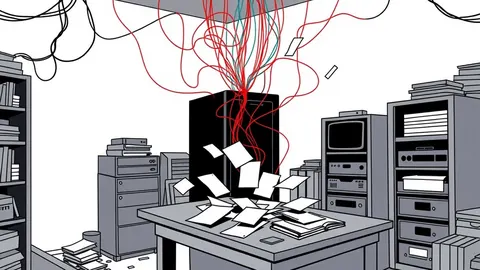
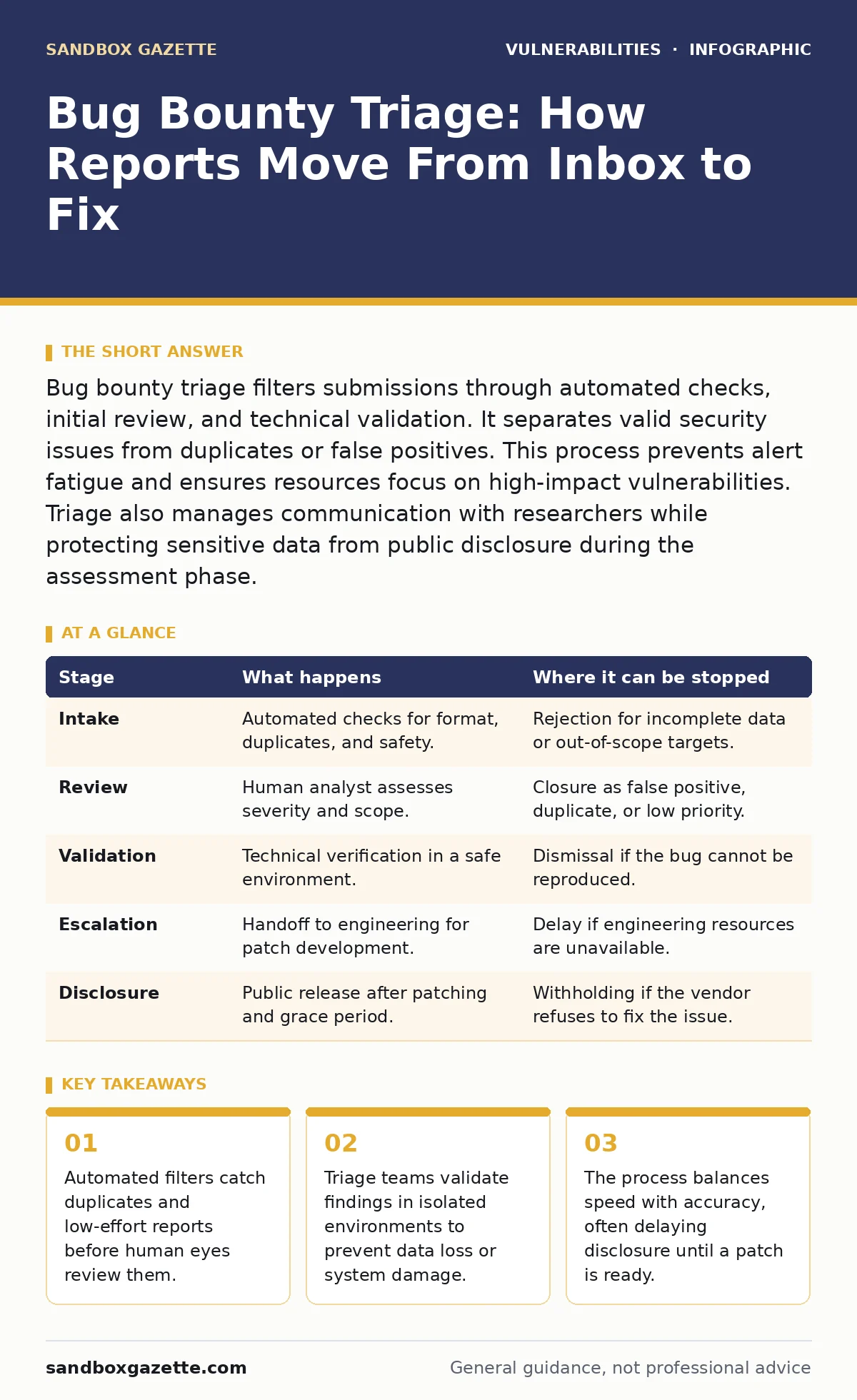
Bug bounty triage filters submissions through automated checks, initial review, and technical validation. It separates valid security issues from duplicates or false positives. This process prevents alert fatigue and ensures resources focus on high-impact vulnerabilities. Triage also manages communication with researchers while protecting sensitive data from public disclosure during the assessment phase.
The Intake Filter
Bug bounty triage begins the moment a researcher submits a report. The system immediately checks for completeness and format compliance. Incomplete reports lack necessary reproduction steps or proof of concept data. The platform rejects these submissions automatically. This step saves human reviewers from reading fragmented text.
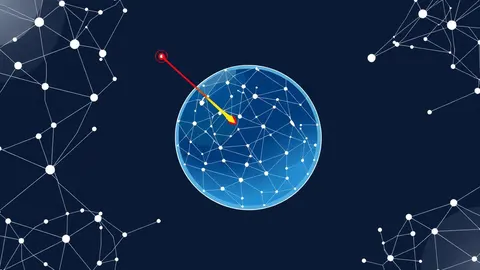
The filter also scans for known duplicates. Many researchers discover the same issue simultaneously. The system matches keywords and URLs against existing open tickets. If a match exists, the new report merges into the original. This prevents redundant work and keeps the queue manageable.
Automated scanners run basic syntax checks. They verify that links are accessible and that attachments are safe to download. Malicious attachments get quarantined. The system flags reports that contain sensitive data in the public description. Researchers often paste database entries or user credentials by mistake. The triage system redacts or blocks these posts to prevent accidental exposure.
Initial Human Review
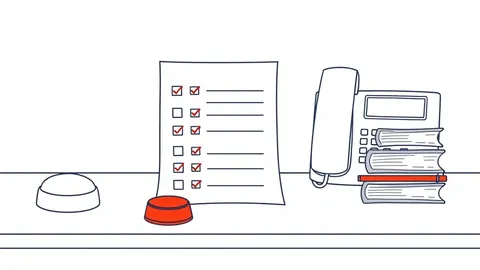
A triage analyst reviews reports that pass the automated filters. This person assesses the severity and category of the claim. They determine if the issue falls within the program scope. Out-of-scope items, such as social engineering or physical security, get closed immediately. The analyst checks if the vulnerability is a known limitation or an accepted risk.
The reviewer looks for clarity in the reproduction steps. Vague descriptions require follow-up questions. The analyst contacts the researcher for more details. This back-and-forth can delay validation significantly. Clear, concise reports move faster. The analyst also checks for impact. A low-impact issue, like a minor cosmetic glitch, gets deprioritized. High-impact issues, such as remote code execution, jump to the front of the queue.
This stage introduces human bias. Analysts may misinterpret complex logic flaws. They might label a valid issue as a false positive due to lack of context. Conversely, they might overstate the severity of a minor bug. Consistency requires strict adherence to a scoring framework. The team uses standardized criteria to rate impact and likelihood.
| Stage | What happens | Where it can be stopped |
|---|---|---|
| Intake | Automated checks for format, duplicates, and safety. | Rejection for incomplete data or out-of-scope targets. |
| Review | Human analyst assesses severity and scope. | Closure as false positive, duplicate, or low priority. |
| Validation | Technical verification in a safe environment. | Dismissal if the bug cannot be reproduced. |
| Escalation | Handoff to engineering for patch development. | Delay if engineering resources are unavailable. |
| Disclosure | Public release after patching and grace period. | Withholding if the vendor refuses to fix the issue. |
Technical Validation
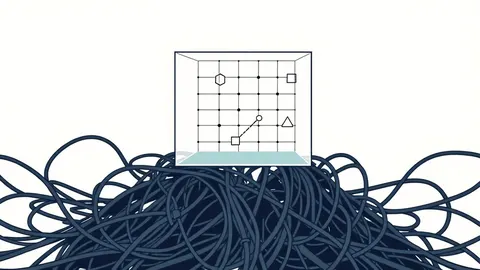
The analyst attempts to reproduce the vulnerability in a controlled environment. This is the most critical step. They never test on production systems. Testing live databases can corrupt data or disrupt services. The team uses staging environments that mirror production. These environments contain sanitized data.
Reproduction confirms the bug exists. It also reveals the true scope. A reported input validation flaw might only affect one endpoint. Or it might impact the entire application. The analyst maps the attack path. They document exactly how an attacker could exploit the issue. This documentation helps engineers understand the fix required.
If the analyst cannot reproduce the issue, they mark it as invalid. This often happens with race conditions or environment-specific bugs. The researcher may need to provide more specific timing or configuration details. Validation prevents wasted engineering time. Fixing a bug that does not exist is costly. It also builds trust with the researcher community.
Engineering Handoff
Once validated, the report moves to the engineering team. The triage analyst translates the security finding into technical requirements. Engineers need clear steps to replicate the issue. They also need to understand the business impact. The analyst provides context about the affected users and data.
The engineering team assesses the fix complexity. Some vulnerabilities require simple code changes. Others need architectural redesigns. The team estimates the time required to patch the issue. They prioritize based on severity and business risk. Critical issues get immediate attention. Lower severity issues enter the regular development backlog.
This handoff often causes delays. Engineers are busy with feature development. Security patches compete for resources. The triage team monitors progress. They ensure the fix addresses the root cause. A superficial patch might leave the system vulnerable to similar attacks. The analyst reviews the proposed fix for effectiveness.
Coordinated Disclosure
After the patch is deployed, the triage team manages disclosure. Coordinated vulnerability disclosure ensures that the public learns about the bug only after it is fixed. This prevents attackers from exploiting the known weakness. The vendor notifies the researcher that the patch is live.
The researcher and vendor agree on a disclosure timeline. A grace period allows users to update their systems. This period varies by severity. Critical bugs might have a short window. Low-severity issues might wait months. The triage team tracks this timeline. They ensure no one discloses the details prematurely.
When the window closes, the report becomes public. The vendor may assign a CVE identifier. This standardizes tracking across the industry. The researcher receives credit and any promised reward. The public disclosure helps other organizations patch similar systems. It also deters future attackers by showing the vendor’s responsiveness.
See also: Build an Incident Response Plan for Small Business Teams · AI in Security Ops: 7 Common Mistakes and Fixes
Limits and Challenges
Bug bounty triage has inherent limits. It relies on human judgment. Analysts make mistakes. They might miss subtle bugs or misclassify severity. The process is slow. Validation takes time. Engineering fixes take longer. Attackers do not wait for this process. They exploit zero-day vulnerabilities before any report is filed.
The system also suffers from noise. Many reports are low-quality or duplicate. This consumes analyst time. It slows down the processing of valid bugs. Researchers may become frustrated with delays. They might turn to private brokers or full disclosure. This undermines the program’s effectiveness.
Triage cannot find all bugs. It only processes what is submitted. Researchers may not test all endpoints. They may not understand the business logic. Some vulnerabilities require deep knowledge of the system. These hidden flaws remain undiscovered until an attacker finds them.
The Hidden Cost of Validation
Validation requires isolated environments. Maintaining these environments is expensive. They must mirror production closely. This requires significant infrastructure and engineering effort. Many organizations skip this step. They test on production or use outdated staging copies. This leads to inaccurate validation.
Testing on production risks data loss. It can crash services. Organizations that avoid isolated testing face a trade-off. They speed up validation but increase risk. They might validate a bug that only appears in production. Or they might miss a bug that only appears in staging. Neither outcome is ideal.
The cost also includes analyst burnout. Triage is repetitive and stressful. Analysts face high volumes of reports. They must maintain focus and accuracy. High turnover disrupts the process. Knowledge leaves with the staff. New analysts take time to learn the systems. This slows down the entire pipeline.
Improving the Pipeline
Organizations can improve triage efficiency. They can automate more checks. Machine learning models can predict severity. They can flag duplicates more accurately. This reduces human workload. It allows analysts to focus on complex issues.
Better communication helps. Clear guidelines for researchers reduce incomplete reports. Templates ensure all necessary details are provided. Regular feedback helps researchers improve their skills. This creates a virtuous cycle. Better reports lead to faster validation. Faster validation leads to quicker fixes.
Integration with patch management systems is key. The triage team should track the fix lifecycle. They should know when a patch is developed, tested, and deployed. This visibility prevents delays. It ensures coordinated disclosure happens on time. It also helps prioritize future testing efforts.
Key takeaways
- Automated filters catch duplicates and low-effort reports before human eyes review them.
- Triage teams validate findings in isolated environments to prevent data loss or system damage.
- The process balances speed with accuracy, often delaying disclosure until a patch is ready.
Frequently asked questions
How long does bug bounty triage take?
Triage time varies by complexity. Simple bugs might be validated in days. Complex issues can take weeks or months. The engineering fix often takes longer than the triage itself.
Can researchers see the validation status?
Most platforms provide status updates. Researchers can see if their report is under review, validated, or rejected. They cannot see internal engineering discussions or patch details.
What happens if a vendor ignores a report?
Researchers may escalate through the platform. Some programs have dispute resolution processes. If the vendor refuses to fix a critical bug, the researcher might disclose it publicly after a long grace period.
Is bug bounty better than internal testing?
Bug bounties find unique, edge-case vulnerabilities. Internal testing ensures consistent coverage. Both are necessary. Bounties supplement internal efforts but do not replace them.
How this guide was produced: written by the Sandbox Gazette editorial team with AI assistance, checked against the public references listed below, and reviewed when the facts change. See our editorial policy or report an error.