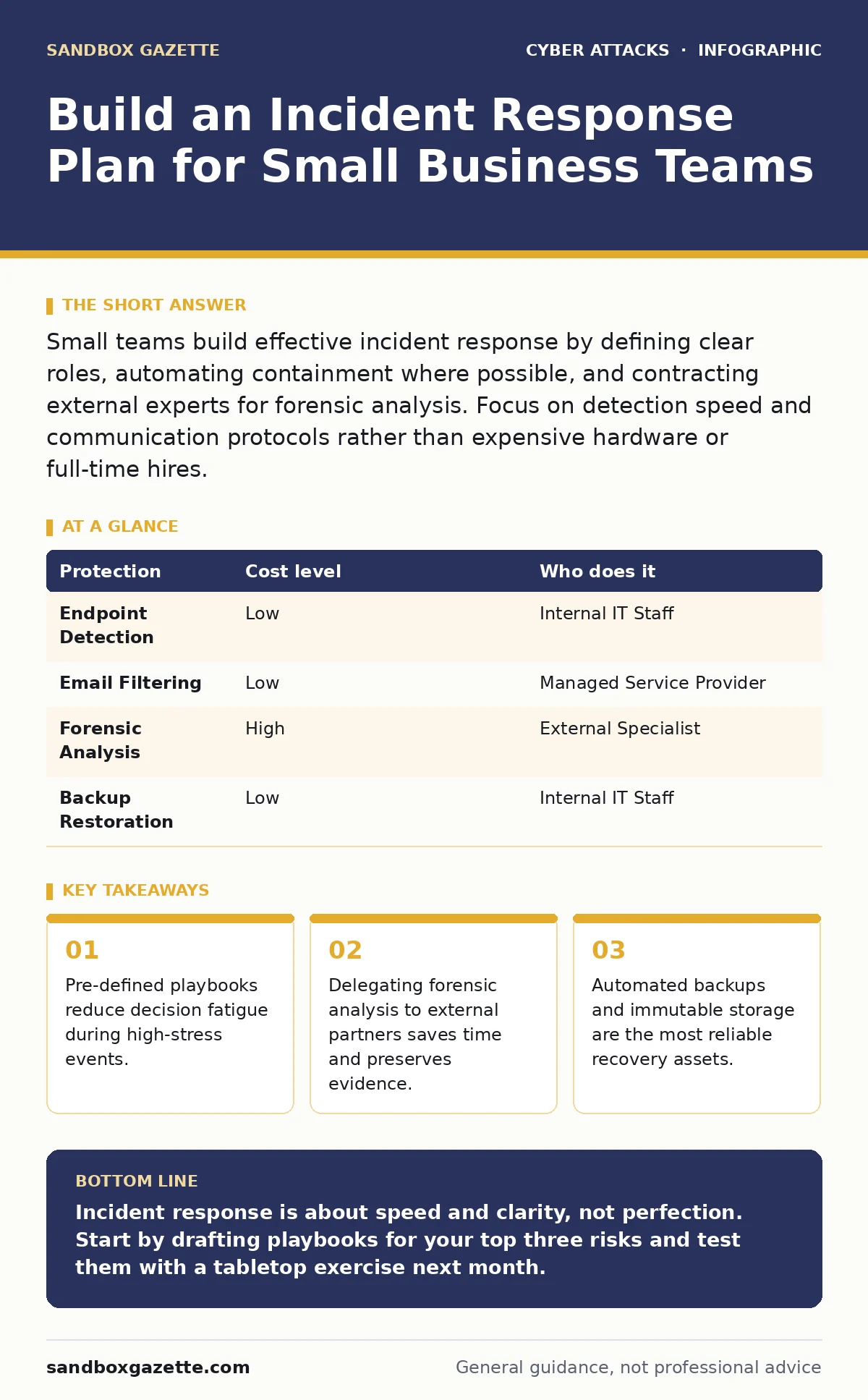
Small teams build effective incident response by defining clear roles, automating containment where possible, and contracting external experts for forensic analysis. Focus on detection speed and communication protocols rather than expensive hardware or full-time hires.
The Hidden Cost of Silence
Many small organizations assume that because they are small, they are invisible. This is a dangerous misconception. Threat actors often target smaller entities precisely because defenses are weaker and resources are limited to absorb the shock. When an incident occurs, the immediate cost is not just the lost data. It is the operational paralysis that follows.
Without a plan, every team member waits for permission to act. This delay allows malware to spread or attackers to exfiltrate more data. You must treat incident response as a operational necessity, not a security luxury. The goal is not to prevent every attack, which is impossible. The goal is to limit the damage and return to normal operations quickly.
Defining the Response Scope
You do not need a complex framework to start. You need to know what constitutes an incident for your specific environment. Is it a single lost laptop? A suspicious email that was opened? A server that stops responding? Define these triggers clearly.
Create a simple matrix of events and responses. For example, if a device is lost, the response is to wipe it remotely. If an email appears to be from your CEO asking for gift cards, the response is to verify the request via a secondary channel. This relates directly to how you handle business email compromise, where the attacker impersonates authority to bypass normal checks. By defining the scope, you remove ambiguity. Ambiguity causes hesitation. Hesitation costs money.
Building Affordable Playbooks
A playbook is a step-by-step list of actions for specific scenarios. You do not need to hire a consultant to write these. You can draft them using public frameworks like NIST or MITRE ATT&CK. These frameworks provide standardized language and steps that are free to use.
Start with the three most likely scenarios: ransomware, data leak, and account compromise. For ransomware, the playbook should prioritize disconnecting affected systems and verifying backup integrity. For account compromise, the focus is on resetting credentials and checking for persistent access methods. This process helps you prepare for account takeover attempts, where an attacker gains control of a user’s identity to move laterally through your network. Keep the steps simple. If a junior technician cannot follow them, they are too complex.
| Protection | Cost level | Who does it |
|---|---|---|
| Endpoint Detection | Low | Internal IT Staff |
| Email Filtering | Low | Managed Service Provider |
| Forensic Analysis | High | External Specialist |
| Backup Restoration | Low | Internal IT Staff |
What to Delegate Effectively
You cannot do everything internally, nor should you try. The key is to delegate tasks that require specialized tools or legal expertise. Your internal team should handle detection, initial containment, and communication. They are the eyes on the ground.
Delegate forensic analysis to a third-party partner. When you investigate a breach yourself, you risk altering the evidence or missing subtle indicators. An external firm has the tools to analyze memory dumps and network logs without impacting your production environment. They can also handle legal notification requirements if a data breach has occurred. This separation of duties ensures that your internal team remains focused on keeping the business running. It also protects you from conflicts of interest if the incident involves internal misuse.
Consider delegating your email security configuration as well. Misconfigured DKIM records can lead to email delivery failures or spoofing vulnerabilities. A managed provider can monitor these settings and adjust them as needed. This allows you to focus on your core business while experts handle the technical nuances of email authentication.
Automating the First Mile
Human reaction time is slow. Machine reaction time is instant. You should automate the first steps of your response whenever possible. This is known as security orchestration. For example, if an endpoint detects malware, the system should automatically isolate the device from the network.
This isolation prevents the malware from spreading to other systems. It buys you time to assess the situation. You can also automate credential resets for compromised accounts. If a password is found in a public breach, the system should force a reset immediately. This reduces the window of opportunity for attackers. Automation does not replace human judgment. It handles the repetitive, high-volume tasks that humans are prone to miss or delay.
See also: How to Implement SOAR: A Step-by-Step Guide for Automation · Warning Signs of Advanced Persistent Threats: What to Spot First
Training for Reality
Your people are your first line of defense, but traditional training often fails. Lectures on theory do not prepare staff for the stress of a real incident. Instead, use tabletop exercises. These are simulated scenarios where the team walks through their playbook without actual systems being at risk.
Start with a simple scenario, such as a phishing email. Ask the team: Who do you notify? What information do you collect? How do you verify the sender? Discuss the outcomes of social engineering attempts, where attackers manipulate people into breaking security protocols. These exercises reveal gaps in communication and decision-making. They also build muscle memory. When a real incident occurs, the team will know their roles and act decisively.
Maintaining the Plan
An incident response plan is not a document you write once and file away. It is a living process that must evolve. Technology changes, threats change, and your business changes. Review your plan every six months. Update it whenever you add new systems, hire new staff, or change vendors.
Check that your contact lists are current. If your primary IT provider changes, update your delegation agreements. Ensure that your backups are tested and that your external partners are aware of your procedures. Consistency is key. A plan that is ignored becomes a liability. A plan that is practiced becomes an asset.
Key takeaways
- Pre-defined playbooks reduce decision fatigue during high-stress events.
- Delegating forensic analysis to external partners saves time and preserves evidence.
- Automated backups and immutable storage are the most reliable recovery assets.
Incident response is about speed and clarity, not perfection. Start by drafting playbooks for your top three risks and test them with a tabletop exercise next month.
Frequently asked questions
Do we need a dedicated incident response team?
No. Small teams can handle initial detection and containment. Delegate complex forensics and legal issues to external partners to save costs and ensure quality.
How often should we test our plan?
At least twice a year. More frequent testing is better if you experience significant changes in your IT environment or staff.
What is the first step during an incident?
Contain the threat. Isolate affected systems to prevent spread. Do not shut them down immediately, as this may destroy volatile evidence needed for analysis.
Who pays for external forensic help?
You. This is a business expense. Consider cyber insurance, which may cover some costs, but ensure you have a pre-vetted vendor list before an incident occurs.
How this guide was produced: written by the Sandbox Gazette editorial team with AI assistance, checked against the public references listed below, and reviewed when the facts change. See our editorial policy or report an error.