
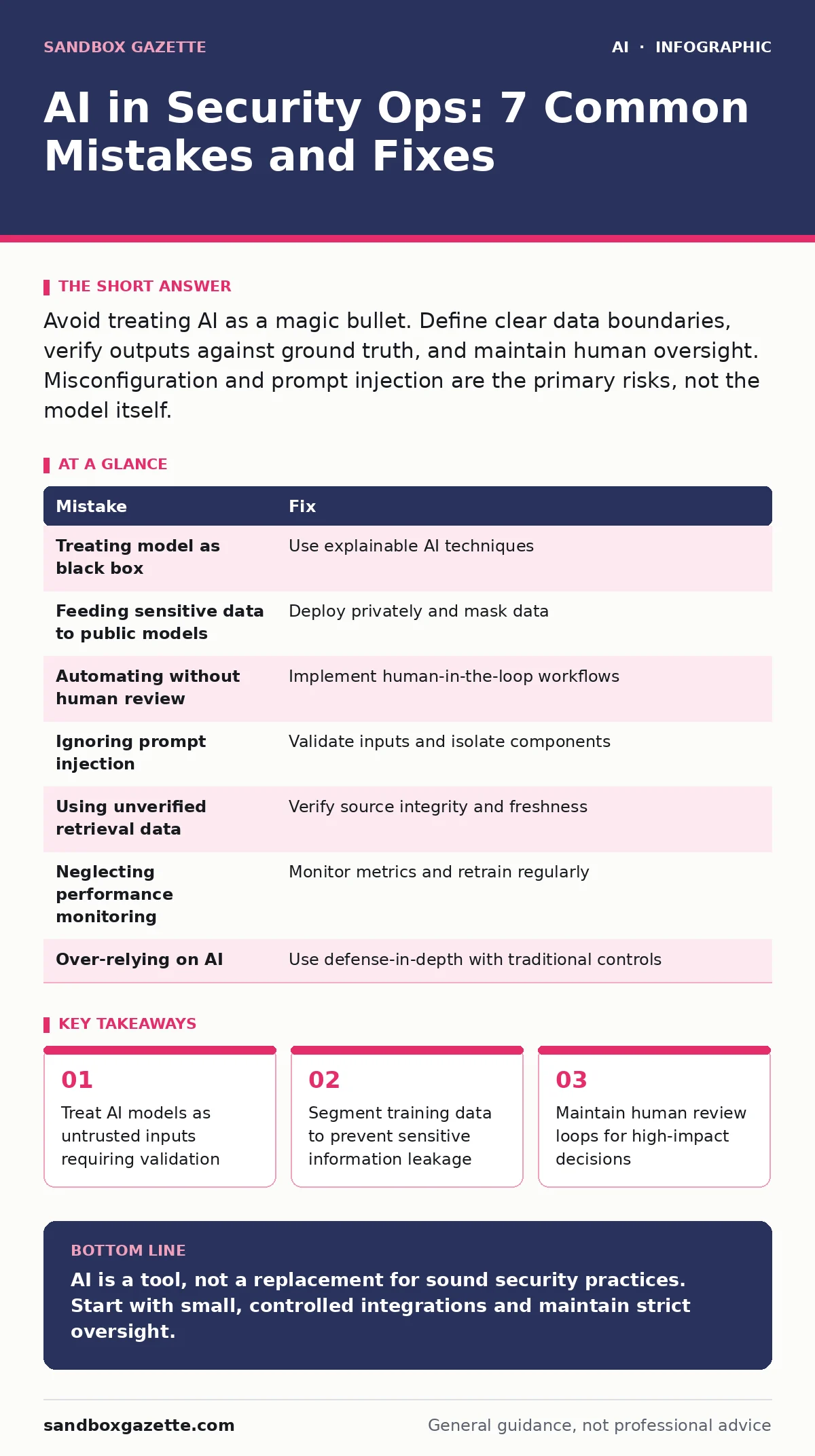
Avoid treating AI as a magic bullet. Define clear data boundaries, verify outputs against ground truth, and maintain human oversight. Misconfiguration and prompt injection are the primary risks, not the model itself.
Mistake 1: Treating the model as a black box
Integrating an AI model without understanding its decision-making process creates a blind spot in your security operations. You cannot defend against what you cannot explain. When a model flags an anomaly, you need to know which features triggered that classification.
Why it hurts:
Opaque decisions lead to false confidence. If the model relies on correlated noise rather than causal indicators, it will fail when the noise disappears. This is known as model drift. You may also violate compliance requirements that demand explainability for automated decisions. Refer to our guide on AI transparency for methods to interpret model weights.
The fix:
Require explainable AI techniques for any model influencing security outcomes. Use feature attribution methods to highlight which inputs drove a specific prediction. Document the logic so analysts can verify the reasoning. If the model cannot explain its output, do not automate the response.
Mistake 2: Feeding sensitive data into public models
Sending internal logs, customer data, or proprietary code to a public large language model for analysis exposes that data to potential leakage. The model may memorize and regurgitate this information in future interactions. This is a significant data loss risk.
Why it hurts:
You lose control over your data once it leaves your environment. The provider may use your data to improve their general models, making it available to other customers. This violates most data protection regulations and internal security policies. See our article on insecure AI plugins and agents for more on data exfiltration vectors.
The fix:
Deploy models on-premises or in a private cloud environment where you control the data lifecycle. Use data masking techniques to remove personally identifiable information before analysis. Establish strict data governance policies that prohibit sending sensitive data to public APIs. Regularly audit data flows to ensure compliance.
Mistake 3: Automating responses without human review
Connecting an AI model directly to action tools, such as blocking IPs or terminating accounts, without a human in the loop creates a high-risk feedback loop. The model may make mistakes that cascade across your infrastructure.
Why it hurts:
False positives can disrupt business operations and lock out legitimate users. If the model is attacked via prompt injection, it may perform malicious actions on your behalf. You lose the ability to nuance decisions based on context that the model cannot perceive. Read about LLM guardrails to understand how to constrain model behavior.
The fix:
Implement a human-in-the-loop workflow for all high-impact actions. The AI should recommend actions, but a human analyst must approve them. Start with low-risk actions, such as generating a summary, before moving to automated responses. Gradually increase automation as confidence in the model grows.
Mistake 4: Ignoring prompt injection attacks
Assuming that AI models are immune to manipulation is a critical error. Attackers can craft inputs that trick the model into ignoring its safety instructions or revealing hidden data. This is known as prompt injection.
Why it hurts:
An attacker can force the model to bypass security filters, execute arbitrary commands, or exfiltrate data. This can compromise the entire application layer that relies on the AI. It turns the AI into an attack vector rather than a defense mechanism. Review the OWASP Top 10 for LLM applications to understand these specific threats.
The fix:
Treat all inputs to the AI as untrusted. Use input validation and sanitization before passing data to the model. Implement output filtering to catch unexpected or malicious responses. Isolate the AI component from critical systems using least-privilege access controls.
Mistake 5: Using unverified retrieval data
Retrieval-augmented generation retrieves external documents to inform the AI's response. If the retrieved data is outdated, incorrect, or malicious, the AI will generate false information. This is known as hallucination.
Why it hurts:
Analysts may act on incorrect information, leading to wasted effort or missed threats. If an attacker can inject malicious documents into the retrieval source, they can poison the AI's responses. This undermines trust in the entire system. Check our guide on retrieval-augmented generation security for best practices.
The fix:
Verify the source and integrity of all retrieved documents. Use checksums or digital signatures to ensure data has not been tampered with. Implement freshness checks to discard outdated information. Cross-reference AI-generated insights with other data sources before taking action.
See also: Access Controls for AI Agents: A Practical Implementation Checklist
Mistake 6: Neglecting model performance monitoring
Deploying a model and forgetting about it leads to degradation over time. Data distributions change, and new attack techniques emerge. The model's accuracy will drop if it is not regularly retrained and validated.
Why it hurts:
Silent failures go undetected until a major incident occurs. The model may become biased toward new types of noise, ignoring real threats. This creates a false sense of security. Refer to AI risk management frameworks for continuous monitoring strategies.
The fix:
Establish continuous monitoring pipelines that track model performance metrics. Set alerts for significant drops in accuracy or precision. Regularly retrain the model with new data to keep it current. Conduct periodic adversarial testing to identify weaknesses.
Mistake 7: Over-relying on AI for threat detection
Using AI as the sole method for detecting threats ignores the value of traditional rule-based systems and human intuition. AI is good at finding patterns, but it struggles with novel attacks.
Why it hurts:
Novel attacks that do not match historical patterns will be missed. This creates a gap in your defense coverage. You also become dependent on the AI vendor, which can be a single point of failure. Explore machine learning for fraud detection to see how hybrid approaches work better.
The fix:
Use AI as one layer in a defense-in-depth strategy. Combine AI with rule-based detection, anomaly detection, and human analysis. Ensure that traditional security controls remain active and effective. Regularly test your overall security posture, not just the AI component.
| Mistake | Fix |
|---|---|
| Treating model as black box | Use explainable AI techniques |
| Feeding sensitive data to public models | Deploy privately and mask data |
| Automating without human review | Implement human-in-the-loop workflows |
| Ignoring prompt injection | Validate inputs and isolate components |
| Using unverified retrieval data | Verify source integrity and freshness |
| Neglecting performance monitoring | Monitor metrics and retrain regularly |
| Over-relying on AI | Use defense-in-depth with traditional controls |
Key takeaways
- Treat AI models as untrusted inputs requiring validation
- Segment training data to prevent sensitive information leakage
- Maintain human review loops for high-impact decisions
- Monitor for prompt injection attacks specifically
AI is a tool, not a replacement for sound security practices. Start with small, controlled integrations and maintain strict oversight.
Frequently asked questions
How do I prevent data leakage in AI models?
Use private deployments, mask sensitive data, and implement strict access controls to prevent unauthorized data exposure.
What is prompt injection?
Prompt injection is an attack where malicious inputs trick an AI model into bypassing its safety instructions or performing unintended actions.
How often should I retrain my security AI models?
Retrain models regularly, especially when new attack patterns emerge or data distributions change, to maintain accuracy and relevance.
How this guide was produced: written by the Sandbox Gazette editorial team with AI assistance, checked against the public references listed below, and reviewed when the facts change. See our editorial policy or report an error.