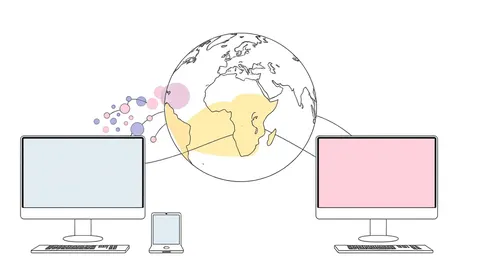
The deep web consists of web pages excluded from standard search engine indexes due to login walls, dynamic generation or lack of links. It operates on standard HTTP or specialized protocols like Tor. Analysts monitor it by scraping accessible surfaces and correlating data with internal telemetry to identify exposure before it becomes a breach.
Defining the Unindexed Surface
The term deep web refers to any part of the internet that standard search engines cannot crawl or index. This is distinct from the dark web, which is a small subset of the deep web requiring specific software to access. Search engines rely on hyperlinks to discover new pages. If a page lacks incoming links or sits behind a login prompt, the crawler skips it. This exclusion is not a security feature; it is a byproduct of how indexing algorithms function.
Most of the deep web consists of private databases, medical records, bank statements and internal corporate portals. These resources are not hidden by design but are simply inaccessible to public crawlers. Understanding this distinction prevents you from wasting resources chasing ghosts. You are not hunting for a secret layer of the internet. You are looking for your own data that has been excluded from public view.
The Mechanics of Data Exclusion
Data enters the deep web through three primary mechanisms. The first is authentication barriers. When a user must log in to view content, the page is excluded from the index. The second is dynamic content generation. Pages built on-the-fly by JavaScript or server-side scripts often do not present static HTML for crawlers to read. The third is intentional exclusion. Webmasters can use robots.txt files or meta tags to instruct crawlers to ignore specific directories.
This exclusion creates a false sense of security. Just because a page is not indexed does not mean it is secure. If an attacker obtains valid credentials, they can access the same content as any authorized user. The barrier is administrative, not cryptographic. This is why access control remains the primary defense. You must assume that any authenticated page could be scraped if credentials leak.
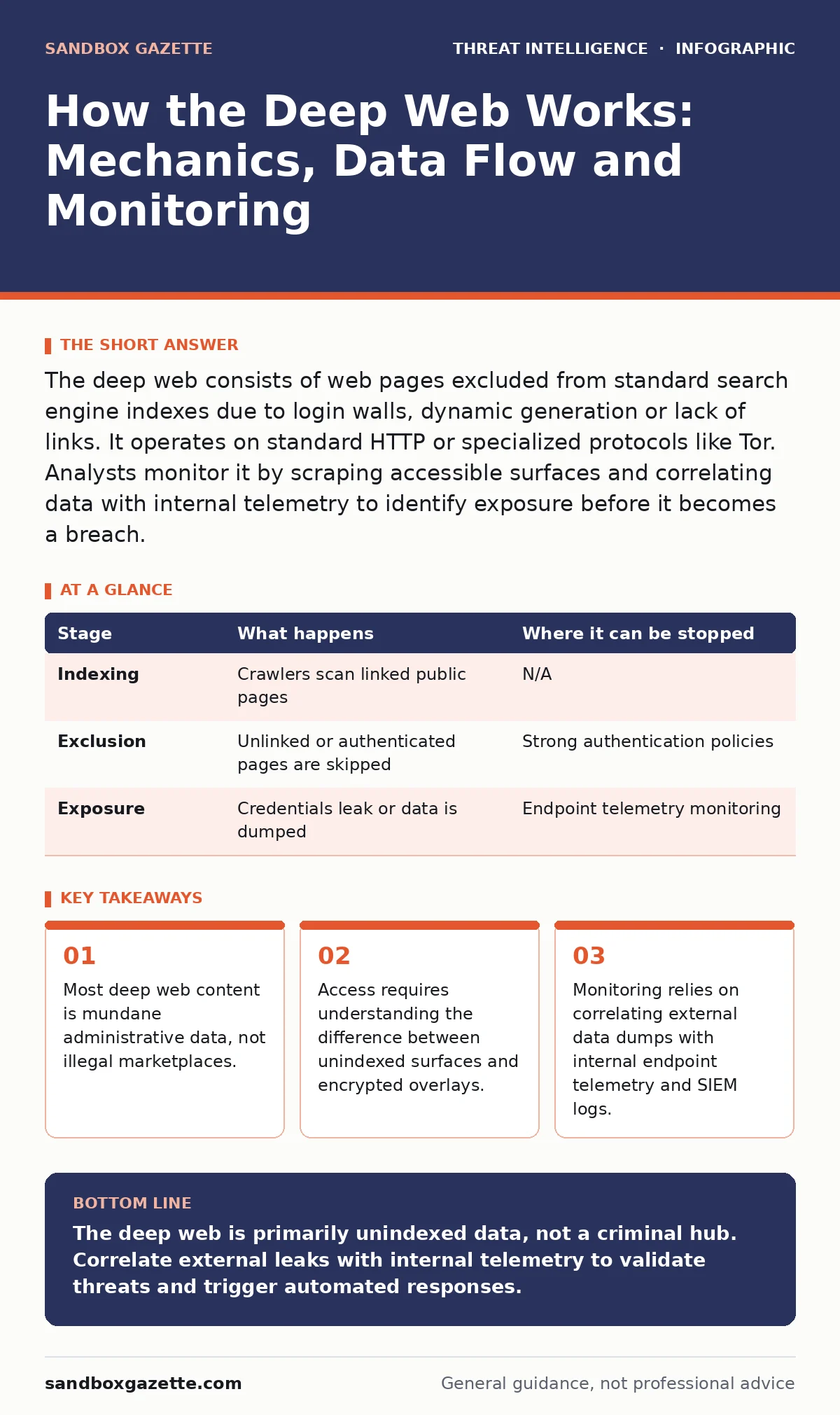
| Stage | What happens | Where it can be stopped |
|---|---|---|
| Indexing | Crawlers scan linked public pages | N/A |
| Exclusion | Unlinked or authenticated pages are skipped | Strong authentication policies |
| Exposure | Credentials leak or data is dumped | Endpoint telemetry monitoring |
Accessing the Encrypted Overlay
A small fraction of the deep web resides on encrypted overlay networks. These networks route traffic through multiple relays to obscure the user's location and identity. The most common protocol is Tor, which uses onion routing. Each relay decrypts one layer of encryption, revealing the next hop. This process adds latency but provides anonymity.
Accessing these networks requires specific client software that speaks the correct protocol. Standard browsers cannot connect to these services directly. You must configure your browser to route traffic through the overlay network. This is often done via proxies or dedicated clients. The addresses on these networks are long, random strings rather than human-readable domain names.
The Lifecycle of a Data Leak
When data leaves a protected environment, it enters the deep web through a leak. This is rarely a direct hack of a database. More often, it is the result of process injection or credential theft. An attacker gains access to a workstation, captures session tokens or extracts plaintext data from memory. This data is then uploaded to forums or pastebin-style sites.
The data sits on these platforms until it is indexed by specialized scrapers or sold on marketplaces. The deep web is not a static repository. It is a dynamic exchange of information. The value of leaked data decreases rapidly as more copies circulate. Your goal is to detect the leak before the data is widely distributed. This requires monitoring for indicators of compromise that appear on these surfaces.
Reading the Signal from Noise
Most data found on the deep web is irrelevant to your organization. Scrapers collect everything, from old password lists to generic templates. Your job is to filter this noise. You need to define what constitutes a true positive. This usually involves matching leaked data against your known assets, such as email domains, IP addresses or employee names.
Context is critical. Finding an email address on a paste site is not an emergency. Finding that same address paired with a valid password hash or internal document is. You must correlate external findings with internal logs. If you see a credential pair, check your SIEM for login attempts using those credentials. If you see a document, check your endpoint telemetry for unauthorized copy or print events.
See also: Hacktivism Risks for Small Business: Real Threats and Low-Cost Defenses · Stop Sensitive Data Leaks Through AI Chatbots: Technical Controls
Applying Intelligence to Defense
Intelligence from the deep web is useless without action. You cannot simply archive the findings. You must integrate them into your security operations. This means updating your threat detection rules. If you see a new exploit kit being discussed on a forum, update your signatures. If you see a new phishing template, block the domain.
This integration requires automation. Manual review is too slow and prone to error. You need a system that can ingest feeds, filter for relevance and trigger workflows. This is where SOAR platforms become valuable. They can automatically isolate endpoints if a leaked credential is used. They can also notify analysts of high-priority findings.
The Hidden Cost of Monitoring
Monitoring the deep web has significant costs. The first is resource intensity. Scraping and analyzing large volumes of data requires substantial compute power. The second is analyst fatigue. Reviewing thousands of false positives leads to burnout. The third is legal risk. Accessing certain areas of the deep web may violate laws in your jurisdiction.
You must balance the benefit of early warning against these costs. Focus on high-value targets. Do not try to monitor everything. Define your crown jewels and monitor for those specific indicators. This focused approach reduces noise and increases the signal-to-noise ratio. It also ensures that you are complying with legal boundaries by limiting your scope to your own data.
Correlating with Internal Telemetry
The final step is closing the loop. External intelligence must be combined with internal data. This correlation reveals the full picture of an attack. For example, if you detect a leaked credential, you check for remote desktop abuse from external IPs. If you detect a new malware sample, you check for port scanning activity from your network.
This holistic view allows you to identify advanced persistent threats that operate across multiple vectors. It also helps you distinguish between a successful breach and a failed attempt. By combining external and internal data, you build a comprehensive understanding of your risk posture. This is the core of effective threat intelligence.
Key takeaways
- Most deep web content is mundane administrative data, not illegal marketplaces.
- Access requires understanding the difference between unindexed surfaces and encrypted overlays.
- Monitoring relies on correlating external data dumps with internal endpoint telemetry and SIEM logs.
The deep web is primarily unindexed data, not a criminal hub. Correlate external leaks with internal telemetry to validate threats and trigger automated responses.
Frequently asked questions
Is the deep web the same as the dark web?
No. The deep web includes all unindexed content, such as private emails and bank portals. The dark web is a small subset that requires special software to access and is often associated with illicit activities.
How do I monitor the deep web safely?
Use specialized threat intelligence feeds that scrape and sanitize the data. Do not access these networks directly from your production environment. Ensure your monitoring tools comply with local laws regarding data access and privacy.
What is the most common type of data found on the deep web?
The most common data is mundane administrative information, including leaked credentials, internal documents and configuration files. This data is valuable to attackers for further targeting but is often overlooked by defenders.
Can I use open-source tools to monitor the deep web?
Yes, many open-source tools are available for scraping and analysis. However, they require significant configuration and maintenance. Commercial solutions often provide better filtering and integration with existing security infrastructure.
How this guide was produced: written by the Sandbox Gazette editorial team with AI assistance, checked against the public references listed below, and reviewed when the facts change. See our editorial policy or report an error.