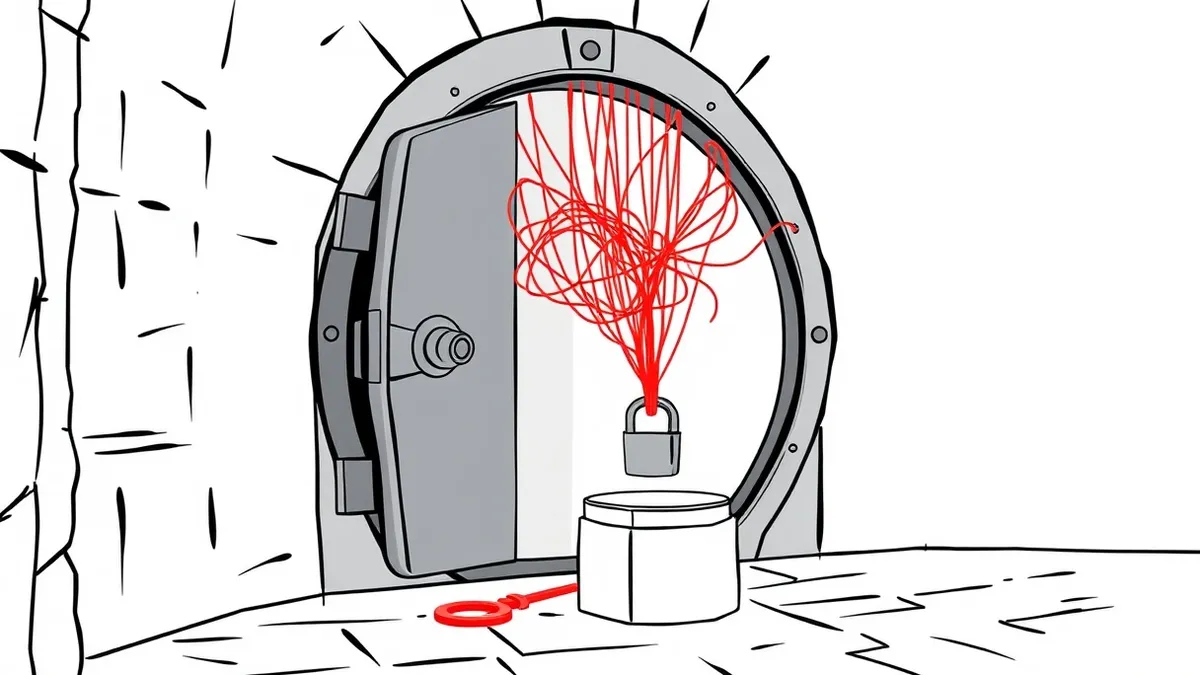
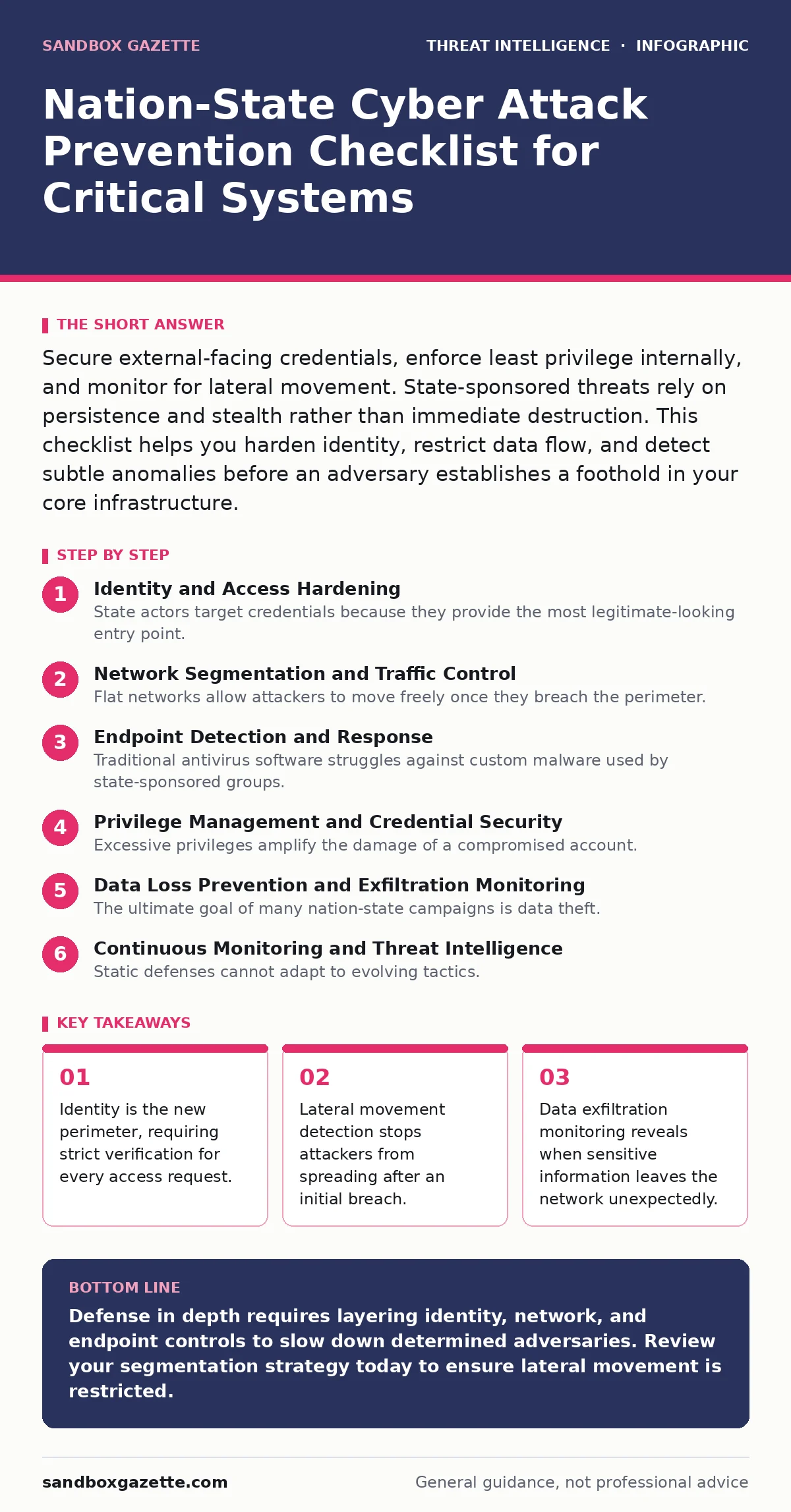
Secure external-facing credentials, enforce least privilege internally, and monitor for lateral movement. State-sponsored threats rely on persistence and stealth rather than immediate destruction. This checklist helps you harden identity, restrict data flow, and detect subtle anomalies before an adversary establishes a foothold in your core infrastructure.
Identity and Access Hardening
State actors target credentials because they provide the most legitimate-looking entry point. Compromised accounts bypass many network defenses that trust internal traffic. You must treat every login attempt as potentially hostile, regardless of the source IP address.
- Enforce multi-factor authentication on all administrative accounts: This prevents attackers from using stolen passwords alone to gain control.
- Implement conditional access policies for remote work: This restricts login attempts based on device health and location risk.
- Audit service accounts for excessive permissions: Service accounts often lack human oversight, making them ideal targets for silent abuse.
Identity mechanisms fail when they rely solely on static secrets. Rotate credentials regularly and disable unused accounts immediately. Refer to our guide on remote desktop abuse for specific hardening steps on remote access protocols.
Network Segmentation and Traffic Control
Flat networks allow attackers to move freely once they breach the perimeter. Segmentation creates barriers that limit the blast radius of a compromise. You should design your network so that compromising one segment does not grant access to critical databases or management systems.
- Segment critical assets from general user networks: This forces attackers to pivot through multiple security controls.
- Monitor east-west traffic for anomalies: Most traditional firewalls only watch north-south traffic, missing internal lateral movement.
- Restrict DNS queries to known resolvers: Attackers often use DNS tunneling to exfiltrate data or command compromised hosts.
Imagine an attacker compromises a marketing server. Without segmentation, they scan the entire internal network for vulnerable systems. With proper segmentation, they remain trapped in a low-value zone.
Endpoint Detection and Response
Traditional antivirus software struggles against custom malware used by state-sponsored groups. These actors write unique code that signature-based scanners cannot recognize. You need behavioral monitoring that identifies suspicious actions regardless of the file name or hash.
- Deploy endpoint detection and response on all servers: This records process creation, registry changes, and file modifications for later analysis.
- Enable kernel-level protection for critical processes: This prevents attackers from injecting code into trusted system services.
- Restrict script execution to approved sources: PowerShell and Python are common tools for living-off-the-land attacks.
Endpoint logs provide the context needed to reconstruct an attack. Without this data, you cannot determine how the adversary entered or what they touched.
Privilege Management and Credential Security
Excessive privileges amplify the damage of a compromised account. Attackers seek high-privilege accounts to dump credentials and move laterally. You must enforce the principle of least privilege, granting users only the access necessary for their specific tasks.
- Disable legacy authentication protocols like NTLMv1: These protocols are vulnerable to interception and relay attacks.
- Monitor for DCSync attack indicators: This specific technique allows attackers to replicate directory data without logging in normally.
- Use just-in-time privilege elevation: This grants temporary admin rights only when needed, reducing the window of opportunity.
Refer to our guide on DCSync attacks to understand how attackers harvest directory credentials.
Data Loss Prevention and Exfiltration Monitoring
The ultimate goal of many nation-state campaigns is data theft. Detecting large data transfers is often the last line of defense before sensitive information leaves your control. You must establish baselines for normal data flow to spot deviations.
- Monitor for unusual outbound data volumes: Sudden spikes in traffic may indicate bulk data exfiltration.
- Block unauthorized cloud storage uploads: Users often bypass security controls by uploading files to personal cloud accounts.
- Encrypt sensitive data at rest and in transit: Encryption renders stolen data useless without the decryption keys.
Data loss prevention tools can generate false positives if not tuned correctly. Balance security with operational efficiency to avoid disrupting legitimate business processes.
See also: Strategic Threat Intelligence Explained for Beginners · Hacktivism Risks for Small Business: Real Threats and Low-Cost Defenses
Continuous Monitoring and Threat Intelligence
Static defenses cannot adapt to evolving tactics. Continuous monitoring allows you to detect new techniques as they emerge. You should integrate external threat intelligence with internal logs to identify known indicators of compromise.
- Correlate internal logs with external threat feeds: This helps identify attacks using known tools or infrastructure.
- Automate response to high-confidence alerts: Manual triage slows down response times during active breaches.
- Conduct regular red teaming exercises: This tests your defenses against realistic attack scenarios.
Refer to our guide on red teaming for methods to validate your detection capabilities.
Incident Response Readiness
Preparation determines how quickly you can contain a breach. Having a plan reduces panic and ensures consistent actions during a crisis. You should test your response procedures regularly to identify gaps.
- Maintain an updated inventory of all assets: You cannot protect what you do not know exists.
- Define clear roles and responsibilities for response teams: Ambiguity delays critical decision-making during an incident.
- Practice communication protocols with stakeholders: Clear communication prevents misinformation and maintains trust.
Refer to our guide on advanced persistent threats for long-term containment strategies.
Key takeaways
- Identity is the new perimeter, requiring strict verification for every access request.
- Lateral movement detection stops attackers from spreading after an initial breach.
- Data exfiltration monitoring reveals when sensitive information leaves the network unexpectedly.
Defense in depth requires layering identity, network, and endpoint controls to slow down determined adversaries. Review your segmentation strategy today to ensure lateral movement is restricted.
Frequently asked questions
How do I detect a nation-state actor?
Look for slow, stealthy lateral movement and custom malware that evades signature-based detection. Monitor for unusual administrative activity.
Is multi-factor authentication enough?
No, it only protects the initial login. Attackers still need to be detected moving internally through segmentation and monitoring.
What is the biggest mistake organizations make?
Assuming the perimeter is secure and neglecting internal traffic monitoring. State actors often start from a compromised insider account.
How often should I review my checklist?
Quarterly reviews ensure your controls adapt to new threats and changes in your infrastructure.
How this guide was produced: written by the Sandbox Gazette editorial team with AI assistance, checked against the public references listed below, and reviewed when the facts change. See our editorial policy or report an error.