Red teaming is not a technical audit or a vulnerability scan. It is an operational exercise that simulates specific adversary goals, including social engineering and physical intrusion. Misunderstanding this leads to false confidence, wasted resources, and security gaps that remain untested until a real breach occurs.
Misreading: Red Teaming Is Just a Longer Penetration Test
Correct reading: Penetration testing identifies technical vulnerabilities within a defined scope and timeframe. Red teaming simulates an adversary’s entire operation to test organizational detection and response capabilities. A penetration tester seeks to find holes in a wall. A red team seeks to determine if anyone notices the wall being breached and if the alarm system works. Confusing these two activities causes security teams to focus on patching code while ignoring the procedural gaps that allow attackers to move laterally. You must define the objective as behavioral simulation, not technical enumeration.
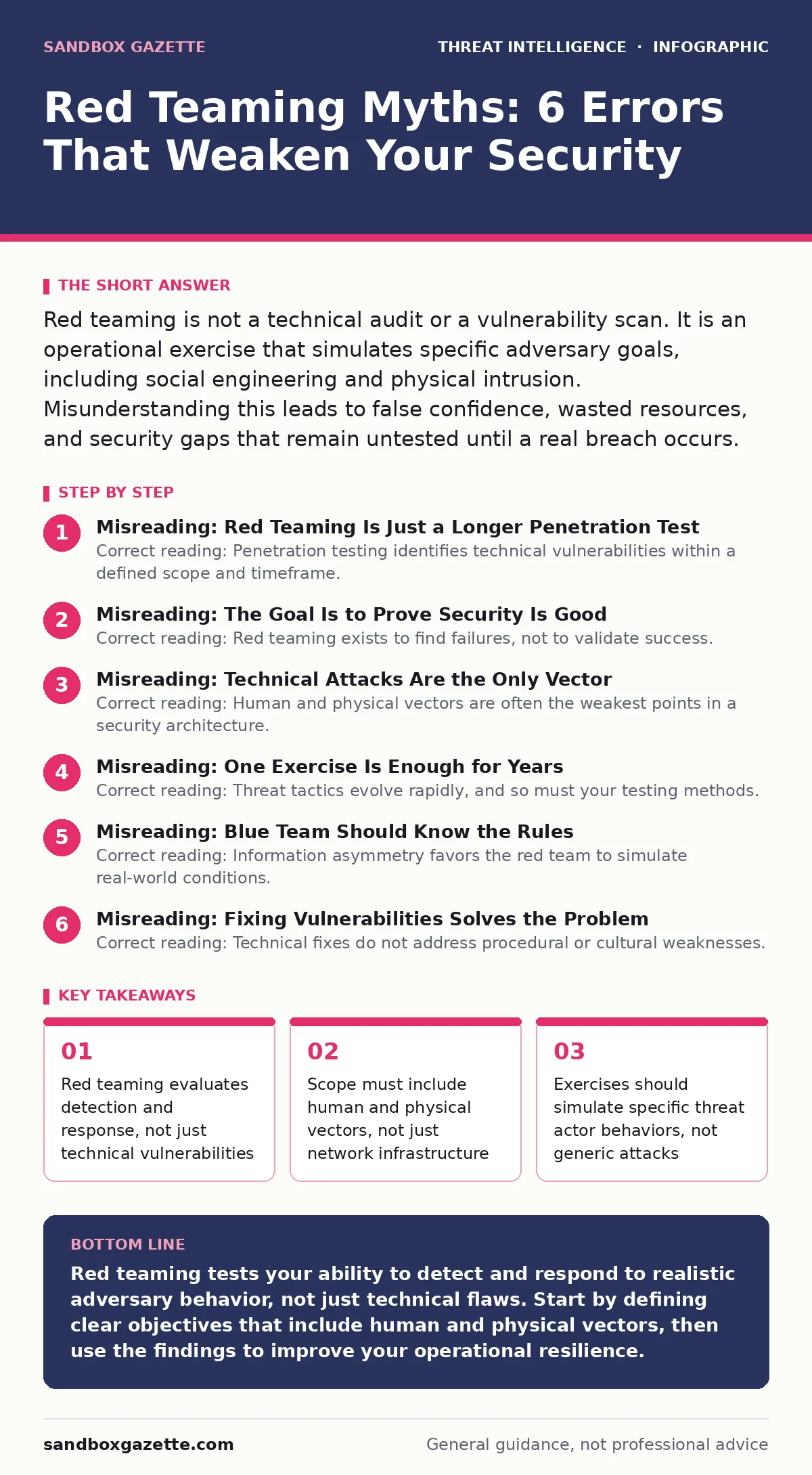
Misreading: The Goal Is to Prove Security Is Good
Correct reading: Red teaming exists to find failures, not to validate success. Organizations that design exercises to "pass" create a false sense of security. The value lies in discovering how far an adversary can penetrate before detection. If the exercise ends because the red team stopped, not because they were caught, the result is inconclusive. You need to measure mean time to detect and mean time to respond. A successful red team exercise often reveals that monitoring tools missed obvious indicators of compromise. This failure data is more valuable than a report stating no critical vulnerabilities were found.
Misreading: Technical Attacks Are the Only Vector
Correct reading: Human and physical vectors are often the weakest points in a security architecture. Ignoring social engineering or physical access limits the exercise to network defenses. Imagine a scenario where an attacker gains access by tailgating through a secure door. The network defenses are irrelevant if the endpoint is already compromised. You must include phishing campaigns, pretexting calls, and physical intrusion attempts. This holistic approach reveals gaps in employee awareness and physical security protocols. Technical controls cannot compensate for a lack of procedural rigor or human vigilance.
Misreading: One Exercise Is Enough for Years
Correct reading: Threat tactics evolve rapidly, and so must your testing methods. A single annual exercise becomes obsolete as soon as it ends. Attackers adapt to new defenses, use different tools, and change their operational security. Your red teaming program must be continuous. You should vary the tactics, techniques, and procedures used in each exercise. This prevents the blue team from memorizing specific attack patterns. Regular testing ensures that detection rules remain effective against new methods. Stagnation in testing leads to stagnation in defense.
Misreading: Blue Team Should Know the Rules
Correct reading: Information asymmetry favors the red team to simulate real-world conditions. The blue team should not receive detailed advance notice of tactics or timing. Giving the defenders a playbook turns the exercise into a script, not a simulation. In a real breach, attackers do not announce their methods. The blue team must rely on existing logs, alerts, and procedures. This tests their ability to identify anomalies without prior context. It reveals whether their monitoring covers the right data sources. Surprise is necessary to validate the efficacy of incident response plans.
See also: Understanding Autonomous System Numbers in Threat Intelligence · How to use YARA rules to detect hidden malware in files
Misreading: Fixing Vulnerabilities Solves the Problem
Correct reading: Technical fixes do not address procedural or cultural weaknesses. Patching a server does not prevent an employee from clicking a malicious link. Red teaming findings often reveal process failures, such as unclear escalation paths or inadequate logging. You must address these systemic issues alongside technical remediation. Implementing better governance and training is as critical as updating software. Ignoring the human element leaves the organization vulnerable to non-technical attacks. Security is a combination of technology, process, and people.
Misreading: Red Teaming Replaces Vulnerability Management
Correct reading: Red teaming and vulnerability management serve different purposes and must coexist. Vulnerability management identifies and prioritizes technical flaws for remediation. Red teaming tests the effectiveness of controls against specific adversary behaviors. You cannot skip vulnerability management because red teaming finds some issues. Regular scanning provides the baseline hygiene needed for a secure environment. Red teaming builds on that foundation to test operational resilience. Both activities are necessary for a mature security posture. One finds the cracks; the other tests if the structure holds.
Misreading: Any Security Team Can Run It
Correct reading: Effective red teaming requires specialized skills in adversary emulation and operational security. General security staff may lack the mindset to think like an attacker. You need personnel who understand how real threat groups operate, including their use of living-off-the-land binaries and custom tools. This requires training and experience beyond standard defensive roles. External firms can provide this expertise if internal teams lack it. The quality of the simulation depends on the realism of the adversary model. Poorly executed exercises waste resources and produce misleading results.
Misreading: Findings Are Only for the Security Team
Correct reading: Red teaming insights must influence executive strategy and budget allocation. Technical details are less important than the business impact of the findings. Executives need to understand the risk of undetected movement within the network. They must see how gaps in detection could lead to data loss or operational disruption. This context drives investment in better monitoring and response capabilities. Sharing findings broadly fosters a culture of security awareness. Isolation of red teaming results limits their value to technical remediation.
Misreading: Success Means Catching the Red Team
Correct reading: Success is measured by the quality of detection and response, not just prevention. Catching the red team is ideal, but learning from near-misses is valuable. Analyze why certain actions went undetected. Improve logging, alerting, and analyst training based on these insights. The goal is continuous improvement, not a perfect score. A failure to detect is an opportunity to strengthen controls. Focus on reducing the time between intrusion and detection. This metric matters more than binary success or failure.
Misreading: Red Teaming Is Too Expensive to Be Useful
Correct reading: The cost of a breach far exceeds the investment in red teaming. Finding gaps proactively reduces the financial impact of potential incidents. Red teaming provides a return on investment by improving security posture and resilience. It identifies high-risk areas that need immediate attention. This prioritization helps allocate resources more effectively. The expense is an investment in risk reduction, not a sunk cost. Compare the cost of the exercise to the potential loss from a successful attack. The math favors proactive testing.
Misreading: Red Teaming Replaces Strategic Threat Intelligence
Correct reading: Strategic threat intelligence informs red teaming by providing context on likely adversaries. You must align your exercises with the threats relevant to your industry and geography. Generic attacks do not test your defenses against your actual enemies. Use intelligence to model specific threat actor behaviors. This ensures the red team uses realistic tactics and tools. It makes the exercise more relevant and valuable. Ignoring intelligence leads to simulations that do not reflect real-world risks.
Misreading: Red Teaming Solves All Security Problems
Correct reading: Red teaming is one component of a broader security strategy. It does not replace access controls, encryption, or employee training. It tests the effectiveness of these controls in a realistic scenario. You must implement strong foundational security measures before red teaming can be effective. Without basic hygiene, the exercise becomes a demonstration of failure rather than a test of resilience. Address fundamental issues first. Then use red teaming to validate and improve your defenses. It is a tool for validation, not a silver bullet.
Key takeaways
- Red teaming evaluates detection and response, not just technical vulnerabilities
- Scope must include human and physical vectors, not just network infrastructure
- Exercises should simulate specific threat actor behaviors, not generic attacks
- Findings require operational changes, not just patching technical flaws
Red teaming tests your ability to detect and respond to realistic adversary behavior, not just technical flaws. Start by defining clear objectives that include human and physical vectors, then use the findings to improve your operational resilience.
Frequently asked questions
How often should we conduct red teaming exercises?
Conduct exercises regularly, varying the scope and tactics to keep the blue team on their toes. Annual exercises are a minimum, but quarterly or biannual testing provides better data for continuous improvement.
Can we use automated tools for red teaming?
Automated tools can supplement manual testing but should not replace it. Real adversaries use manual techniques to evade detection. Over-reliance on automation produces false confidence in your detection capabilities.
Who should be involved in a red team exercise?
Include members of the security operations center, incident response teams, and relevant business units. Executives should review the final report to understand the business impact of the findings.
How do we measure the success of a red team exercise?
Measure success by the quality of detection and response, not just prevention. Track metrics like mean time to detect and mean time to respond. Analyze near-misses to identify areas for improvement.
How this guide was produced: written by the Sandbox Gazette editorial team with AI assistance, checked against the public references listed below, and reviewed when the facts change. See our editorial policy or report an error.