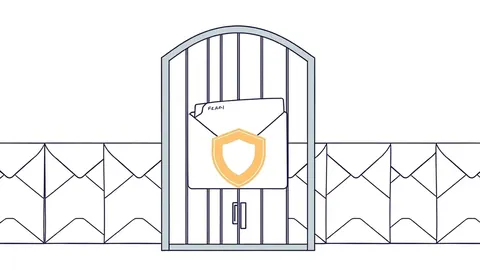
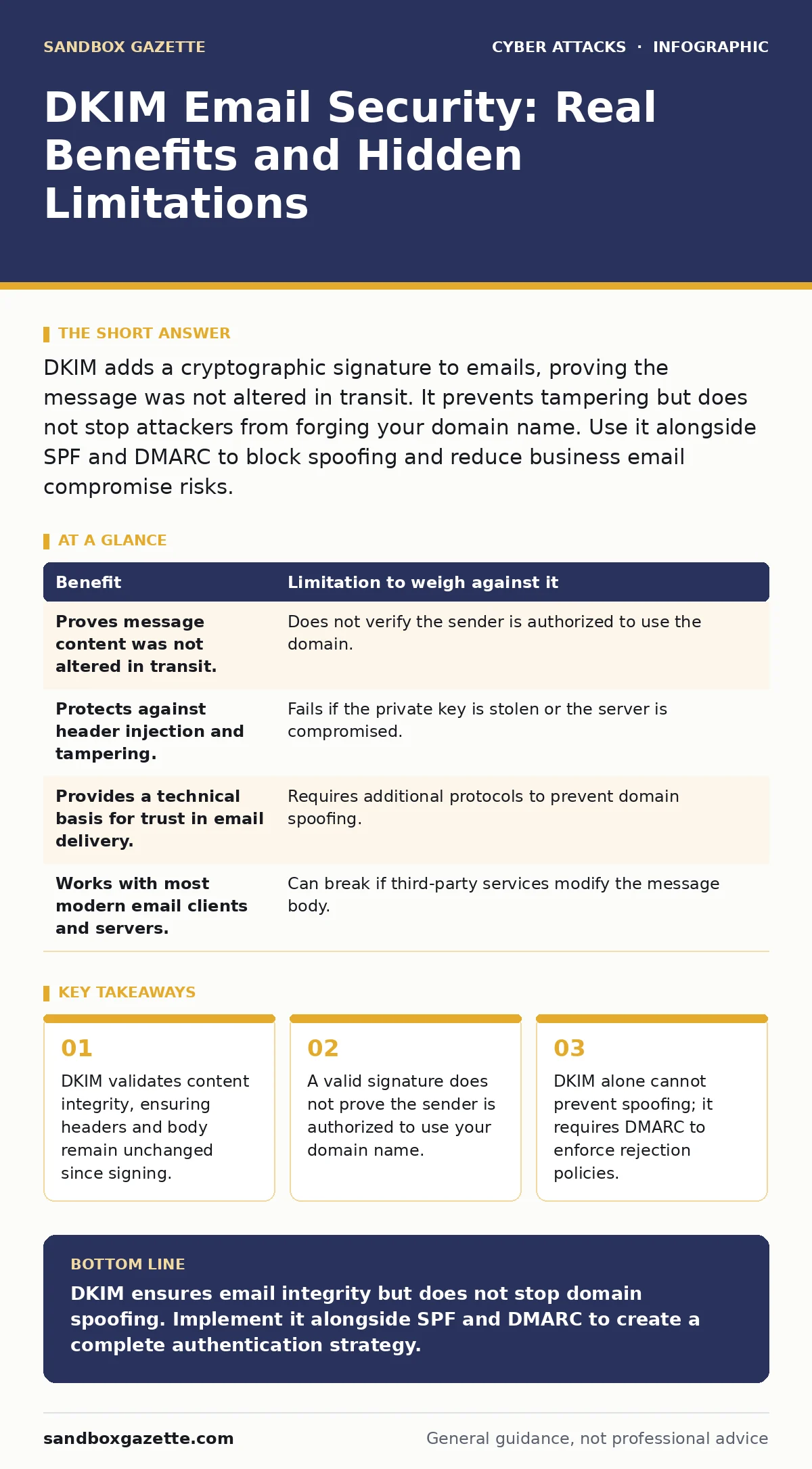
DKIM adds a cryptographic signature to emails, proving the message was not altered in transit. It prevents tampering but does not stop attackers from forging your domain name. Use it alongside SPF and DMARC to block spoofing and reduce business email compromise risks.
How the Cryptographic Signature Works
DKIM, or DomainKeys Identified Mail, operates by attaching a digital signature to the header of an outbound email. This signature is generated using a private key held by your mail server. The corresponding public key is published in your domain’s DNS records. When a recipient receives the message, their server retrieves the public key and checks the signature. If the math matches, the message has not been altered. If it does not match, the content was tampered with or the signature is invalid.
This mechanism relies on asymmetric cryptography. The private key never leaves your infrastructure, while the public key is openly accessible. This separation allows anyone to verify the message without compromising the ability to create new signatures. The process happens automatically during transmission, adding minimal latency to the delivery pipeline.
The Integrity Benefit
The primary advantage of DKIM is proof of integrity. It guarantees that the email content you sent is exactly what the recipient received. This matters for legal compliance and audit trails. If a message is modified by a malicious relay or a compromised gateway, the signature breaks. The recipient’s server can then flag or reject the message based on this failure.
This protection extends to the header fields included in the signature. Attackers often try to inject hidden headers or modify display names to bypass filters. DKIM catches these alterations because the signature covers specific header values. This makes it harder for attackers to disguise the true origin of a message within the technical metadata.
However, integrity does not equal authenticity. A message can be perfectly intact and still come from an unauthorized source. The signature only proves that the current sender holds the private key. It does not prove that the holder is supposed to send mail for your domain.
The Spoofing Gap
DKIM has a significant limitation: it does not prevent domain spoofing on its own. An attacker who compromises a legitimate user’s account can send emails that pass DKIM verification. The message is signed with the correct private key, so the signature is valid. The recipient sees a passing result, assuming the email is trustworthy.
This creates a false sense of security. Operations teams often assume that a passing DKIM check means the sender is authorized. This is incorrect. DKIM confirms the message was not changed, not that the sender is legitimate. Without additional checks, attackers can use compromised credentials to send phishing or social engineering messages that appear technically valid.
Imagine an attacker gains access to a CEO’s email account. They send a request for wire transfers to the finance team. The email passes DKIM because it originates from the legitimate server. The signature is valid. The recipient’s system sees no technical reason to reject it. The attack succeeds because DKIM does not validate authorization.
Weighing Benefits Against Limitations
To understand the value of DKIM, you must balance its strengths against its weaknesses. The table below contrasts the core benefit with the corresponding limitation.
| Benefit | Limitation to weigh against it |
|---|---|
| Proves message content was not altered in transit. | Does not verify the sender is authorized to use the domain. |
| Protects against header injection and tampering. | Fails if the private key is stolen or the server is compromised. |
| Provides a technical basis for trust in email delivery. | Requires additional protocols to prevent domain spoofing. |
| Works with most modern email clients and servers. | Can break if third-party services modify the message body. |
This balance shows that DKIM is a necessary but insufficient control. It solves the problem of tampering but ignores the problem of unauthorized use. You need other mechanisms to address the latter.
When It Is Worth It
Implementing DKIM is worth it when you need to ensure message integrity for compliance or auditing. If your organization sends sensitive data, legal notices, or financial reports via email, DKIM provides a verifiable chain of custody. It proves that the message arrived as sent. This is valuable for dispute resolution and regulatory requirements.
It is also worth it when combined with SPF and DMARC. SPF checks the sending IP address, while DKIM checks the content. DMARC uses both results to decide whether to accept or reject the email. Together, they create a layered defense. DKIM adds depth to this stack, catching attacks that bypass IP-based checks.
For organizations using third-party marketing or transactional email services, DKIM is often mandatory. These services sign emails on your behalf. Without proper DKIM alignment, your emails may land in spam folders. Setting up DKIM correctly ensures deliverability and maintains trust with recipient servers.
See also: Email Encryption Best Practices for Secure Data Exchange · Secure Email Gateways: 9 FAQs on Architecture and Limits
When It Is Not Worth It
DKIM is not worth it if you use it as a standalone security control. Relying solely on DKIM leaves your domain open to spoofing and phishing. Attackers can exploit this gap to send fraudulent messages that pass technical checks. You must implement DMARC to enforce policies based on DKIM and SPF results.
It is also not worth it if your infrastructure cannot maintain key security. If your mail servers are poorly secured, the private key is at risk. A stolen key allows attackers to sign malicious emails that appear legitimate. In this case, fixing server security is more urgent than deploying DKIM.
For small teams with minimal email volume, the operational overhead may outweigh the benefits. Managing keys, monitoring failures, and coordinating with third-party senders requires resources. If your communication needs are simple, basic spam filtering and security awareness training may suffice.
The Role of Zero Trust Security
DKIM fits into a broader zero trust security model. Zero trust assumes no user or device is trusted by default, even inside the network. Email security must reflect this principle. DKIM provides one layer of verification, but it must be part of a larger strategy.
Integrate DKIM with secure email gateways to filter malicious content. Use these gateways to inspect attachments and links before they reach users. Combine this with MFA fatigue attacks mitigation to protect account credentials. If an attacker cannot compromise accounts, they cannot misuse valid DKIM signatures.
Remember that technology alone is not enough. Social engineering remains a major threat. Users must recognize phishing attempts even when they pass technical checks. Regular training helps teams identify suspicious content, regardless of the signature status.
Key takeaways
- DKIM validates content integrity, ensuring headers and body remain unchanged since signing.
- A valid signature does not prove the sender is authorized to use your domain name.
- DKIM alone cannot prevent spoofing; it requires DMARC to enforce rejection policies.
DKIM ensures email integrity but does not stop domain spoofing. Implement it alongside SPF and DMARC to create a complete authentication strategy.
Frequently asked questions
Does DKIM prevent phishing attacks?
DKIM does not prevent phishing. It only verifies that the message was not altered. Attackers can still send phishing emails that pass DKIM if they compromise a legitimate account.
How often should I rotate DKIM keys?
Rotate DKIM keys periodically, such as every six months or after a security incident. This limits the damage if a private key is compromised.
Can DKIM break my email deliverability?
Yes, if configured incorrectly. Mismatched keys or modified message bodies can cause signatures to fail, leading to spam filtering. Test all configurations before full deployment.
Do I need DKIM if I use SPF?
Yes, SPF and DKIM serve different purposes. SPF checks the sending server, while DKIM checks the message content. Using both provides stronger protection against spoofing and tampering.
How this guide was produced: written by the Sandbox Gazette editorial team with AI assistance, checked against the public references listed below, and reviewed when the facts change. See our editorial policy or report an error.