
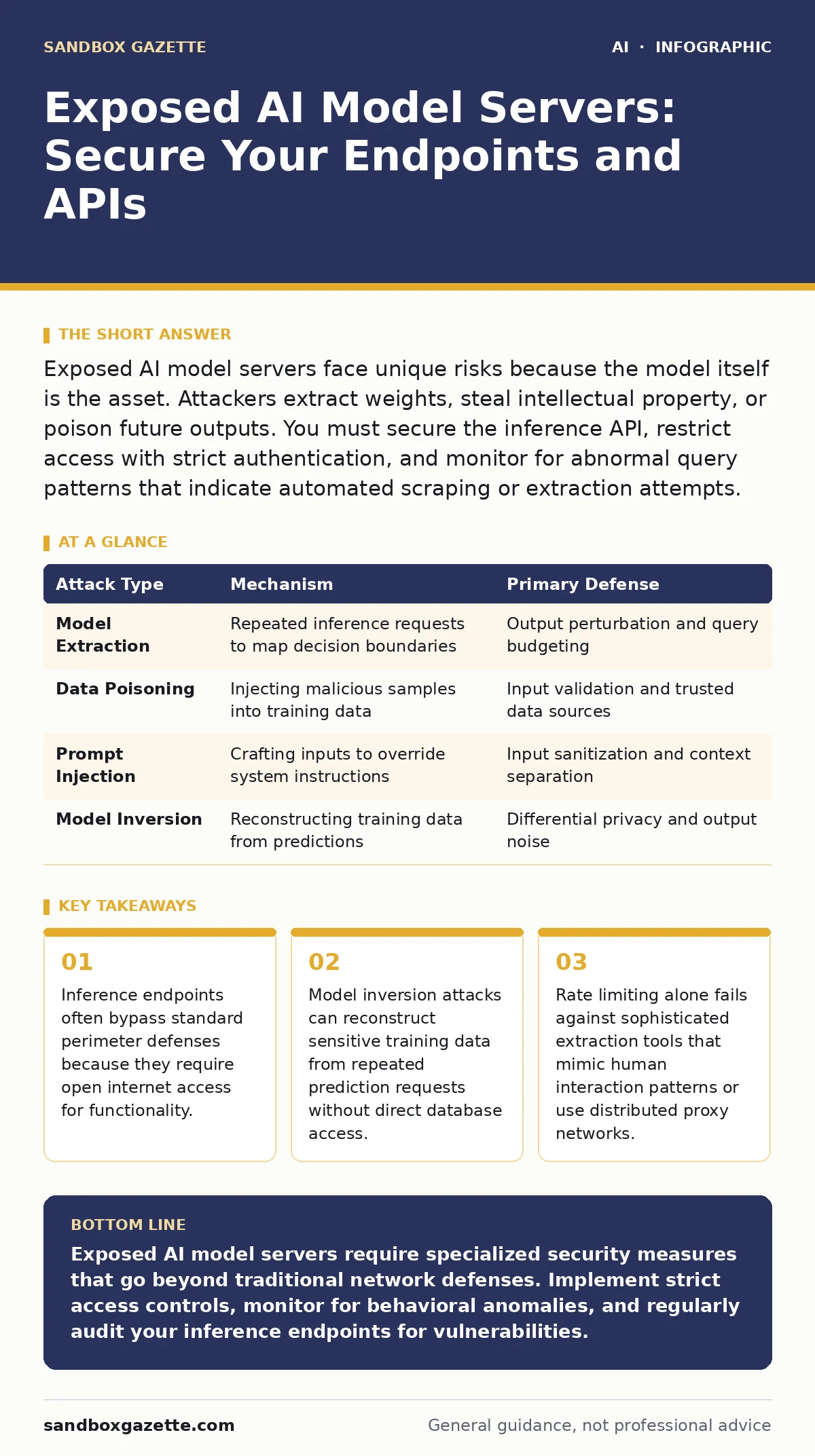
Exposed AI model servers face unique risks because the model itself is the asset. Attackers extract weights, steal intellectual property, or poison future outputs. You must secure the inference API, restrict access with strict authentication, and monitor for abnormal query patterns that indicate automated scraping or extraction attempts.
What defines an exposed AI model server?
An exposed AI model server is any endpoint that accepts inference requests from untrusted networks without strict identity verification or network segmentation. These servers host machine learning models that process input data and return predictions. When these endpoints are publicly accessible, they become high-value targets for attackers seeking to steal intellectual property or manipulate model behavior. The exposure occurs when the service relies on default configurations or lacks proper access controls.
Why do standard firewalls fail to protect model endpoints?
Standard firewalls inspect network traffic based on IP addresses, ports, and protocol headers, but they cannot interpret the semantic content of API payloads. AI inference requests often use standard HTTPS traffic that looks identical to legitimate web browsing. Traditional security tools lack the context to distinguish between a benign user query and a malicious attempt to extract model weights. This blind spot allows attackers to interact with the model directly, bypassing perimeter defenses entirely.
How do attackers extract proprietary model weights?
Attackers use model inversion and extraction techniques to reconstruct the underlying model architecture and parameters. By sending thousands of carefully crafted inputs and analyzing the outputs, they can map the decision boundaries of the model. This process reveals the mathematical relationships within the neural network, effectively cloning the proprietary logic. The stolen model can then be deployed elsewhere, bypassing licensing fees and exposing any embedded secrets.
What is model poisoning and how does it occur?
Model poisoning involves injecting malicious data into the training process or updating an online learning model with adversarial examples. If an exposed server accepts user-generated content for continuous learning, attackers can submit crafted inputs that shift the model’s behavior. This degradation leads to incorrect predictions, biased outcomes, or complete failure of the service. The damage persists because the model retains the poisoned patterns, affecting all future users.
Why is rate limiting insufficient for AI security?
Rate limiting restricts the number of requests per user, but sophisticated attackers use distributed networks to spread queries across many IP addresses. They also employ slow-and-low techniques that stay below detection thresholds while still extracting significant information over time. Simple counters cannot distinguish between high-volume legitimate usage and malicious extraction campaigns. Without behavioral analysis, rate limits provide a false sense of security against determined adversaries.
| Attack Type | Mechanism | Primary Defense |
|---|---|---|
| Model Extraction | Repeated inference requests to map decision boundaries | Output perturbation and query budgeting |
| Data Poisoning | Injecting malicious samples into training data | Input validation and trusted data sources |
| Prompt Injection | Crafting inputs to override system instructions | Input sanitization and context separation |
| Model Inversion | Reconstructing training data from predictions | Differential privacy and output noise |
See also: Synthetic Media Definition: How Generated Content Works and What to Verify
How can you detect automated model scraping?
Detection requires monitoring for anomalous query patterns rather than just volume spikes. Look for requests that systematically cover the entire input space, such as sequential variations of text or image features. These patterns differ from natural user behavior, which tends to be random or goal-oriented. Implementing behavioral analytics helps identify when an entity is probing the model’s limits rather than using it for intended purposes. Early detection allows you to block extraction attempts before significant damage occurs.
What role does API authentication play in protection?
Strong API authentication ensures that only authorized users can access the model endpoints. This includes verifying user identities and enforcing least-privilege access controls. Without proper authentication, anyone with the endpoint URL can interact with the model. Multi-factor authentication adds an additional layer of security, reducing the risk of credential theft. Regularly rotating API keys prevents long-term unauthorized access if a key is compromised.
How do you secure the inference pipeline?
Securing the inference pipeline involves hardening every component from the input gateway to the model runtime. Use container isolation to prevent code execution vulnerabilities from affecting the host system. Validate all inputs before they reach the model to block injection attacks. Monitor system resources for unusual spikes that might indicate denial-of-service attempts. Regular updates and patching of the underlying framework address known vulnerabilities in the software stack.
What is the impact of model transparency on security?
High transparency allows users to understand how decisions are made, but it can also reveal sensitive details about the model’s structure. Striking a balance requires careful disclosure of model capabilities without exposing proprietary algorithms. Explainable AI techniques can provide insights into predictions without revealing the full model architecture. This approach maintains trust with users while protecting intellectual property from reverse engineering.
How do you respond to a suspected model theft?
Immediate containment is critical to stop further extraction. Revoke access credentials and rotate API keys to invalidate existing sessions. Analyze logs to determine the scope of the breach and identify the attacker’s methods. Assess whether the stolen model contains sensitive data or proprietary logic. Notify affected stakeholders and implement additional monitoring to detect any misuse of the compromised assets.
Where do you find more detailed frameworks?
For deeper insights into adversarial tactics, consult the MITRE ATLAS framework, which catalogs specific threats to AI systems. Understanding AI model theft helps you appreciate the financial and operational impact of exposure. Review guides on AI transparency to balance security with user trust. Explore AI bias mitigation to ensure that security controls do not inadvertently discriminate against legitimate users.
Key takeaways
- Inference endpoints often bypass standard perimeter defenses because they require open internet access for functionality.
- Model inversion attacks can reconstruct sensitive training data from repeated prediction requests without direct database access.
- Rate limiting alone fails against sophisticated extraction tools that mimic human interaction patterns or use distributed proxy networks.
Exposed AI model servers require specialized security measures that go beyond traditional network defenses. Implement strict access controls, monitor for behavioral anomalies, and regularly audit your inference endpoints for vulnerabilities.
Frequently asked questions
Can I secure my AI model by only using private networks?
Private networks reduce exposure but do not eliminate risk. Internal threats and misconfigurations can still lead to unauthorized access or data leakage. You must still enforce strict access controls and monitor for anomalies within the private environment.
Does encrypting the model file protect it from extraction?
Encryption protects the model at rest, but it must be decrypted to run inferences. Attackers target the running model through its API, not the stored file. Encryption does not prevent extraction via repeated inference requests.
How often should I rotate API keys for AI services?
Rotate API keys regularly, ideally every 90 days, or immediately upon suspicion of compromise. Regular rotation limits the window of opportunity for attackers who may have stolen credentials. Automated rotation tools help maintain security without disrupting service.
Can I use watermarks to protect my AI model?
Watermarks can help identify stolen models, but they do not prevent extraction. Attackers can often remove or bypass watermarks during the cloning process. Use watermarks as a forensic tool rather than a primary security measure.
How this guide was produced: written by the Sandbox Gazette editorial team with AI assistance, checked against the public references listed below, and reviewed when the facts change. See our editorial policy or report an error.