
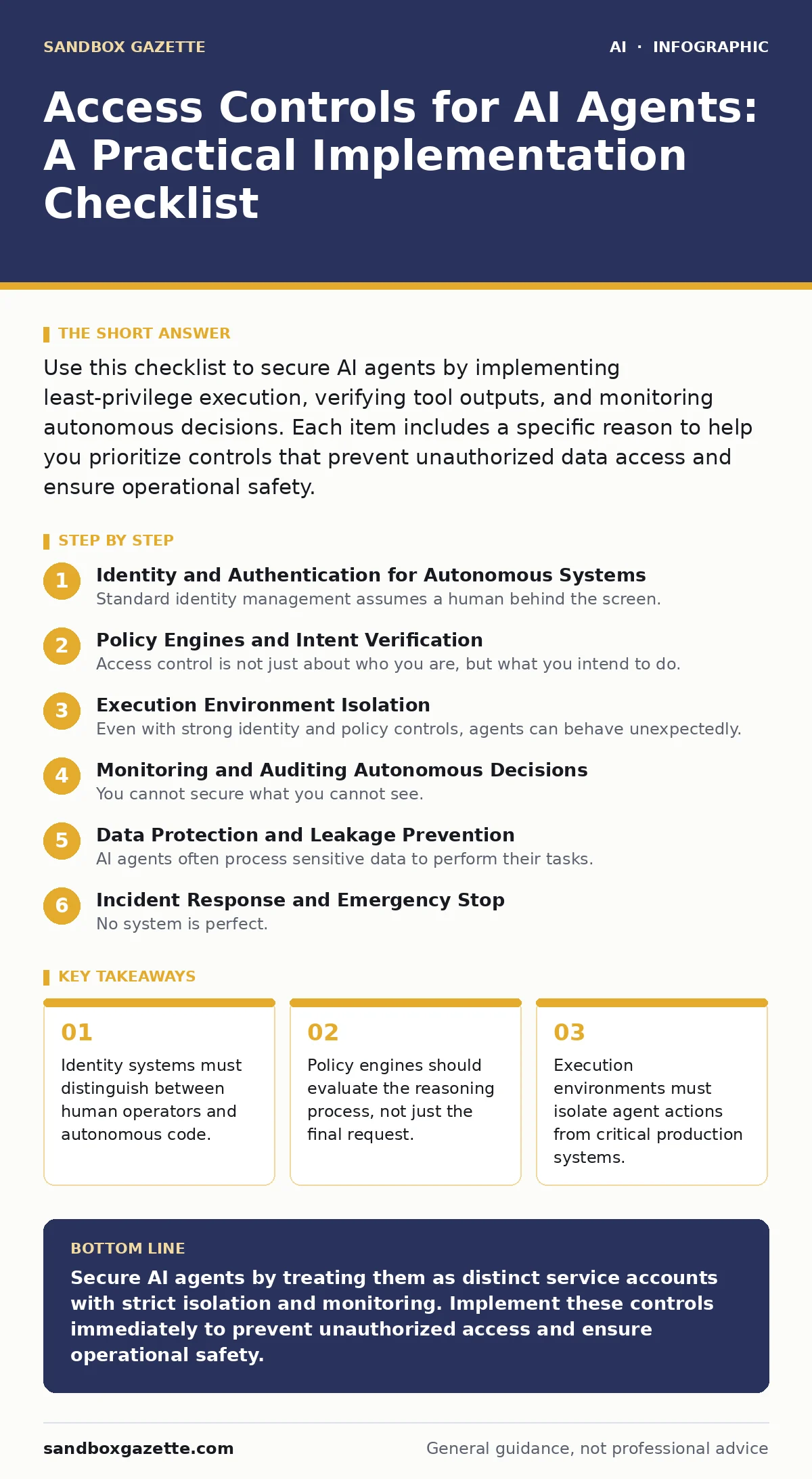
Use this checklist to secure AI agents by implementing least-privilege execution, verifying tool outputs, and monitoring autonomous decisions. Each item includes a specific reason to help you prioritize controls that prevent unauthorized data access and ensure operational safety.
Identity and Authentication for Autonomous Systems
Standard identity management assumes a human behind the screen. AI agents break this model by acting without direct supervision. You must treat each agent as a distinct service account with strict boundaries.
- Assign unique service identities to each agent: Prevents privilege escalation by ensuring one compromised agent cannot impersonate another.
- Implement short-lived credential rotation: Reduces the window of opportunity for attackers who steal authentication tokens.
- Disable interactive login for agent accounts: Stops attackers from using stolen credentials to bypass multi-factor authentication challenges.
Policy Engines and Intent Verification
Access control is not just about who you are, but what you intend to do. Traditional firewalls inspect packets, not purpose. AI agents generate natural language requests that require semantic analysis before execution. You need a policy engine that understands context.
- Require explicit tool definitions for each agent: Limits the agent to known, safe functions and prevents arbitrary code execution.
- Validate reasoning traces before action execution: Ensures the agent’s logic aligns with security policies and prevents hallucinated permissions.
- Enforce human-in-the-loop for high-risk actions: Adds a verification step for decisions that could cause significant data loss or system damage.
Execution Environment Isolation
Even with strong identity and policy controls, agents can behave unexpectedly. You must assume that any agent will eventually make a mistake or be manipulated. Isolation ensures that mistakes remain contained.
- Run agents in ephemeral containers: Ensures that state from previous sessions does not leak into new tasks or persist after completion.
- Restrict network access to necessary endpoints only: Prevents agents from scanning internal networks or exfiltrating data to external servers.
- Implement read-only access for sensitive databases: Stops agents from accidentally modifying or deleting critical records during data retrieval tasks.
Monitoring and Auditing Autonomous Decisions
You cannot secure what you cannot see. AI agents operate at speeds and volumes that exceed human monitoring capabilities. You need automated logging and alerting that captures the full decision lifecycle.
- Log all tool calls and responses: Provides an audit trail for forensic analysis and helps identify patterns of misuse.
- Monitor for anomalous behavior patterns: Detects when an agent deviates from its expected workflow or accesses unusual resources.
- Retain logs for compliance and review: Ensures you have historical data to investigate incidents and demonstrate regulatory compliance.
Data Protection and Leakage Prevention
AI agents often process sensitive data to perform their tasks. Without proper controls, they can inadvertently expose this information through logs, outputs, or external API calls. You must protect data at rest, in transit, and in use.
- Implement data classification labels: Helps agents understand which data requires additional protection or redaction before processing.
- Redact sensitive information in logs: Prevents accidental exposure of personal or proprietary data in debugging outputs.
- Restrict external API access for data-heavy tasks: Stops agents from sending sensitive data to third-party services that may not have adequate security.
See also: Synthetic Media Definition: How Generated Content Works and What to Verify
Incident Response and Emergency Stop
No system is perfect. You must have a way to stop an agent immediately if it begins to behave maliciously or dangerously. This requires pre-defined emergency procedures that can be triggered automatically or manually.
- Define clear kill-switch mechanisms: Allows operators to immediately terminate agent processes without affecting other system components.
- Automate detection of policy violations: Triggers immediate containment actions when an agent attempts to bypass security controls.
- Test emergency stop procedures regularly: Ensures that response teams can effectively halt autonomous systems under pressure.
Integration with Existing Security Frameworks
AI agents do not exist in a vacuum. They must integrate with your existing security infrastructure, including identity providers, logging systems, and incident response tools. This integration ensures consistent security posture across all systems.
- Align agent controls with organizational risk policies: Ensures that AI security measures support broader business objectives and compliance requirements.
- Integrate agent logs with SIEM systems: Provides centralized visibility into agent activities and enables correlation with other security events.
- Regularly update agent security configurations: Keeps protections current against emerging threats and evolving agent capabilities.
Key takeaways
- Identity systems must distinguish between human operators and autonomous code.
- Policy engines should evaluate the reasoning process, not just the final request.
- Execution environments must isolate agent actions from critical production systems.
Secure AI agents by treating them as distinct service accounts with strict isolation and monitoring. Implement these controls immediately to prevent unauthorized access and ensure operational safety.
Frequently asked questions
How do I prevent AI agents from accessing sensitive data?
Implement data classification labels and restrict external API access to ensure agents only process necessary information.
What is the best way to monitor AI agent behavior?
Log all tool calls and responses, and use automated anomaly detection to identify unusual patterns in real time.
Can I use existing identity systems for AI agents?
Yes, but you must assign unique service identities and disable interactive login to prevent credential misuse.
How do I stop an AI agent that is behaving maliciously?
Define clear kill-switch mechanisms and test emergency stop procedures regularly to ensure effective containment.
How this guide was produced: written by the Sandbox Gazette editorial team with AI assistance, checked against the public references listed below, and reviewed when the facts change. See our editorial policy or report an error.