
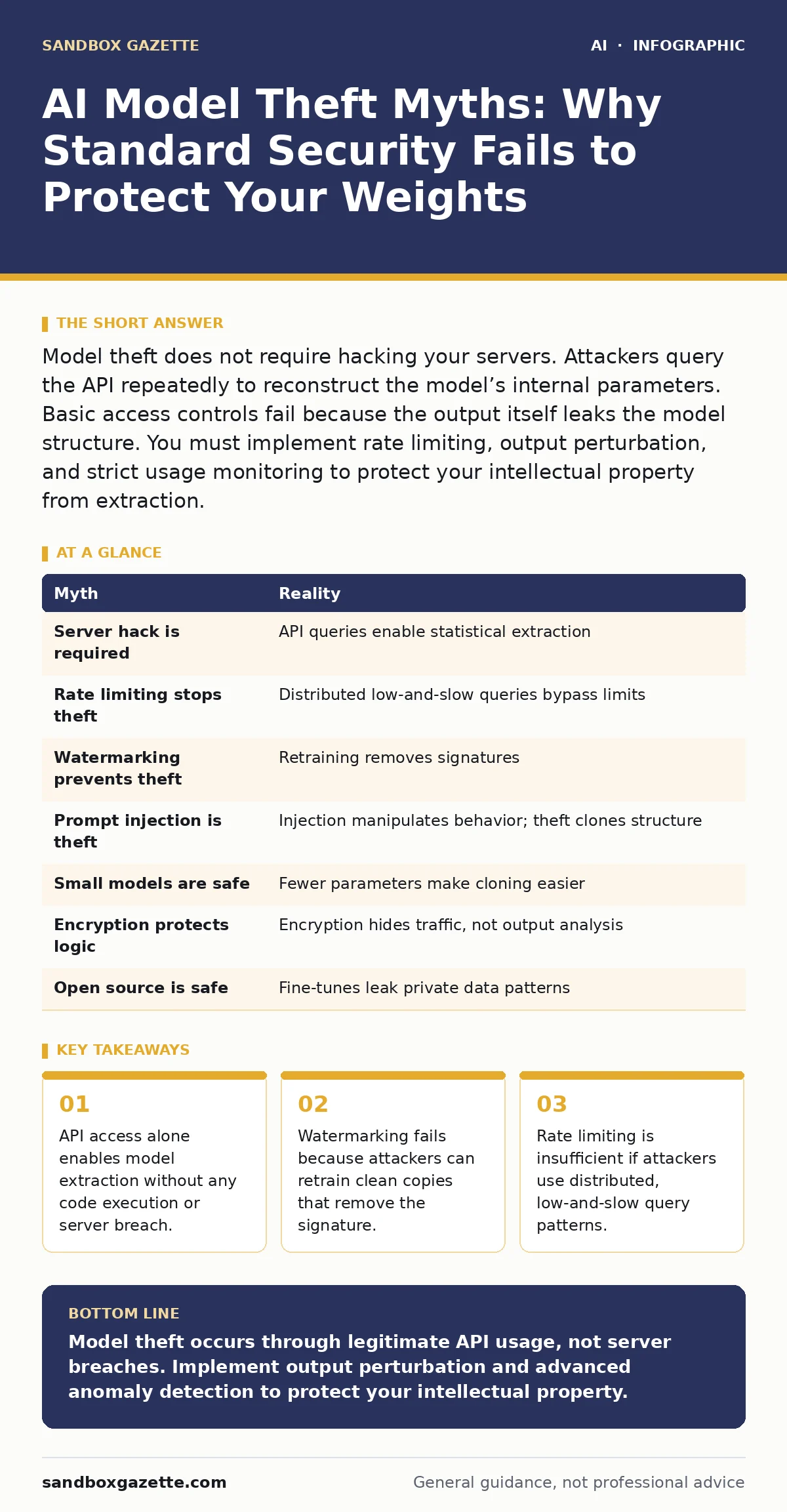
Model theft does not require hacking your servers. Attackers query the API repeatedly to reconstruct the model’s internal parameters. Basic access controls fail because the output itself leaks the model structure. You must implement rate limiting, output perturbation, and strict usage monitoring to protect your intellectual property from extraction.
Myth: You Must Hack the Server to Steal a Model
Reality: Adversaries extract proprietary weights through statistical inference on the output interface alone. They do not need to breach your firewall or obtain source code. By sending thousands of carefully crafted inputs to the public API, they analyze the probability distributions of the outputs. This process, known as model inversion or extraction, reconstructs the internal mathematical structure.
The model behaves like a black box, but its responses reveal enough data to build a functional surrogate. You assume your network perimeter protects the intellectual property. In truth, the API endpoint is the vulnerability. The model serves data to anyone with valid credentials. If those credentials are compromised or guessed, the theft begins. This mechanism bypasses traditional intrusion detection systems that look for malicious payloads. Instead, the traffic looks like legitimate, high-volume usage.
Myth: Rate Limiting Stops Extraction Attacks
Reality: Simple rate limiting fails against distributed, low-and-slow query patterns. Attackers spread requests across many accounts or IP addresses to stay under thresholds. They may make one request every few minutes, which appears normal to monitoring tools. Over weeks, this accumulates enough data to clone the model. The trade-off is between usability and security. If you limit requests too aggressively, legitimate users experience degraded performance.
If you allow high throughput, you enable extraction. You must distinguish between human-like usage and automated probing. Human users vary their inputs randomly. Extraction scripts follow systematic patterns to cover the input space efficiently. Anomaly detection algorithms can flag these systematic queries. However, sophisticated attackers mimic human variability to evade detection. This creates an arms race in monitoring logic.
Myth: Watermarking Protects Your Intellectual Property
Reality: Digital watermarks embedded in outputs can be removed by retraining. Attackers use your model to generate a large dataset of text. They then train a new model on this data, effectively washing away the signature. The new model performs similarly but carries no trace of the original owner. This process is called model distillation.
The surrogate model learns the behavior without inheriting the proprietary weights or markers. You might think watermarking proves ownership in court. It does not prevent the theft itself. It only provides evidence after the fact. By then, the intellectual property has already been copied. The cost of legal action often exceeds the value of the stolen asset. Prevention requires making the extraction process computationally expensive or inaccurate.
Myth: Prompt Injection Is the Same as Model Theft
Reality: Prompt injection manipulates behavior; model theft steals structure. They are distinct threats requiring different defenses. Prompt injection tricks the model into ignoring its instructions. This might lead to data leakage or unauthorized actions. Model theft aims to replicate the model’s weights for offline use. You cannot treat them as the same problem.
Defenses against prompt injection, such as input sanitization, do not stop extraction. Extraction relies on statistical analysis of outputs, not tricking the model. Understanding this difference is critical for your security architecture. See our guide on prompt injection attacks for behavioral defenses. For theft, you need output-level protections. Confusing the two leads to gaps in your security posture.
Myth: Small Models Are Safe From Theft
Reality: Smaller models are easier to clone with fewer queries. Large models require more data to reconstruct accurately. Small models have fewer parameters, reducing the complexity of the extraction task. Attackers prioritize small models because the return on investment is higher. They can clone a small model quickly and deploy it.
You might assume obscurity protects smaller, niche models. This is a false sense of security. The lower the model size, the less data an attacker needs. This makes them prime targets for automated extraction tools. You must apply the same rigor to small models as large ones. Do not deprioritize them in your risk assessment. The ease of cloning makes them vulnerable.
See also: Access Controls for AI Agents: A Practical Implementation Checklist
Myth: Open Source Models Cannot Be Stolen
Reality: Open source models are public, but proprietary fine-tunes can be extracted. Many organizations take an open base model and train it on private data. This fine-tuned version contains proprietary knowledge. Attackers can query this fine-tuned model to reverse-engineer the private data. They do not steal the base model, which is already public.
They steal the adjustments made to it. This is a form of data poisoning or membership inference. The output reveals patterns unique to the private training set. You must protect the fine-tuned layer, not just the base. The base is free; the value is in the customization. Ignoring this distinction leaves your private data exposed.
Myth: Encryption Protects the Model in Transit
Reality: Encryption protects data in transit, not the model’s logic. TLS ensures that eavesdroppers cannot read the API traffic. It does not prevent the recipient from analyzing the responses. The model processes the input and returns an output. The attacker sees the output in plain text. They use these outputs to build their clone. Encryption is necessary but not sufficient. It prevents interception, not extraction. You need application-layer security to protect the model. This includes rate limiting, anomaly detection, and output perturbation. Encryption is a baseline requirement, not a defense against theft. Do not rely on it to secure intellectual property.
| Myth | Reality |
|---|---|
| Server hack is required | API queries enable statistical extraction |
| Rate limiting stops theft | Distributed low-and-slow queries bypass limits |
| Watermarking prevents theft | Retraining removes signatures |
| Prompt injection is theft | Injection manipulates behavior; theft clones structure |
| Small models are safe | Fewer parameters make cloning easier |
| Encryption protects logic | Encryption hides traffic, not output analysis |
| Open source is safe | Fine-tunes leak private data patterns |
Key takeaways
- API access alone enables model extraction without any code execution or server breach.
- Watermarking fails because attackers can retrain clean copies that remove the signature.
- Rate limiting is insufficient if attackers use distributed, low-and-slow query patterns.
- Output perturbation adds noise to prevent precise parameter reconstruction.
Model theft occurs through legitimate API usage, not server breaches. Implement output perturbation and advanced anomaly detection to protect your intellectual property.
Frequently asked questions
How do I detect if my model is being stolen?
Monitor for systematic query patterns that cover the input space. Look for high-volume, low-variability requests from single sources.
What is output perturbation?
It adds small amounts of noise to model outputs. This reduces the accuracy of statistical reconstruction without harming user experience.
Can I use legal action to stop theft?
Legal action is difficult and slow. Prevention through technical controls is more effective. Laws vary by jurisdiction.
Does using a third-party API increase risk?
Yes, you have less control over their security measures. Review their security documentation and implement your own monitoring.
How this guide was produced: written by the Sandbox Gazette editorial team with AI assistance, checked against the public references listed below, and reviewed when the facts change. See our editorial policy or report an error.