
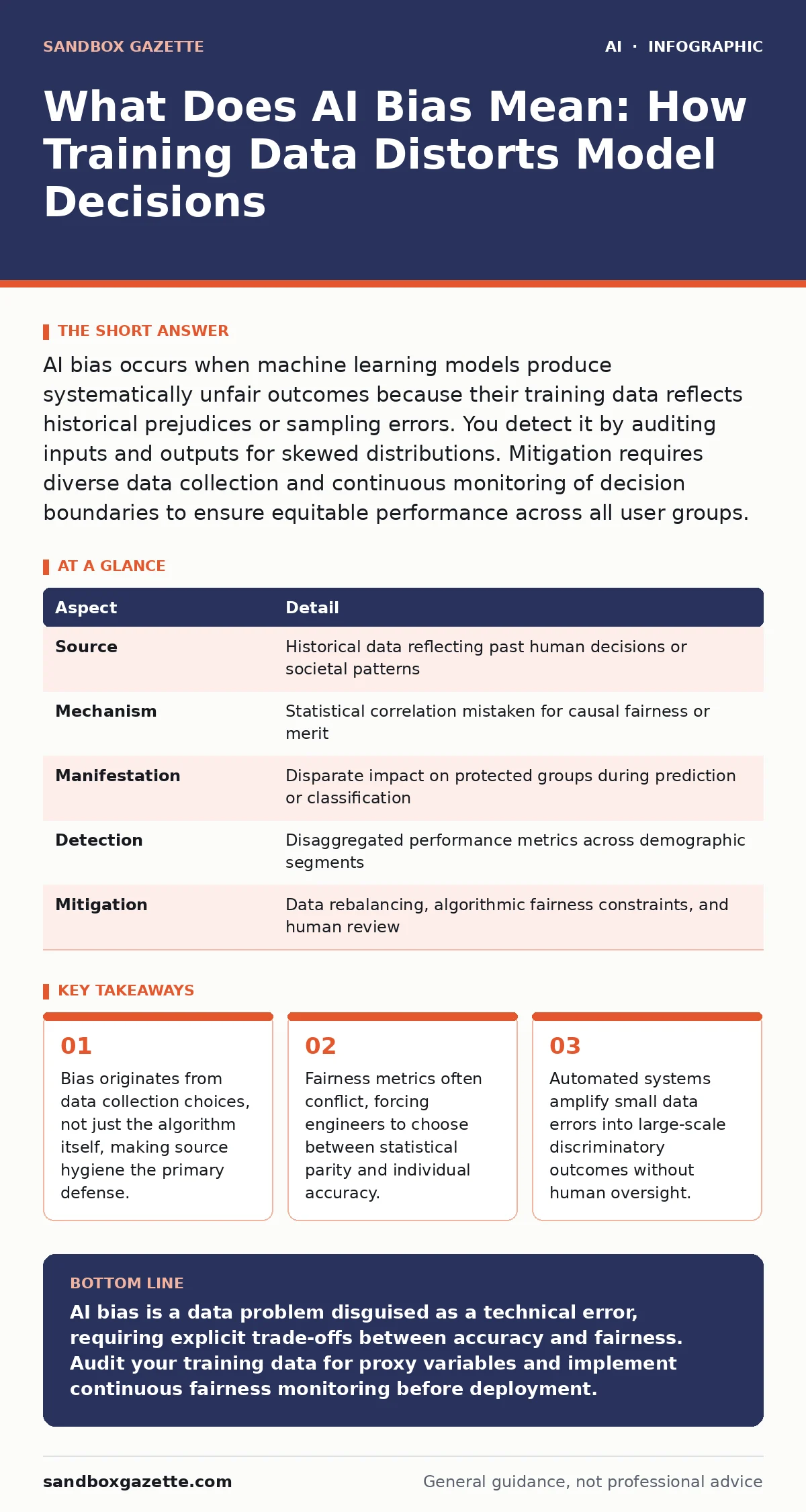
AI bias occurs when machine learning models produce systematically unfair outcomes because their training data reflects historical prejudices or sampling errors. You detect it by auditing inputs and outputs for skewed distributions. Mitigation requires diverse data collection and continuous monitoring of decision boundaries to ensure equitable performance across all user groups.
An Everyday Analogy for Systemic Error
Imagine hiring a chef who only cooks from a single cookbook written by one person. The chef becomes excellent at replicating those specific recipes but fails completely when presented with ingredients from other cultures. The chef is not malicious; the training material was simply narrow. AI models operate on the same principle. They learn patterns from the data you provide. If that data contains historical gaps or prejudices, the model learns those gaps as truth.
What Does AI Bias Mean
What does AI bias mean in technical terms? It refers to systematic errors in machine learning systems that create unfair outcomes, often disadvantaging specific groups of people. These errors arise because the model optimizes for statistical likelihood based on past data rather than objective fairness. The model does not understand justice or equality. It only understands correlation. When historical data reflects societal bias, the model codifies that bias into its decision-making logic. This creates a feedback loop where past discrimination predicts future discrimination.
How the Mechanism Works
The mechanism relies on pattern recognition within high-dimensional data spaces. Training data contains labels that represent "correct" outcomes. The model adjusts its internal weights to minimize the difference between its predictions and these labels. If the labels themselves are biased, the model learns to reproduce the bias. For example, if historical hiring data shows fewer women in technical roles, the model associates "female" with "lower suitability for technical roles." The model treats this correlation as a predictive feature. It does not question the validity of the underlying data. It simply maximizes accuracy based on the provided signal.
| Aspect | Detail |
|---|---|
| Source | Historical data reflecting past human decisions or societal patterns |
| Mechanism | Statistical correlation mistaken for causal fairness or merit |
| Manifestation | Disparate impact on protected groups during prediction or classification |
| Detection | Disaggregated performance metrics across demographic segments |
| Mitigation | Data rebalancing, algorithmic fairness constraints, and human review |
Who It Affects and Where It Fails
Bias affects anyone interacting with automated decision systems. It is most visible in high-stakes environments like credit scoring, healthcare triage, and criminal justice risk assessment. These systems often claim objectivity because they are mathematical. This perceived neutrality makes bias harder to detect than human prejudice. Engineers usually focus on overall accuracy. They rarely check how accuracy distributes across different subgroups. This disparity goes unnoticed until the system causes harm. The affected individuals rarely know the system exists, let alone how it works.
What People Usually Get Wrong
Many assume bias is solely a problem of the algorithm's code. They believe that using a more complex neural network will solve the issue. This is incorrect. The algorithm is often mathematically sound. The problem lies in the data distribution and the definition of the target variable. Another common error is assuming that removing demographic labels eliminates bias. Proxies remain. Zip codes, shopping habits, and linguistic patterns often correlate strongly with race or gender. The model uses these proxies to reconstruct the excluded demographic information. This makes bias invisible to simple audits.
Another misconception is that fairness is a single metric. It is not. Statistical parity, equal opportunity, and predictive parity are mathematically incompatible in most real-world scenarios. You cannot optimize for all of them simultaneously. Choosing one fairness definition often violates another. Engineers must explicitly choose which trade-off is acceptable for their specific use case. There is no universal "fair" model. The choice depends on the context and the values of the organization deploying the system.
See also: Implement Machine Learning for Fraud Detection: A Step-by-Step Plan · How MITRE ATLAS Prevents AI Model Supply Chain Failures
Practical Mitigation Strategies
Mitigation starts with data auditing. You must understand the provenance of every feature. Ask why each feature exists and what it predicts. Remove features that act as proxies for protected attributes. Use techniques like data rebalancing to ensure underrepresented groups have sufficient representation in the training set. This does not fix the model automatically, but it provides a better foundation.
Algorithmic adjustments are the next step. You can add fairness constraints to the loss function. This forces the model to penalize unfair predictions during training. Post-processing methods adjust the decision thresholds for different groups to achieve parity. These methods require careful tuning. They often reduce overall accuracy. You must accept this trade-off explicitly. Monitoring is critical. Bias can emerge after deployment as user behavior changes. Continuous evaluation against fairness metrics is necessary to maintain trust.
For deeper technical implementation, teams often reference frameworks like MITRE ATLAS to understand adversarial threats to AI systems. Understanding how attackers can exploit bias is part of a broader security posture. Related concerns include sensitive data leaks through AI chatbots, which can expose the very demographic data you are trying to protect. Ensuring explainable AI practices helps auditors understand why a model made a specific decision, making bias detection easier.
The Hidden Cost of Fairness
Implementing bias mitigation has a hidden cost: reduced performance. Fairness constraints often lower the model's overall accuracy or precision. This is not a bug; it is a mathematical reality. You are forcing the model to ignore some statistical signals to achieve equity. Stakeholders must understand this trade-off. They cannot demand both maximum profit and perfect fairness. The organization must decide how much accuracy it is willing to sacrifice for equity. This decision should be documented and reviewed regularly.
Transparency is the only way to manage this cost. Users have a right to know that a system makes trade-offs. Hiding the fairness constraints creates a false sense of objectivity. When errors occur, they are harder to explain. Clear documentation of the fairness definitions used and the resulting performance metrics builds trust. It also helps regulators and auditors evaluate the system. This aligns with broader AI risk management strategies that prioritize long-term sustainability over short-term optimization.
Integrating Bias Checks into Operations
Bias checks must become part of the standard development lifecycle. Do not treat them as an afterthought. Integrate fairness metrics into your continuous integration pipeline. Block model deployments that fail fairness thresholds. This automates the defense. It ensures that no biased model reaches production.
Teams should also consider the broader ecosystem. Insecure AI plugins and agents can introduce new vectors for bias if they pull data from unvetted sources. Similarly, machine learning for fraud detection often relies on historical fraud patterns that may reflect biased enforcement. These systems require specific scrutiny. Exposed AI model servers can be probed by attackers to discover bias, which can then be exploited for social engineering or targeted attacks. Securing the model infrastructure is as important as securing the data.
Key takeaways
- Bias originates from data collection choices, not just the algorithm itself, making source hygiene the primary defense.
- Fairness metrics often conflict, forcing engineers to choose between statistical parity and individual accuracy.
- Automated systems amplify small data errors into large-scale discriminatory outcomes without human oversight.
AI bias is a data problem disguised as a technical error, requiring explicit trade-offs between accuracy and fairness. Audit your training data for proxy variables and implement continuous fairness monitoring before deployment.
Frequently asked questions
Can I fix AI bias by just adding more data?
Adding more data helps only if the new data is diverse and representative. If you add more biased data, you reinforce the existing patterns. Quality and balance matter more than volume.
Is AI bias illegal?
Bias itself is not illegal, but discriminatory outcomes may violate civil rights laws. Regulations are evolving to hold organizations accountable for automated decision-making that results in unfair treatment.
How do I detect bias in a black-box model?
Use model-agnostic testing tools that analyze inputs and outputs. Compare performance metrics across different demographic subgroups. Look for significant disparities in false positive or false negative rates.
Does explainable AI solve bias?
Explainable AI helps identify where bias occurs by showing feature importance. It does not automatically remove bias. It provides the visibility needed to implement corrective measures and accountability.
How this guide was produced: written by the Sandbox Gazette editorial team with AI assistance, checked against the public references listed below, and reviewed when the facts change. See our editorial policy or report an error.