
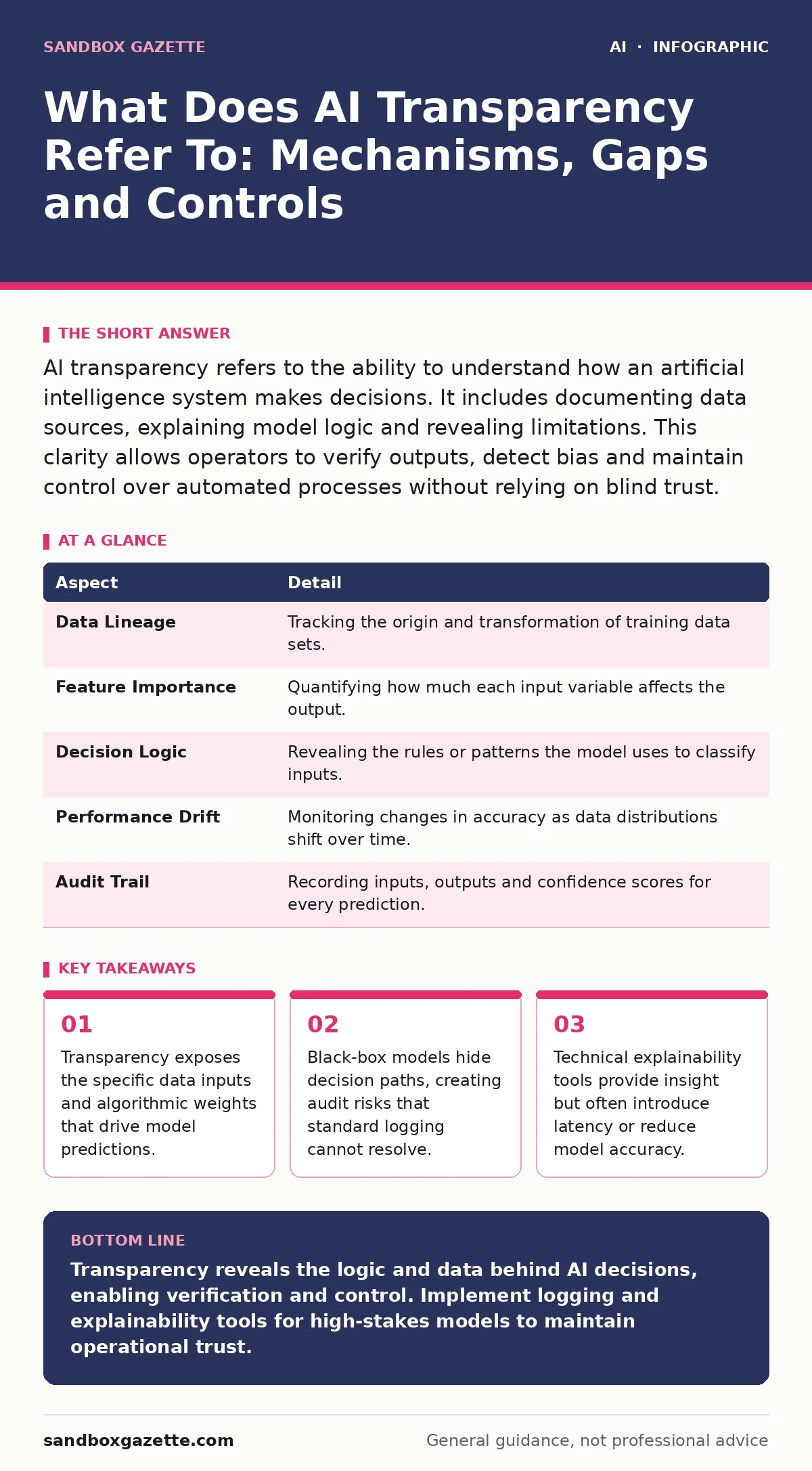
AI transparency refers to the ability to understand how an artificial intelligence system makes decisions. It includes documenting data sources, explaining model logic and revealing limitations. This clarity allows operators to verify outputs, detect bias and maintain control over automated processes without relying on blind trust.
What does ai transparency refer to
What does ai transparency refer to? It refers to the practice of making the internal workings of an artificial intelligence system visible and understandable to human operators. This visibility covers the data used for training, the mathematical logic applied to inputs and the reasoning behind specific outputs. Transparency is not about publishing source code. It is about providing enough context for a human to verify whether a decision aligns with policy and reality. Without this clarity, systems operate as opaque entities that can enforce hidden biases or make errors that are impossible to trace.
You cannot audit what you cannot see. When a model denies a request or flags an anomaly, you need to know which factors contributed to that result. Transparency provides the mechanism to trace that lineage. It transforms the system from a mysterious oracle into a traceable process. This shift is fundamental for maintaining control in environments where automated decisions carry significant operational weight.
The mechanics of model visibility
Transparency operates through two distinct layers. The first layer is documentation. This includes records of training data sources, preprocessing steps and performance metrics across different subsets of data. The second layer is technical explainability. This involves methods that highlight which input features influenced a specific prediction. For instance, a feature importance score shows which variables carried the most weight in a decision.
These mechanisms work together to create a narrative of the model’s behavior. Documentation tells you what the model knows. Explainability tells you how it uses that knowledge. Neither layer is sufficient on its own. A model can have perfect documentation but still make unpredictable decisions if the underlying logic is complex. Conversely, explainability tools can mislead if they do not align with the actual model architecture. You must combine both to achieve true visibility.
| Aspect | Detail |
|---|---|
| Data Lineage | Tracking the origin and transformation of training data sets. |
| Feature Importance | Quantifying how much each input variable affects the output. |
| Decision Logic | Revealing the rules or patterns the model uses to classify inputs. |
| Performance Drift | Monitoring changes in accuracy as data distributions shift over time. |
| Audit Trail | Recording inputs, outputs and confidence scores for every prediction. |
Who bears the responsibility
Transparency affects everyone who interacts with automated decision-making. Developers must build systems that allow for inspection. This means avoiding unnecessary complexity when a simpler model would suffice. It also means integrating logging and explainability tools from the start, rather than adding them later. Security teams must verify that the transparency mechanisms themselves are secure. Attackers can probe explainability interfaces to learn how to bypass filters.
Operational staff rely on transparency to trust the system. If a tool flags a threat, the operator needs to know why. If the explanation is vague, the operator must investigate manually, wasting time and resources. Management must understand the limitations of transparency. They cannot assume that a transparent system is always correct. They must establish policies for when human intervention is required. The burden of understanding falls on the organization, not just the algorithm.
Common misconceptions about clarity
People often mistake transparency for explainability. These are not the same thing. Explainability focuses on individual predictions. It tells you why a specific decision was made. Transparency is broader. It covers the entire lifecycle of the model, including data collection, training procedures and deployment conditions. You can have a model that explains its decisions clearly but still lacks transparency if you do not know how the training data was collected or cleaned.
Another common error is assuming that transparency guarantees fairness. A model can be fully transparent and still be biased. If the training data contains historical prejudices, the model will learn and reflect those prejudices. Transparency reveals this bias, but it does not automatically fix it. You must still address the root cause in the data or the model design. Relying on transparency as a silver bullet for ethics is a dangerous oversimplification.
Integrating transparency into operations
You must treat transparency as an operational requirement, not a theoretical concept. Start by defining which decisions require explanation. Not every prediction needs a detailed breakdown. Focus on high-stakes actions, such as blocking network traffic or denying access. For these cases, implement logging that captures inputs, outputs and the model’s internal state.
Use standard frameworks to structure this information. Refer to MITRE ATLAS for guidance on adversarial tactics and how they might exploit opaque systems. This helps you anticipate where transparency gaps could be exploited. Ensure that your logging system is tamper-proof. If an attacker can alter the logs, the transparency is worthless. Integrate these logs with your existing security information and event management systems. This allows you to correlate AI decisions with other security events.
See also: Emergency Stop for AI Systems: 8 Critical Questions Answered · Exposed AI Model Servers: Secure Your Endpoints and APIs
The hidden costs of visibility
Transparency introduces performance overhead. Calculating feature importance or generating detailed explanations takes computational resources. This latency can be unacceptable in real-time applications. You must balance the need for insight with the need for speed. In some cases, you may need to run a simpler, transparent model alongside a complex, high-performance model. Use the complex model for speed and the transparent model for audit and verification.
There is also a cost in complexity. Explainability tools can produce outputs that are difficult for humans to interpret. A SHAP value plot might show complex interactions between variables that are hard to digest quickly. You must train your staff to read these outputs. Without proper training, the transparency becomes noise rather than signal. This training is an ongoing investment, not a one-time fix.
Building a sustainable framework
Sustainable transparency requires continuous monitoring. Models drift as data changes. A model that was transparent and accurate last year may become opaque and biased today. You must regularly re-evaluate the model’s performance and its explanations. Automate this process where possible. Set thresholds for when a model’s behavior deviates from the expected pattern.
Consider the implications of shadow AI. Employees may use unauthorized AI tools that lack any transparency. These tools operate outside your control and visibility. You must have policies that address the use of external AI services. Require that any AI tool used for business purposes meets your transparency standards. This ensures that you maintain visibility over all automated decisions, even those made by third-party vendors.
Review your access controls for AI agents regularly. Ensure that only authorized personnel can modify model parameters or view sensitive training data. Transparency should not expose confidential information. You must balance the need for insight with the need for privacy. Use techniques like differential privacy to protect individual data points while still allowing for aggregate analysis.
Next steps for implementation
Begin by auditing your current AI deployments. Identify which models make high-risk decisions. Prioritize these for transparency improvements. Document the data sources and preprocessing steps for each model. Implement logging for inputs and outputs. Choose an explainability method that fits your model type and operational needs. Train your staff to interpret the results. Establish a review process to regularly assess the model’s behavior and fairness.
Remember that transparency is a means to an end. The goal is not to have perfect visibility, but to have enough visibility to maintain control and trust. Use the insights from transparency to improve your models and processes. Continuously refine your approach as new techniques and threats emerge. Stay informed about developments in machine learning in cybersecurity to keep your transparency practices current.
Key takeaways
- Transparency exposes the specific data inputs and algorithmic weights that drive model predictions.
- Black-box models hide decision paths, creating audit risks that standard logging cannot resolve.
- Technical explainability tools provide insight but often introduce latency or reduce model accuracy.
Transparency reveals the logic and data behind AI decisions, enabling verification and control. Implement logging and explainability tools for high-stakes models to maintain operational trust.
Frequently asked questions
How do I explain a black-box model to non-technical stakeholders?
Focus on the inputs and outputs rather than the internal mechanics. Use simple analogies and highlight the factors that most influence the decision. Avoid technical jargon and focus on the business impact of the prediction.
Does transparency slow down AI performance?
Yes, generating explanations adds computational overhead. This latency can be significant in real-time applications. You may need to balance transparency with speed by using simpler models for critical decisions or by caching explanations.
Can transparency prevent AI bias?
No, transparency only reveals bias. It does not automatically fix it. You must still address the root causes in the training data or model design. Transparency is a diagnostic tool, not a cure for biased outcomes.
What is the difference between transparency and interpretability?
Interpretability refers to how easily a human can understand the model’s logic. Transparency refers to the availability of information about the model’s data, training and deployment. A model can be transparent but not easily interpretable.
How this guide was produced: written by the Sandbox Gazette editorial team with AI assistance, checked against the public references listed below, and reviewed when the facts change. See our editorial policy or report an error.