MITRE ATLAS provides a standardized framework for understanding how adversaries compromise artificial intelligence systems. It allows you to map specific threats against your data pipelines, training processes, and inference endpoints. This visibility turns abstract AI risks into concrete technical controls you can audit and enforce.
Mapping the Invisible Attack Surface
Traditional security frameworks focus on infrastructure, applications, and identity. They assume the software behaves as written. Machine learning systems break this assumption. The model is not static code; it is a statistical artifact derived from data. This derivation process introduces new failure modes that standard vulnerability scanners miss.
MITRE ATLAS addresses this gap by cataloging how adversaries compromise AI systems. It does not just list vulnerabilities; it describes the behavior of attackers across the entire lifecycle. This includes data collection, model training, deployment, and ongoing inference.
You cannot secure what you cannot define. Without a shared taxonomy, a data scientist might call a "data drift" issue while a security engineer calls it a "supply chain compromise." ATLAS provides the common vocabulary required to align these perspectives.
The Lifecycle Perspective
AI security is not a single checkpoint. It is a continuous process spanning multiple environments. ATLAS organizes threats into phases that mirror how models are built and used. This structure forces you to consider security at each stage, rather than treating it as an afterthought during deployment.
The framework covers tactics such as data poisoning, where an attacker injects malicious samples to skew model outputs. It also covers model extraction, where an adversary queries the model to reconstruct its internal weights. Each tactic has specific techniques and sub-techniques that describe the "how."
By mapping your architecture to these phases, you identify which controls are missing. You might have strong network segmentation but weak validation on training data sources. ATLAS highlights this asymmetry.
Decisions Informed by the Framework
Using ATLAS changes how you prioritize security investments. Instead of buying generic tools, you select controls that address specific tactics relevant to your architecture. This reduces waste and increases coverage.
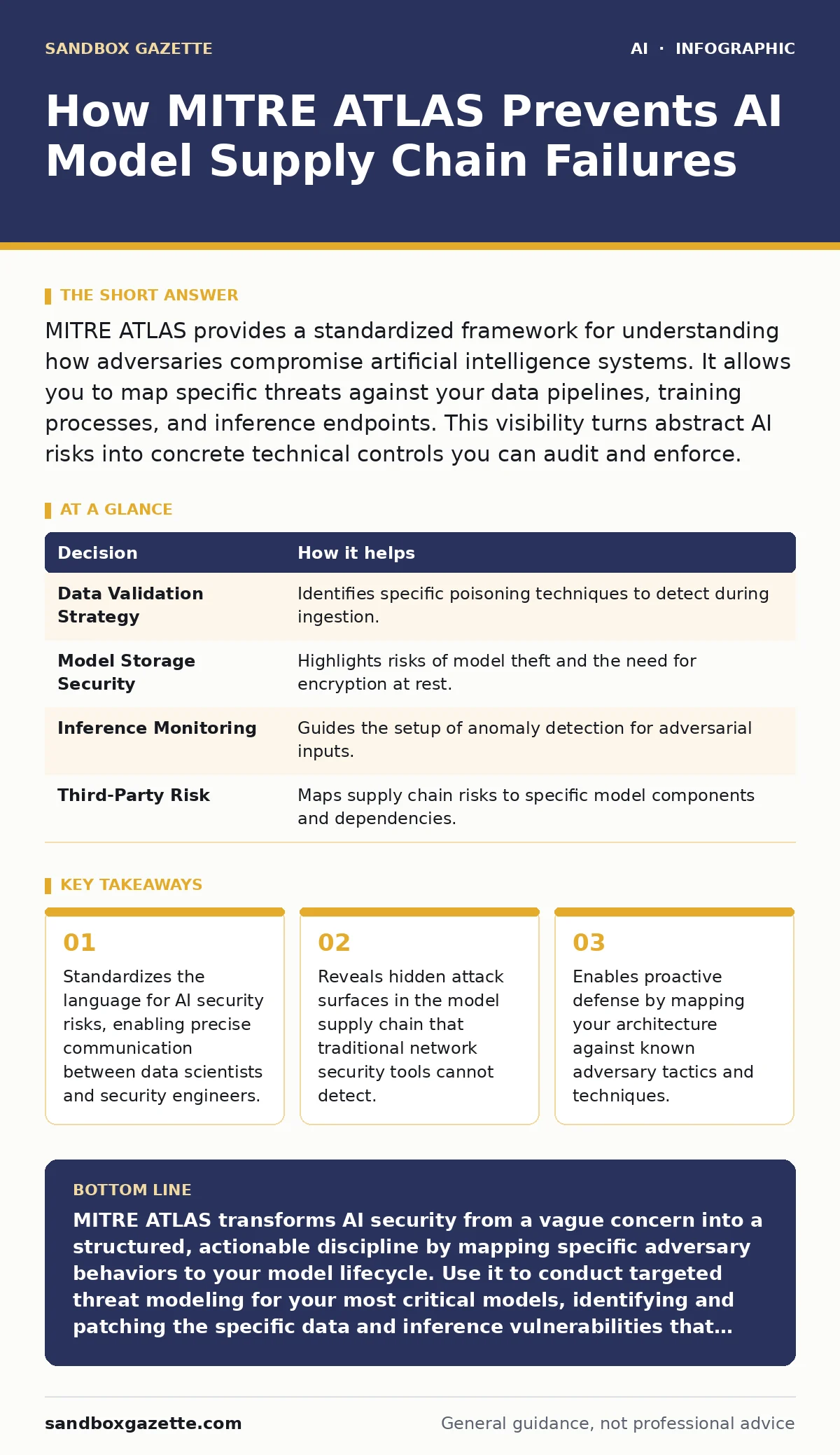
| Decision | How it helps |
|---|---|
| Data Validation Strategy | Identifies specific poisoning techniques to detect during ingestion. |
| Model Storage Security | Highlights risks of model theft and the need for encryption at rest. |
| Inference Monitoring | Guides the setup of anomaly detection for adversarial inputs. |
| Third-Party Risk | Maps supply chain risks to specific model components and dependencies. |
This table shows how abstract security goals become concrete technical requirements. You move from "secure the data" to "detect label flipping in training sets."
What Goes Wrong Without It
Without a structured framework, AI security becomes reactive. Teams often focus on the most visible threats, such as API abuse, while ignoring subtle data manipulation. This creates blind spots that adversaries exploit.
A common failure is treating the model as a black box. You monitor inputs and outputs but ignore the internal state. Attackers can manipulate the model’s behavior without triggering output anomalies immediately. ATLAS forces you to consider the internal mechanics of the model as a security boundary.
Another failure is siloed responsibility. Data scientists own the model, while security teams own the infrastructure. Without a shared framework, neither group feels responsible for the intersection. ATLAS bridges this gap by defining shared ownership of specific techniques.
How Teams Use the Framework
Teams use ATLAS to conduct threat modeling exercises. They map their specific AI architecture against the framework’s tactics. This reveals which techniques are applicable to their stack and which are not.
For example, a team using pre-trained models from public repositories faces different risks than a team training models from scratch. ATLAS allows them to filter out irrelevant tactics and focus on supply chain integrity for pre-trained models.
Teams also use ATLAS to design detection rules. By understanding the specific techniques an adversary might use, you can create monitoring alerts that look for those behaviors. This is more effective than generic anomaly detection.
See also: Access Controls for AI Agents: A Practical Implementation Checklist
The Hidden Cost of Complexity
Adopting ATLAS introduces complexity. You must maintain mappings between your architecture and the framework. This requires ongoing effort as your models and infrastructure evolve.
The hidden cost is cognitive load. Security teams must understand AI concepts to use the framework effectively. AI teams must understand security concepts. This cross-pollination takes time and training.
However, the cost of not using ATLAS is higher. A single successful attack on a critical model can cause significant operational and reputational damage. The framework reduces the probability of such incidents by ensuring comprehensive coverage.
Integrating with Existing Controls
ATLAS does not replace existing security frameworks. It complements them. You can map ATLAS techniques to controls in frameworks like NIST AI RMF or ISO/IEC 27001. This creates a layered defense strategy.
For instance, ATLAS identifies data poisoning as a tactic. NIST AI RMF provides governance controls for data quality. By combining them, you ensure that technical detections align with organizational policies.
This integration ensures that AI security is not an isolated effort. It becomes part of the broader security posture. This alignment is critical for maintaining compliance and trust.
Beyond Technical Controls
ATLAS also informs organizational decisions. It helps define roles and responsibilities for AI security. It clarifies who is responsible for detecting specific types of attacks.
This clarity reduces friction between teams. When an incident occurs, you know which team leads the response. This speed is critical in mitigating damage.
By establishing clear ownership, you create a culture of shared responsibility. AI security becomes a team sport rather than a siloed function. This cultural shift is as important as the technical controls.
Key takeaways
- Standardizes the language for AI security risks, enabling precise communication between data scientists and security engineers.
- Reveals hidden attack surfaces in the model supply chain that traditional network security tools cannot detect.
- Enables proactive defense by mapping your architecture against known adversary tactics and techniques.
MITRE ATLAS transforms AI security from a vague concern into a structured, actionable discipline by mapping specific adversary behaviors to your model lifecycle. Use it to conduct targeted threat modeling for your most critical models, identifying and patching the specific data and inference vulnerabilities that traditional security tools ignore.
Frequently asked questions
Is MITRE ATLAS only for large enterprises?
No, the framework is useful for any organization using AI. It helps you identify relevant threats based on your specific architecture, regardless of size.
How often should I update my ATLAS mappings?
You should update them whenever your model architecture, data sources, or deployment environment changes significantly.
Does ATLAS cover generative AI?
Yes, the framework includes tactics and techniques relevant to generative models, including prompt injection and training data leakage.
Can I use ATLAS with other security frameworks?
Yes, ATLAS is designed to integrate with existing frameworks like NIST and ISO standards, providing specific AI-focused context.
How this guide was produced: written by the Sandbox Gazette editorial team with AI assistance, checked against the public references listed below, and reviewed when the facts change. See our editorial policy or report an error.