
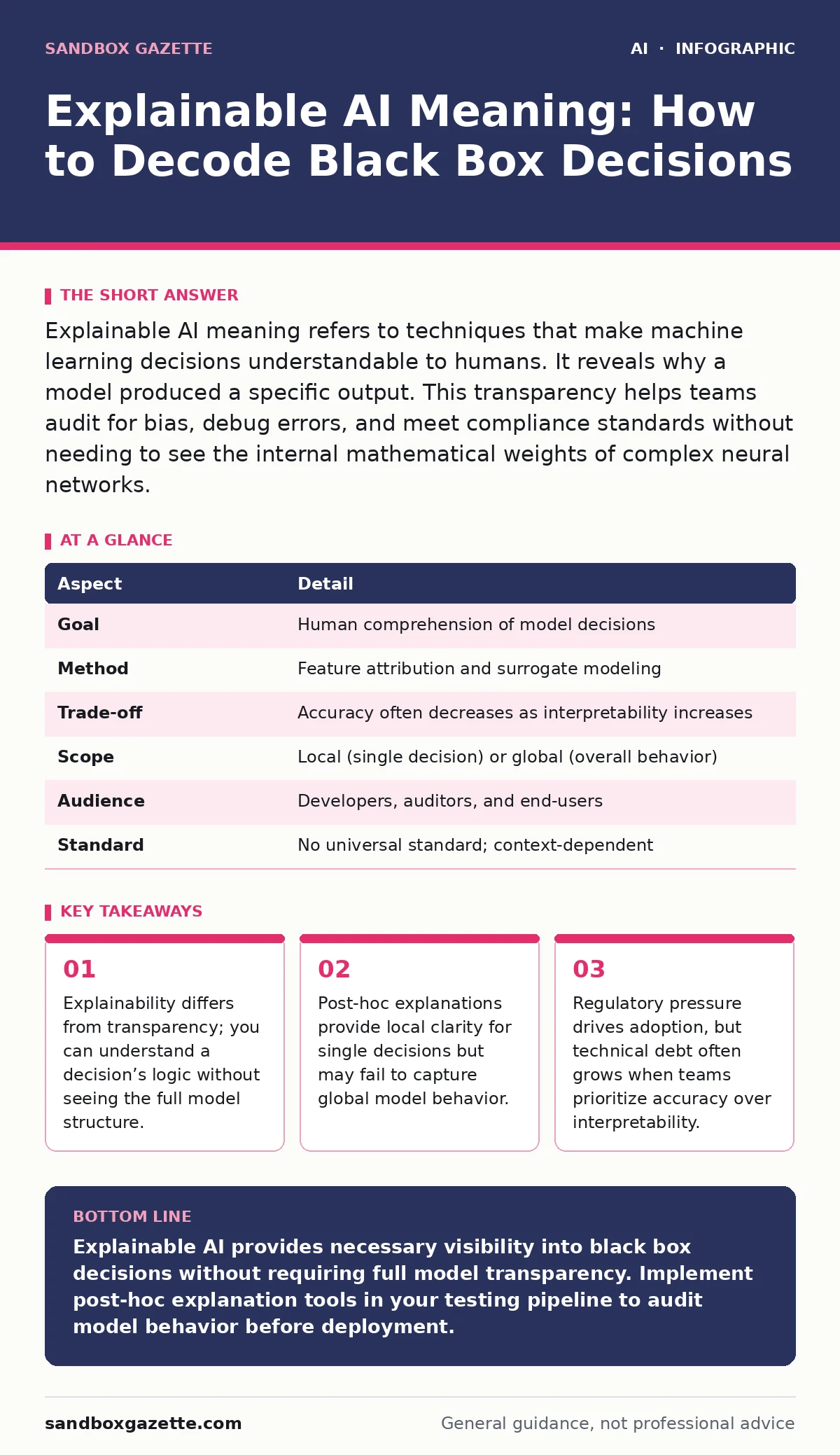
Explainable AI meaning refers to techniques that make machine learning decisions understandable to humans. It reveals why a model produced a specific output. This transparency helps teams audit for bias, debug errors, and meet compliance standards without needing to see the internal mathematical weights of complex neural networks.
Everyday analogy: the recipe versus the taste
Imagine a chef who creates a perfect dish but refuses to share the recipe. You can taste the result and describe the flavors, but you cannot replicate the process or identify a harmful ingredient. Traditional machine learning often operates like this sealed kitchen. The model ingests data and produces an output, but the internal transformation remains hidden. Explainable AI acts as a tasting menu with notes. It does not necessarily reveal every spice added, but it tells you which ingredients dominated the final flavor profile. This distinction matters when the dish causes an allergic reaction.
What is explainable ai meaning?
Explainable AI meaning describes methods that allow humans to understand and trust the outputs of machine learning systems. It bridges the gap between complex algorithmic processing and human comprehension. Black box models, such as deep neural networks, often achieve high accuracy by using millions of parameters that no single engineer can inspect. Explainability techniques extract features that influenced a specific prediction. They highlight which inputs mattered most. This allows operators to verify that the model relied on relevant signals rather than spurious correlations.
| Aspect | Detail |
|---|---|
| Goal | Human comprehension of model decisions |
| Method | Feature attribution and surrogate modeling |
| Trade-off | Accuracy often decreases as interpretability increases |
| Scope | Local (single decision) or global (overall behavior) |
| Audience | Developers, auditors, and end-users |
| Standard | No universal standard; context-dependent |
How explainable AI works
Explainability techniques generally fall into two categories: intrinsic and post-hoc. Intrinsic methods build interpretability into the model structure from the start. Decision trees and linear regression are inherently explainable because their logic follows a clear path. Post-hoc methods apply to any model after training.
They analyze the relationship between inputs and outputs without altering the model. Feature importance scores rank variables by their impact on the prediction. Local interpretable model-agnostic explanations create a simple, linear approximation around a specific data point. This surrogate model mimics the complex model’s behavior in a small neighborhood, revealing local logic.
Who this affects
Security operations teams use explainability to detect adversarial attacks and data poisoning. If a model suddenly flags benign traffic as malicious, explanation tools reveal whether the trigger is a known signature or an anomalous pattern. This helps distinguish between legitimate threats and model drift. Developers rely on these tools to debug performance issues.
When a model fails in production, knowing which features caused the error accelerates remediation. Legal and compliance officers require explanations to satisfy regulatory mandates. They must prove that automated decisions do not discriminate against protected classes. End-users benefit from trust. When patients or customers understand why a system made a recommendation, they are more likely to accept the outcome.
What people usually get wrong
Many teams confuse transparency with explainability. Transparency implies full visibility into the model’s code and weights. Explainability only requires understanding the decision logic. You can have explainability without transparency. Another common error is assuming global explanations apply to local cases. A model might generally rely on income for loan decisions, but for a specific applicant, it might rely on employment history.
Relying on global averages can mask individual biases. Teams also mistake correlation for causation. Explanation tools show which features correlated with the output, not which features caused it. A model might use shoe size to predict age in children. The explanation will highlight shoe size as important, even though it is not a causal factor for adulthood.
See also: Emergency Stop for AI Systems: 8 Critical Questions Answered · Exposed AI Model Servers: Secure Your Endpoints and APIs
Implementing explainability in practice
Start by defining the audience for the explanation. A developer needs technical details about gradients and weights. A business user needs plain language about contributing factors. Choose the right technique for the question. Use global methods like partial dependence plots to understand overall model behavior. Use local methods like SHAP values to explain individual predictions. Integrate explanation tools into your CI/CD pipeline. Generate explanations during testing to catch drift early. Document the limitations of your explanation methods. Note that surrogate models are approximations. They may not capture complex interactions present in the original model.
Hidden costs and trade-offs
Pursuing explainability often reduces model accuracy. Simple models are easier to explain but may miss complex patterns in the data. Teams must balance performance against interpretability based on the use case. High-stakes decisions in healthcare or finance require higher interpretability, even at the cost of accuracy. Computational overhead is another cost.
Generating explanations for every prediction adds latency. This can be problematic for real-time systems like fraud prevention. Finally, maintainability increases. Teams must manage both the model and the explanation infrastructure. Bugs in the explanation layer can provide misleading insights, leading to incorrect operational decisions.
Related considerations
Explainability supports broader governance efforts. It complements AI risk management by providing evidence for decision audits. It helps mitigate AI model theft by limiting the exposure of internal logic to external observers. When dealing with sensitive data, explainability tools must be configured to prevent training data leakage through their outputs. For systems using retrieval-augmented generation security, explanations must clarify whether the model relied on retrieved documents or internal parameters. Understanding these dependencies is vital for maintaining trust and security in complex AI ecosystems.
Key takeaways
- Explainability differs from transparency; you can understand a decision’s logic without seeing the full model structure.
- Post-hoc explanations provide local clarity for single decisions but may fail to capture global model behavior.
- Regulatory pressure drives adoption, but technical debt often grows when teams prioritize accuracy over interpretability.
Explainable AI provides necessary visibility into black box decisions without requiring full model transparency. Implement post-hoc explanation tools in your testing pipeline to audit model behavior before deployment.
Frequently asked questions
Is explainable AI the same as AI transparency?
No. Transparency means full visibility into the model’s code and structure. Explainability means understanding the logic behind specific decisions, which can be achieved without seeing the full internal mechanics.
Does explainable AI guarantee fair outcomes?
No. Explainability reveals which features influenced a decision, but it does not automatically correct for bias. Teams must actively analyze these explanations to identify and mitigate discriminatory patterns.
Can I use explainable AI for real-time fraud detection?
Yes, but with caution. Some explanation methods add significant computational latency. Lightweight techniques like decision trees or pre-computed feature importance scores are better suited for low-latency environments.
How do I choose between global and local explanations?
Use global explanations to understand overall model behavior and detect systemic bias. Use local explanations to debug specific errors or provide reasons for individual decisions to end-users.
How this guide was produced: written by the Sandbox Gazette editorial team with AI assistance, checked against the public references listed below, and reviewed when the facts change. See our editorial policy or report an error.