
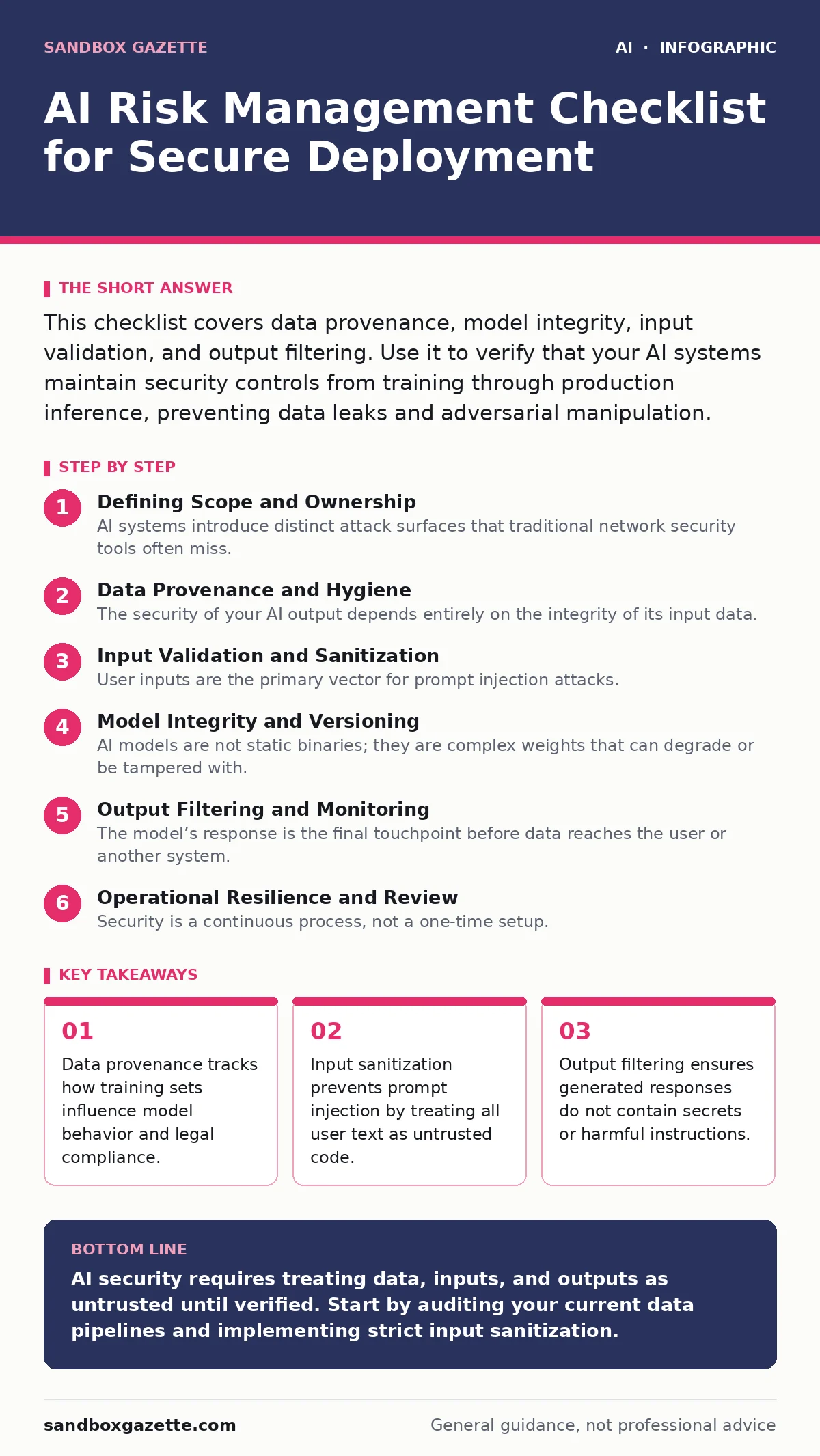
This checklist covers data provenance, model integrity, input validation, and output filtering. Use it to verify that your AI systems maintain security controls from training through production inference, preventing data leaks and adversarial manipulation.
Defining Scope and Ownership
AI systems introduce distinct attack surfaces that traditional network security tools often miss. You must define the boundary of the AI service before you can protect it. This includes the model itself, the supporting infrastructure, and the data pipelines feeding it.
- Identify model owners: Assign clear accountability for maintenance and incident response to specific engineers, not just the data science team.
- Map data dependencies: Document every external API and internal database the model accesses during training and inference.
- Define failure modes: List acceptable behaviors when the model encounters unknown or ambiguous inputs.
Imagine a scenario where a model begins hallucinating credentials because its training data included a deprecated log file. Without clear ownership, no one knows who should patch the data pipeline. This ambiguity delays remediation and increases exposure.
Data Provenance and Hygiene
The security of your AI output depends entirely on the integrity of its input data. Poor data hygiene leads to model drift, where the system’s behavior changes unpredictably over time. You must treat training data with the same rigor as source code.
- Audit training sources: Verify that all datasets come from authorized, clean sources without embedded malware or hidden payloads.
- Label sensitive content: Tag personally identifiable information and proprietary secrets before ingestion to prevent memorization.
- Monitor for data poisoning: Detect statistical anomalies in incoming data that suggest adversarial manipulation of the training set.
For deeper insights on preventing accidental exposure, review the guide on sensitive data leaks through AI chatbots. Understanding how data enters the system helps you control what leaves it.
Input Validation and Sanitization
User inputs are the primary vector for prompt injection attacks. These attacks trick the model into ignoring its system instructions by embedding malicious commands within seemingly benign text. You must assume every character entering the model is hostile.
- Implement input filtering: Strip or escape special characters and control sequences that might alter model interpretation.
- Enforce context windows: Limit the length of user inputs to reduce the surface area for complex injection attempts.
- Validate against schemas: Ensure structured data inputs match expected formats before passing them to the model.
See the section on prompt injection attacks for specific techniques adversaries use to bypass these filters. Simple length limits are not enough; you need semantic validation that understands the intent of the input.
Model Integrity and Versioning
AI models are not static binaries; they are complex weights that can degrade or be tampered with. Without strict version control, you cannot reproduce results or roll back to a safe state after a compromise.
- Hash model weights: Create cryptographic signatures for every model version to detect unauthorized modifications.
- Store weights securely: Keep model artifacts in access-controlled storage with encryption at rest and in transit.
- Track environment variables: Record the exact libraries and dependencies used during training to ensure reproducibility.
Refer to the guide on retrieval-augmented generation security for details on protecting the vector databases that support your models. If the underlying knowledge base is compromised, the model will generate false or harmful answers regardless of its own integrity.
Output Filtering and Monitoring
The model’s response is the final touchpoint before data reaches the user or another system. Malicious outputs can include code execution instructions, leaked secrets, or social engineering text. You must inspect every response before it is delivered.
- Scan for secrets: Use pattern matching to detect API keys, passwords, or private data in generated text.
- Verify factual claims: Cross-reference critical assertions against trusted sources before displaying them to users.
- Log all interactions: Record inputs and outputs for forensic analysis, ensuring compliance with audit requirements.
Explore the guide on LLM guardrails to learn how to automate this filtering process. Manual review is impossible at scale, so automated checks must be robust and low-latency.
See also: Access Controls for AI Agents: A Practical Implementation Checklist
Operational Resilience and Review
Security is a continuous process, not a one-time setup. AI systems evolve, and so do the threats targeting them. Regular reviews ensure that your controls remain effective against new techniques.
- Conduct red teaming: Simulate adversarial attacks to test the effectiveness of your input and output filters.
- Update threat models: Incorporate new attack vectors discovered in the wild into your defense strategy.
- Train staff on AI risks: Ensure developers and operators understand the unique risks of generative AI versus traditional software.
For a broader view, check the guide on AI transparency to understand how to explain model decisions to auditors and users. Clarity in operation reduces the risk of accidental misuse.
Key takeaways
- Data provenance tracks how training sets influence model behavior and legal compliance.
- Input sanitization prevents prompt injection by treating all user text as untrusted code.
- Output filtering ensures generated responses do not contain secrets or harmful instructions.
AI security requires treating data, inputs, and outputs as untrusted until verified. Start by auditing your current data pipelines and implementing strict input sanitization.
Frequently asked questions
How often should I update my AI risk management checklist?
Update the checklist whenever you change the model version, add new data sources, or identify new threat vectors in the industry.
Does this checklist apply to open-source models?
Yes, open-source models often require stricter scrutiny of training data and weights since you lack vendor support for security patches.
Can automated tools replace manual review entirely?
No, automated tools catch known patterns, but human review is necessary for nuanced threats and evolving attack techniques.
What is the biggest risk in AI deployment?
The biggest risk is uncontrolled data leakage, where the model inadvertently reveals sensitive information from its training set.
How this guide was produced: written by the Sandbox Gazette editorial team with AI assistance, checked against the public references listed below, and reviewed when the facts change. See our editorial policy or report an error.