
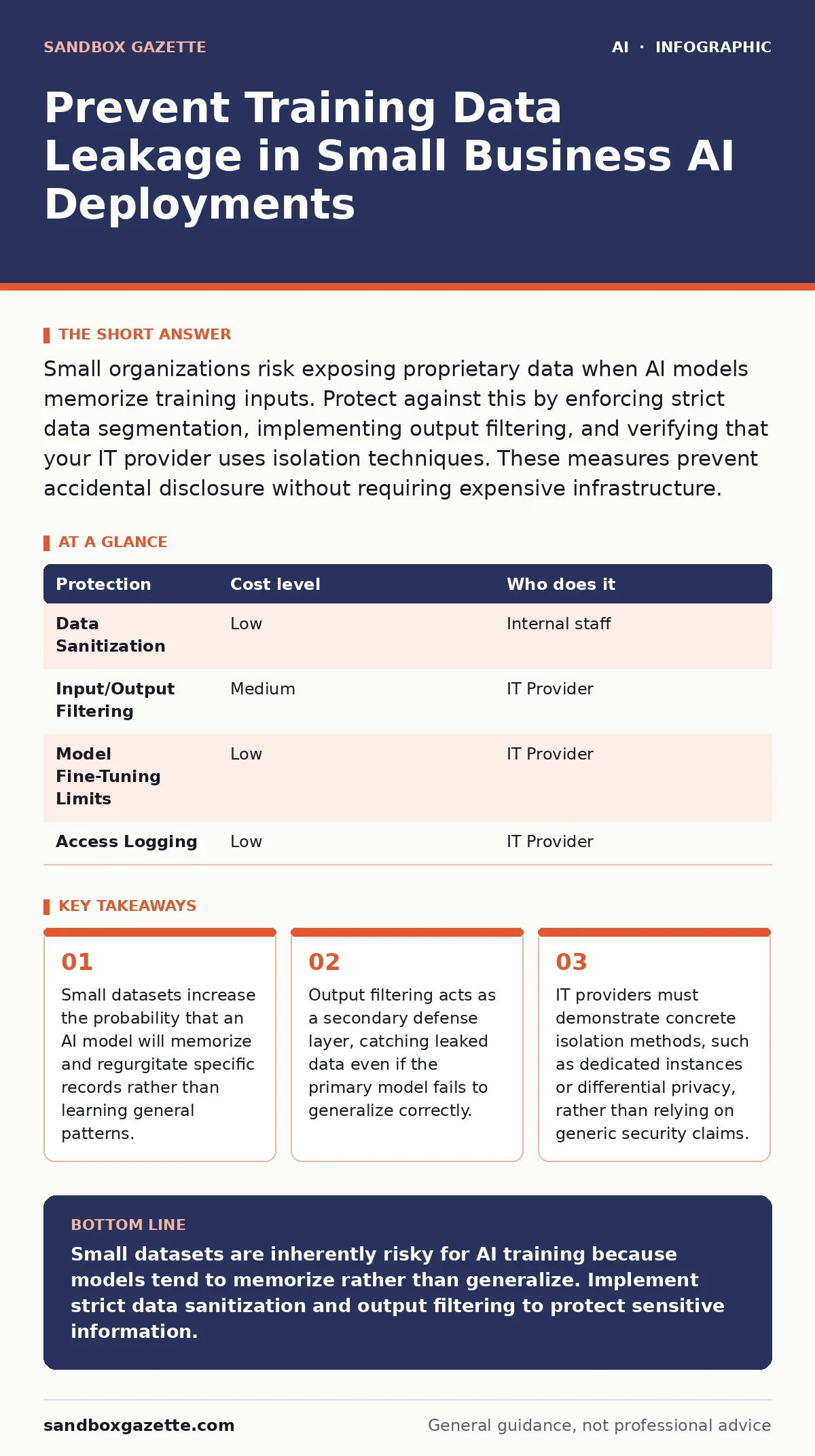
Small organizations risk exposing proprietary data when AI models memorize training inputs. Protect against this by enforcing strict data segmentation, implementing output filtering, and verifying that your IT provider uses isolation techniques. These measures prevent accidental disclosure without requiring expensive infrastructure.
The Small Data Paradox
Small organizations face a distinct vulnerability when adopting artificial intelligence. Large enterprises possess massive datasets that dilute individual records, making it statistically difficult for a model to isolate and repeat specific information. Small businesses often have limited data points. Each record carries more weight in the training process. This increases the likelihood of memorization. The model learns the exact data rather than the underlying pattern.
This phenomenon is known as overfitting. The system becomes too specialized for the training set. It loses the ability to generalize to new, unseen inputs. In security terms, this means the model acts as a database rather than an intelligence tool. You must treat the model’s memory as a potential leak vector.
Mechanisms of Leakage
Data leakage occurs through two primary pathways. The first is direct memorization. The model stores specific sequences from the training data. When prompted correctly, it reproduces these sequences verbatim. This often happens with sensitive identifiers like social security numbers or credit card details.
The second pathway is inference attacks. An attacker does not ask for the data directly. Instead, they craft inputs that force the model to reveal hidden correlations. By analyzing the model’s confidence scores or output variations, an adversary can reconstruct parts of the training set. This method requires no direct access to the model weights. It exploits the mathematical relationship between input and output.
Low-Cost Protection Strategies
You do not need enterprise-grade infrastructure to mitigate these risks. Several effective controls rely on process and configuration rather than expensive hardware. The following table outlines practical steps for small teams.
| Protection | Cost level | Who does it |
|---|---|---|
| Data Sanitization | Low | Internal staff |
| Input/Output Filtering | Medium | IT Provider |
| Model Fine-Tuning Limits | Low | IT Provider |
| Access Logging | Low | IT Provider |
Data sanitization is the first line of defense. Remove personally identifiable information before training. This reduces the amount of sensitive material the model can memorize. Use tokenization to replace real values with placeholders. This preserves the data structure for learning while destroying the sensitive content.
Input and output filtering adds a second layer. You can implement keyword blocking or pattern matching. This scans outputs for common formats like email addresses or phone numbers. If a match occurs, the system blocks the response. This does not prevent the model from learning the data, but it prevents the data from leaving the system.
Configuring Safe Interaction
How users interact with the model matters as much as the training data. Open-ended prompts encourage the model to explore its full memory. Constrained prompts limit the scope of possible responses. You should design interfaces that restrict user input to specific categories.
Implementing LLM guardrails helps enforce these boundaries. These are rules that check inputs and outputs against predefined policies. For example, a guardrail can reject any prompt that asks for lists of customers. It can also flag outputs that contain high-confidence matches for sensitive patterns. This approach shifts security from the model weights to the application layer. It is easier to update and verify.
Evaluating IT Provider Claims
When outsourcing AI development, you must verify security practices. Vague promises of "enterprise security" are insufficient. You need specific technical details. The following questions help you assess the provider’s competence.
- What data isolation methods do you use?
- How do you prevent cross-tenant data leakage?
- Can you demonstrate output filtering in action?
- What is your process for data deletion after training?
Ask for concrete examples of isolation. A provider should use dedicated compute resources for your model. Shared environments increase the risk of data mixing. If they use a public cloud, they must implement strict access controls. They should also provide logs that show who accessed the data and when.
Request a demonstration of output filtering. Ask them to show how the system blocks a request for sensitive information. This tests the effectiveness of their guardrails. It also reveals whether they understand the specific risks of your industry.
See also: Access Controls for AI Agents: A Practical Implementation Checklist
Integrating with Broader Security
AI security does not exist in a vacuum. It must align with your existing security framework. Review your current application security practices. Ensure that AI components are included in your risk assessments.
You might find insights from resources like the OWASP Top 10 for LLM applications. This framework categorizes common vulnerabilities in large language models. It helps you identify gaps in your current setup. Similarly, understanding retrieval-augmented generation security is vital if you use external knowledge bases. This technique reduces reliance on model memory by fetching data at runtime. It shifts the trust boundary from the model to the retrieval system.
Monitoring and Incident Response
Even with strong protections, incidents can occur. You need a plan for detection and response. Monitor logs for unusual access patterns. Look for spikes in data retrieval or repeated failed authentication attempts.
Establish a clear protocol for suspected leakage. This should include immediate suspension of access. It should also involve a thorough review of the model’s outputs. If leakage is confirmed, you must retrain the model with sanitized data. Do not simply patch the output filter. The underlying model may still contain the sensitive information.
Long-Term Resilience
Security is an ongoing process. As AI capabilities evolve, so do the attack methods. Stay informed about new techniques. Regularly review your security controls. Update your filtering rules and guardrails as needed.
Consider the broader implications of AI adoption. Look into how AI model theft could impact your organization. Attackers may attempt to copy your model to extract its training data. Implementing watermarks or other detection methods can help identify unauthorized use. This adds another layer of protection against sophisticated adversaries.
Key takeaways
- Small datasets increase the probability that an AI model will memorize and regurgitate specific records rather than learning general patterns.
- Output filtering acts as a secondary defense layer, catching leaked data even if the primary model fails to generalize correctly.
- IT providers must demonstrate concrete isolation methods, such as dedicated instances or differential privacy, rather than relying on generic security claims.
Small datasets are inherently risky for AI training because models tend to memorize rather than generalize. Implement strict data sanitization and output filtering to protect sensitive information.
Frequently asked questions
Does using a cloud provider eliminate data leakage risks?
No, cloud providers offer infrastructure but do not automatically secure your data. You remain responsible for configuring access controls and filtering outputs. Shared environments can still pose risks if isolation is not properly enforced.
What is the difference between training data leakage and prompt injection?
Training data leakage involves the model revealing data it learned during training. Prompt injection involves an attacker manipulating the input to bypass safety filters. Both are serious, but they require different mitigation strategies.
How this guide was produced: written by the Sandbox Gazette editorial team with AI assistance, checked against the public references listed below, and reviewed when the facts change. See our editorial policy or report an error.