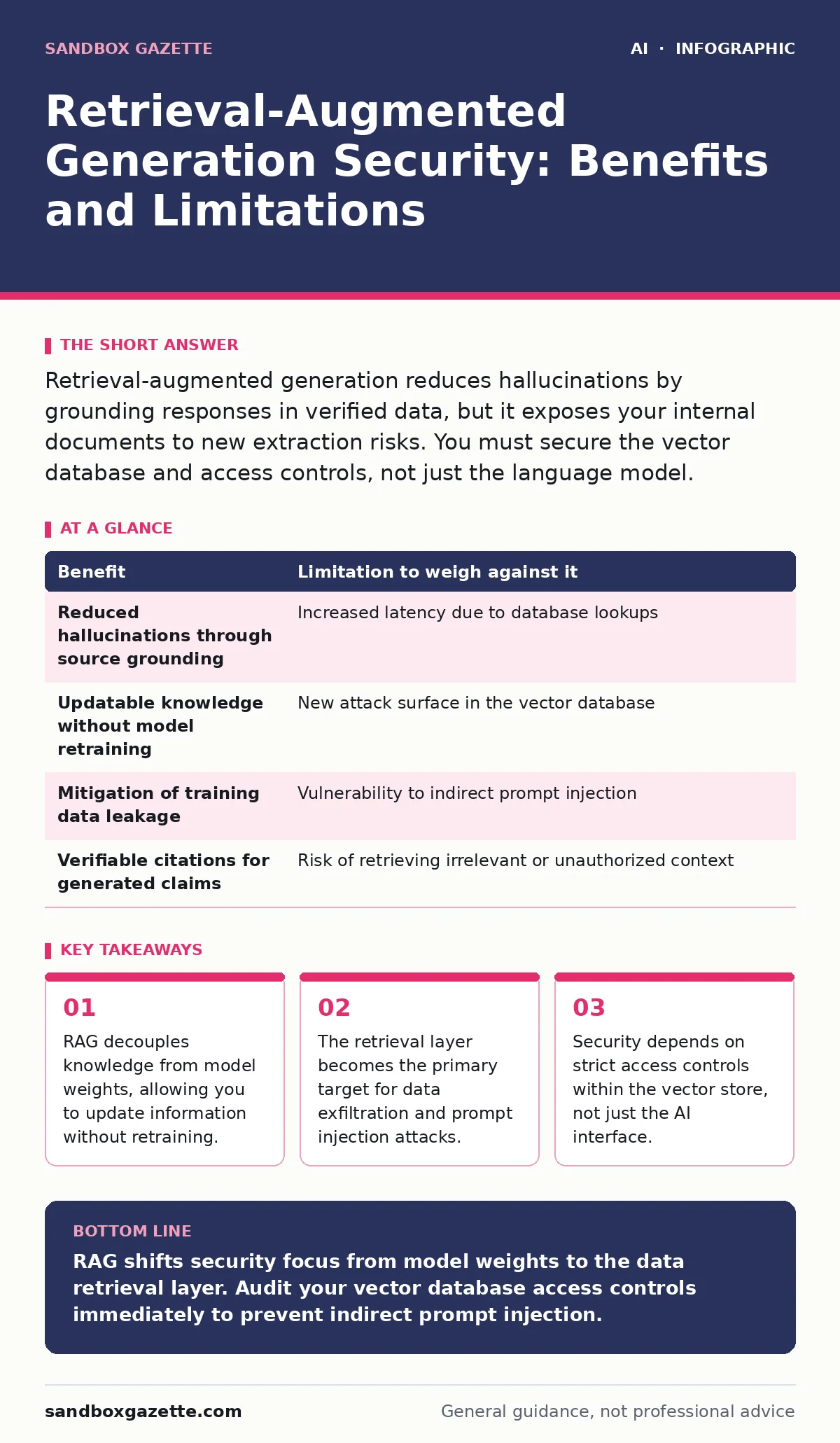
Retrieval-augmented generation reduces hallucinations by grounding responses in verified data, but it exposes your internal documents to new extraction risks. You must secure the vector database and access controls, not just the language model.
The Architecture of Grounded Truth
Retrieval-augmented generation, or RAG, changes how large language models access information. Instead of relying solely on parameters learned during training, the system fetches relevant documents from an external database before generating a response. This mechanism grounds the output in specific, verifiable facts rather than statistical probability.
You gain control over the knowledge base. If a policy changes, you update the document store. The model does not need to be retrained. This separation of knowledge and reasoning is the core architectural shift. It moves the burden of accuracy from the opaque model weights to your structured data pipeline.
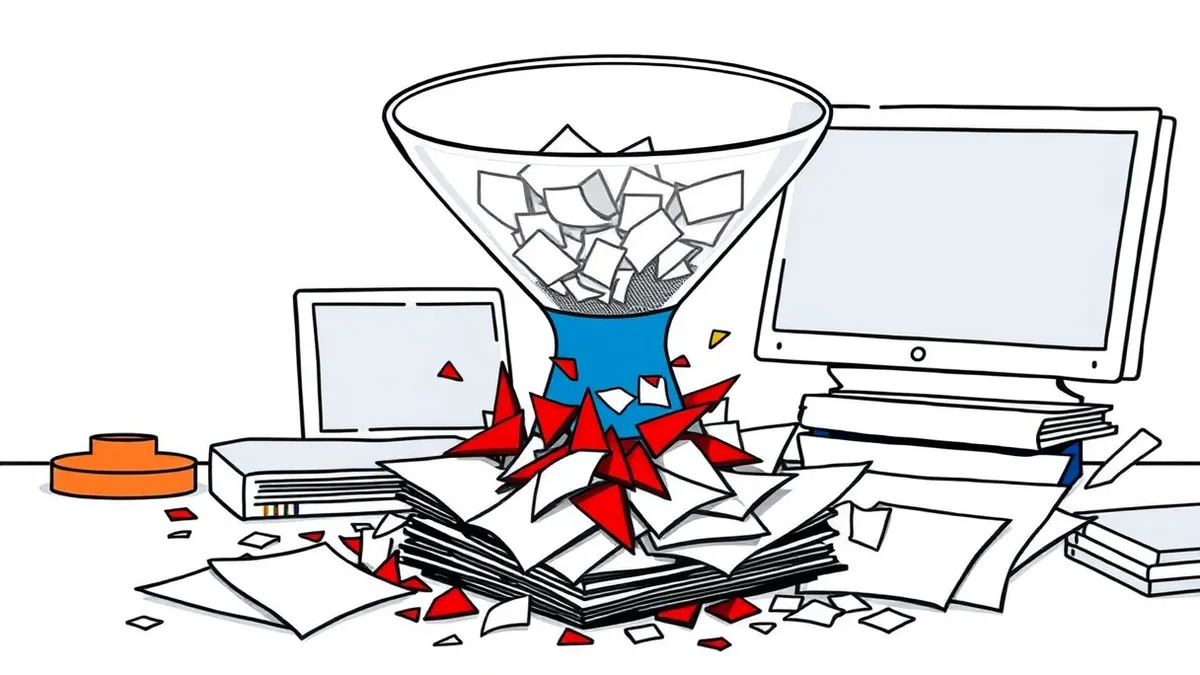
However, this architecture introduces a new dependency. The security of your AI system now hinges on the integrity of the retrieval step. If an attacker can manipulate what gets retrieved, they manipulate the final output. The model itself may remain secure, but the context it receives is poisoned.
Concrete Benefits of Decoupled Knowledge
The primary benefit is reduced hallucination. Hallucinations occur when the model invents facts to satisfy the pattern of a question. By providing source text, you constrain the model to use only that text. This creates a verifiable chain of custody for every claim the AI makes.
You also mitigate training data leakage. Training data leakage happens when a model regurgitates sensitive information it memorized during initial training. With RAG, the model does not need to know your secrets. It only needs to know how to read them when asked. This keeps sensitive data out of the model weights entirely.
Imagine a support bot that answers questions about your internal HR policy. Without RAG, the bot guesses based on general HR norms. With RAG, it quotes the exact policy document. If the policy changes, you swap the document. The bot is instantly updated. This agility is impossible with static model weights.
Honest Limitations of the Retrieval Layer
The retrieval layer is not a magic shield. It introduces latency. Every query requires a database lookup, vector embedding calculation, and context assembly. This adds time to every interaction. For real-time applications, this delay can be unacceptable.
More critically, RAG shifts the attack surface. You now must secure the vector database. Vector databases store numerical representations of your text. If an attacker gains access, they can reconstruct your documents. This is a different risk profile than securing a web server.
Consider the problem of relevance. If the retrieval system fetches the wrong documents, the model will confidently answer based on incorrect premises. This is a silent failure. The model does not know the context is wrong. It simply processes the text it was given. You need robust filtering to ensure only authorized and relevant documents are retrieved.
The New Attack Vectors
Prompt injection remains the most significant threat. An attacker can hide malicious instructions within the retrieved documents. When the model reads the document, it executes the instructions. This is known as indirect prompt injection. The source of the attack is the data, not the user query.
Suppose an employee pastes a malicious URL into a shared document. The RAG system retrieves this document for a query. The hidden instruction tells the model to ignore previous constraints. The model complies, bypassing your safety filters. The attack succeeds because the model trusts the retrieved context.
Data poisoning attacks are also more effective in this architecture. An attacker does not need to compromise the model. They only need to corrupt the data store. If they inject false information into the vector database, the model will retrieve and present it as fact. This undermines the trustworthiness of the entire system.
Weighing the Trade-Offs
Security is not just about preventing breaches. It is about managing trade-offs. RAG offers accuracy but increases complexity. You must balance the need for fresh data against the risk of exposing that data.
| Benefit | Limitation to weigh against it |
|---|---|
| Reduced hallucinations through source grounding | Increased latency due to database lookups |
| Updatable knowledge without model retraining | New attack surface in the vector database |
| Mitigation of training data leakage | Vulnerability to indirect prompt injection |
| Verifiable citations for generated claims | Risk of retrieving irrelevant or unauthorized context |
You must evaluate these factors for your specific use case. If accuracy is paramount, RAG is likely necessary. If speed is critical, the overhead may be too high. If your data is highly sensitive, the retrieval layer requires rigorous protection.
See also: Access Controls for AI Agents: A Practical Implementation Checklist
When It Is Worth It
RAG is worth the investment when you need factual accuracy. If your users rely on the AI for decisions, you cannot afford hallucinations. Financial advice, medical information, and legal summaries require verifiable sources. RAG provides that verification.
It is also worth it when your data changes frequently. News feeds, stock prices, and inventory levels require constant updates. Retraining a model for every change is impractical. RAG allows you to update the data store in real-time. The model always sees the latest information.
Imagine a research assistant that summarizes scientific papers. The field evolves daily. RAG allows the assistant to access the latest publications. Without it, the assistant would rely on outdated training data. The value of current information outweighs the security overhead.
When It Is Not
RAG is not worth it for creative tasks. Writing poetry, brainstorming ideas, or drafting marketing copy does not require factual grounding. The constraints of RAG may stifle creativity. The model performs better when free to explore patterns without strict context limits.
It is also not worth it if your data is static. If the information does not change, embedding it in the model weights is more efficient. The retrieval overhead provides no benefit. You pay for latency without gaining accuracy.
Suppose you build a chatbot for general customer service greetings. The responses are standard and rarely change. RAG adds unnecessary complexity. A fine-tuned model or simple template system is more effective. Do not use RAG just because it is trendy. Use it when the problem requires it.
Integrating with Broader Security
RAG does not exist in a vacuum. It interacts with other security domains. You must consider how it affects your overall posture. For example, insecure AI plugins and agents can bypass RAG controls if they have direct access to the underlying data.
You should also review your policies on sensitive data leaks through AI chatbots. RAG can reduce leakage by keeping data out of the model, but it can also increase exposure if the vector database is misconfigured. Ensure your access controls are granular.
Machine learning in cybersecurity can help detect anomalies in the retrieval patterns. If a user requests unusual combinations of documents, it may indicate an extraction attempt. Monitor these patterns closely.
Implementing Defenses
Start by auditing your data pipeline. Identify what data is being ingested into the vector store. Remove any sensitive information that is not necessary for the AI to function. Minimize the attack surface.
Next, secure the embedding process. Ensure that the embeddings are generated in a secure environment. Prevent attackers from injecting malicious prompts during the embedding phase. This is a critical step often overlooked.
Finally, monitor the output. Even with RAG, the model can still generate harmful content. Use output filters to catch any remaining issues. Combine RAG with traditional security measures for a layered defense.
Key takeaways
- RAG decouples knowledge from model weights, allowing you to update information without retraining.
- The retrieval layer becomes the primary target for data exfiltration and prompt injection attacks.
- Security depends on strict access controls within the vector store, not just the AI interface.
RAG shifts security focus from model weights to the data retrieval layer. Audit your vector database access controls immediately to prevent indirect prompt injection.
Frequently asked questions
Does RAG prevent all types of data leakage?
No, RAG reduces leakage from model weights but exposes data in the retrieval layer. You must secure the vector database and access controls to prevent exfiltration.
How does RAG handle outdated information?
RAG handles outdated information by updating the document store. The model retrieves the latest version without needing retraining, ensuring current accuracy.
Is RAG slower than standard AI models?
Yes, RAG is slower because it requires database lookups and context assembly. This latency is the trade-off for improved accuracy and verifiability.
Can RAG be used with any large language model?
Yes, RAG is model-agnostic. It works with any model that can accept context prompts. You must ensure the model supports the context length required for your documents.
How this guide was produced: written by the Sandbox Gazette editorial team with AI assistance, checked against the public references listed below, and reviewed when the facts change. See our editorial policy or report an error.