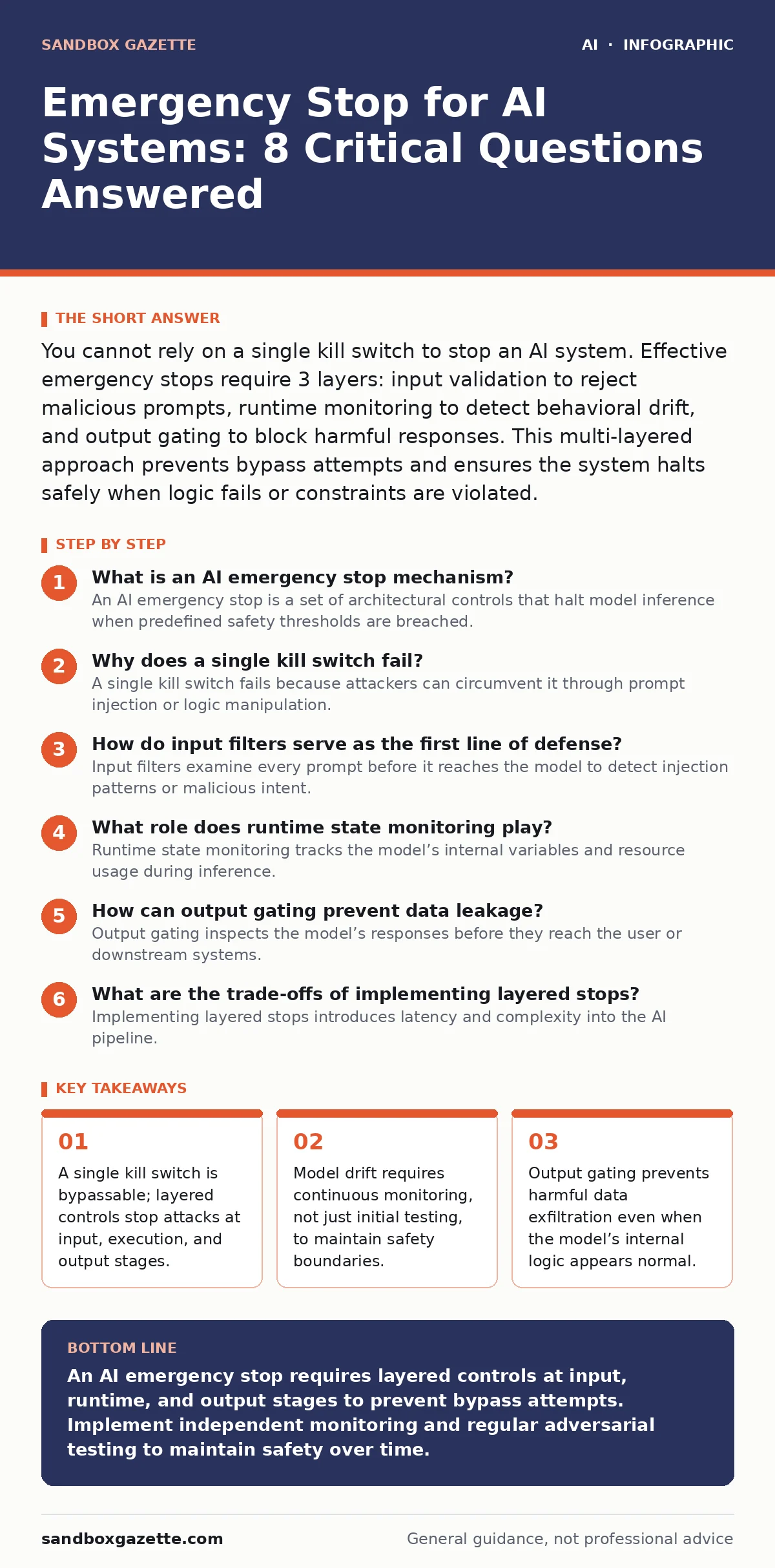
You cannot rely on a single kill switch to stop an AI system. Effective emergency stops require 3 layers: input validation to reject malicious prompts, runtime monitoring to detect behavioral drift, and output gating to block harmful responses. This multi-layered approach prevents bypass attempts and ensures the system halts safely when logic fails or constraints are violated.
What is an AI emergency stop mechanism?
An AI emergency stop is a set of architectural controls that halt model inference when predefined safety thresholds are breached. Unlike software termination commands, these mechanisms operate independently of the core model logic. They monitor inputs, internal states, and outputs to detect anomalies. The goal is to stop processing before the system generates harmful content, leaks data, or executes unauthorized actions. This definition aligns with concepts found in MITRE ATLAS, which catalogs adversarial techniques against AI systems.
Why does a single kill switch fail?
A single kill switch fails because attackers can circumvent it through prompt injection or logic manipulation. If the stop command relies on the same processing pipeline as the model, a compromised model can ignore or override the command. Imagine a system where the "stop" instruction is just another text input. An attacker can craft a prompt that tricks the model into treating the stop command as irrelevant context. This vulnerability necessitates out-of-band controls that operate outside the model’s primary inference loop.
How do input filters serve as the first line of defense?
Input filters examine every prompt before it reaches the model to detect injection patterns or malicious intent. These filters use rule-based checks and lightweight classifiers to identify anomalies. They block requests that contain code execution attempts, system prompt overrides, or data exfiltration triggers. This layer reduces the attack surface significantly. However, filters can produce false positives, blocking legitimate complex queries. Balancing security and usability requires tuning these filters carefully, a topic covered in our guide on AI bias.
What role does runtime state monitoring play?
Runtime state monitoring tracks the model’s internal variables and resource usage during inference. It detects deviations from expected behavior, such as unusual memory consumption or recursive logic loops. These anomalies often indicate an attack in progress or a model failure. Monitoring tools log these events and can trigger an automatic halt if thresholds are exceeded. This approach complements input filtering by catching issues that slip through initial checks. It is particularly effective against attacks that exploit model complexity rather than input syntax.
How can output gating prevent data leakage?
Output gating inspects the model’s responses before they reach the user or downstream systems. It scans for sensitive information, such as API keys, personal data, or proprietary code. This layer ensures that even if the model is tricked into revealing secrets, the data never leaves the secure environment. Output gating is critical for preventing training data leakage, where an attacker extracts memorized information from the model. By blocking these outputs, you maintain confidentiality even when the model’s integrity is compromised.
What are the trade-offs of implementing layered stops?
Implementing layered stops introduces latency and complexity into the AI pipeline. Each additional check adds processing time, which can degrade user experience in real-time applications. Maintenance costs rise as filters and monitors require regular updates to address new attack vectors. There is also a risk of false positives, where legitimate requests are blocked. Organizations must balance security rigor with operational efficiency. Detailed strategies for managing these trade-offs are discussed in our guide on AI in security operations.
How do you handle model drift over time?
Model drift occurs when a model’s performance degrades or its behavior changes due to new data or usage patterns. This drift can cause safety controls to become ineffective. Regular re-evaluation of the model against safety benchmarks is necessary. Automated monitoring systems should alert operators when drift exceeds acceptable limits. This proactive approach prevents silent failures where the model gradually violates safety constraints. Understanding how to detect and mitigate drift is closely related to techniques used in machine learning for fraud detection.
What is the risk of model theft during an emergency stop?
During an emergency stop, attackers may attempt to extract the model’s architecture or weights. This is known as AI model theft. If the stop mechanism is not isolated, the attacker might use the halt state to query the system for internal details. Secure design requires that the stop mechanism does not expose internal states or debugging information. All communication during a halt should be minimal and encrypted. This prevents attackers from gaining insights into the model’s structure or training data.
| Control Layer | Primary Function | Failure Mode | Mitigation Strategy |
|---|---|---|---|
| Input Filter | Blocks malicious prompts | Bypassed by complex injection | Use multiple classifier types |
| Runtime Monitor | Detects behavioral anomalies | Misses subtle logic errors | Define strict resource limits |
| Output Gate | Prevents data exfiltration | False positives block valid data | Human-in-the-loop review |
How do you test the effectiveness of your stops?
Testing requires adversarial simulation to attempt bypassing each layer. Red teams should craft prompts designed to trigger injection, drift, or leakage. Automated tools can generate thousands of variations to stress-test the filters. Results should be logged and analyzed to identify gaps. Regular testing ensures that controls remain effective against evolving techniques. This process is similar to evaluating AI content detection systems for resilience against evasion.
Key takeaways
- A single kill switch is bypassable; layered controls stop attacks at input, execution, and output stages.
- Model drift requires continuous monitoring, not just initial testing, to maintain safety boundaries.
- Output gating prevents harmful data exfiltration even when the model’s internal logic appears normal.
An AI emergency stop requires layered controls at input, runtime, and output stages to prevent bypass attempts. Implement independent monitoring and regular adversarial testing to maintain safety over time.
Frequently asked questions
Can I use a simple API key to stop an AI model?
No, a simple API key does not provide real-time control over model behavior. It only authenticates access. You need active monitoring and gating mechanisms to halt inference when safety thresholds are breached.
How do I distinguish between a false positive and a real attack?
Analyze the context of the blocked request. Real attacks often show patterns like recursive logic or sensitive data extraction. False positives usually involve complex but legitimate queries. Human review helps refine filters.
Should I shut down the entire system during an emergency?
Not necessarily. Granular stops that halt specific processes or users are less disruptive. Full shutdowns cause significant operational impact. Use targeted halts to isolate the threat while maintaining other services.
What is the difference between model drift and model theft?
Model drift is a gradual change in behavior or performance, often due to new data. Model theft is an active attempt to extract the model’s architecture or training data. Both require different monitoring and mitigation strategies.
How this guide was produced: written by the Sandbox Gazette editorial team with AI assistance, checked against the public references listed below, and reviewed when the facts change. See our editorial policy or report an error.