
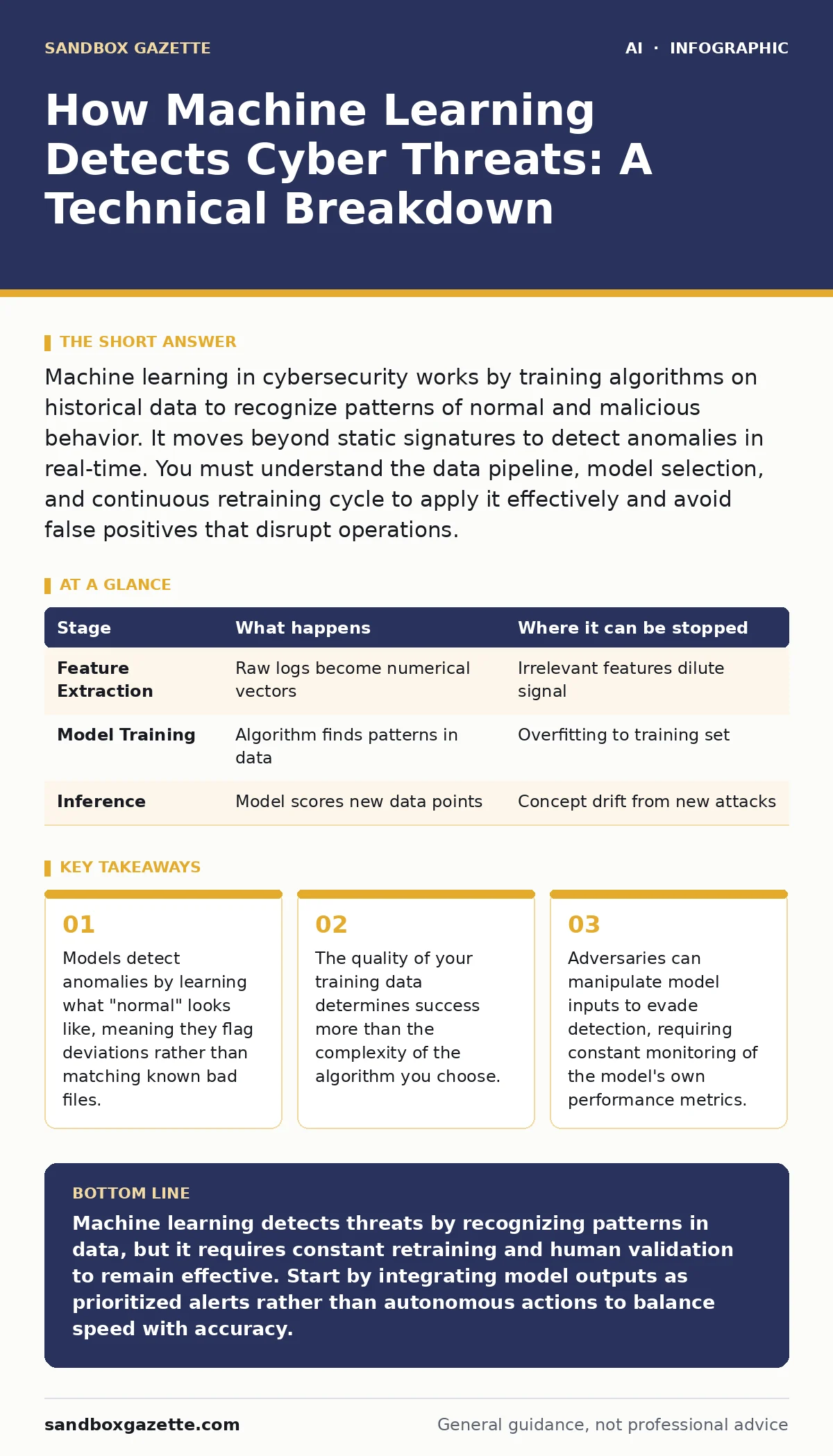
Machine learning in cybersecurity works by training algorithms on historical data to recognize patterns of normal and malicious behavior. It moves beyond static signatures to detect anomalies in real-time. You must understand the data pipeline, model selection, and continuous retraining cycle to apply it effectively and avoid false positives that disrupt operations.
The Data Foundation
Machine learning does not create intelligence from nothing. It relies entirely on the data you feed it. If your historical logs lack examples of specific attack vectors, the model will not recognize them. This creates a dependency on comprehensive logging and data hygiene before any algorithmic work begins.
You must clean and label your data before training. Labeling means marking each data point as benign or malicious. This step is labor-intensive but necessary. Without accurate labels, the model learns incorrect associations. Imagine a fire alarm that learns to ignore smoke because it was trained only on clear air. It will never trigger during an actual fire.
Stage 1: Feature Extraction
Raw data is too noisy for most algorithms to process efficiently. You must convert raw logs into numerical features that the model can understand. This process is called feature extraction. It involves selecting relevant attributes, such as packet size, connection duration, or user login times, while discarding irrelevant noise.
The choice of features dictates the model's ability to distinguish between normal activity and an attack. Poor feature selection leads to high false positive rates. For example, including the time of day might help detect off-hours brute force attempts, but it might also flag legitimate night-shift workers as threats. You must balance specificity with coverage.
| Stage | What happens | Where it can be stopped |
|---|---|---|
| Feature Extraction | Raw logs become numerical vectors | Irrelevant features dilute signal |
| Model Training | Algorithm finds patterns in data | Overfitting to training set |
| Inference | Model scores new data points | Concept drift from new attacks |
Stage 2: Model Training
During training, the algorithm adjusts its internal weights to minimize prediction errors. It looks for mathematical relationships between the input features and the known labels. Supervised learning uses labeled data, while unsupervised learning finds clusters without predefined labels.
Most security teams use a mix of both. Supervised models catch known malware families. Unsupervised models detect novel anomalies that do not match any known signature. The trade-off is control. Unsupervised models are harder to tune and often generate more noise. You must validate the model against a hold-out dataset to ensure it generalizes to new data.
Stage 3: Inference and Scoring
In production, the model receives new, unseen data. This is the inference phase. The model calculates a probability score for each input. A high score indicates a high likelihood of malicious activity. You must set a threshold to determine when to trigger an alert.
Setting this threshold is a business decision, not just a technical one. A lower threshold catches more threats but increases false positives, overwhelming analysts. A higher threshold reduces noise but misses subtle attacks. You must monitor the precision and recall metrics continuously. Precision measures how many alerts were true threats. Recall measures how many actual threats were caught.
Stage 4: Feedback Loop
Machine learning models degrade over time. This is known as concept drift. Attackers change their tactics, and normal user behavior shifts. A model trained on last year's data may be useless today. You must establish a feedback loop where analysts label false positives and true negatives.
These labels retrain the model, keeping it aligned with current realities. Without this loop, the model becomes stale. Imagine a security camera that learns to ignore a new uniform worn by staff. It will flag every employee in that uniform as an intruder. Continuous learning is not optional; it is the maintenance requirement of the system.
See also: Implement Machine Learning for Fraud Detection: A Step-by-Step Plan · How MITRE ATLAS Prevents AI Model Supply Chain Failures
Reading Model Outputs
You cannot trust a model's output blindly. You must understand why it made a decision. Explainable AI techniques help you see which features influenced the score. If a model flags a login because of the IP address, you can verify if that IP is known to be malicious.
If the model flags a login because of an obscure combination of mouse movements and keystroke timing, it may be a false positive caused by a new keyboard layout. You need to audit the model's reasoning to maintain trust. Refer to guides on AI transparency to understand how to demand explanations from black-box models.
Applying ML in Operations
Integrate machine learning outputs into your existing workflow. Do not let the model act autonomously without human oversight. Use it to prioritize alerts. High-confidence threats get immediate attention. Low-confidence anomalies get queued for review.
This hybrid approach leverages the speed of automation and the judgment of humans. It reduces alert fatigue. You must also protect the model itself. Adversaries may try to poison the training data or inject malicious prompts to confuse the system. See our guide on data poisoning attacks to understand how attackers corrupt the learning process.
Common Pitfalls
One major pitfall is assuming the model is static. It is not. Another is ignoring the computational cost. Real-time inference requires significant processing power. You must balance accuracy with latency. A model that takes five seconds to analyze a packet is useless for network traffic.
Also, avoid using machine learning for problems that have simple rule-based solutions. If you can write a regular expression to catch a specific malware hash, do not train a neural network. Machine learning adds complexity and cost. Use it only when the pattern is too complex for static rules.
Maintaining Trust
Trust in machine learning comes from consistent performance. You must track performance metrics over time. If precision drops, investigate why. Is the data changing? Is the model drifting? Regular audits ensure the system remains reliable.
Do not rely on a single model. Use an ensemble of models to cross-verify results. One model might catch file-based malware, while another detects behavioral anomalies. This diversity reduces the risk of a single point of failure. For more on securing these complex systems, review the OWASP Top 10 for LLM applications to understand broader AI security risks.
Key takeaways
- Models detect anomalies by learning what "normal" looks like, meaning they flag deviations rather than matching known bad files.
- The quality of your training data determines success more than the complexity of the algorithm you choose.
- Adversaries can manipulate model inputs to evade detection, requiring constant monitoring of the model's own performance metrics.
Machine learning detects threats by recognizing patterns in data, but it requires constant retraining and human validation to remain effective. Start by integrating model outputs as prioritized alerts rather than autonomous actions to balance speed with accuracy.
Frequently asked questions
Can machine learning detect zero-day attacks?
Yes, unsupervised learning models can detect zero-day attacks by identifying anomalies that deviate from established baselines of normal behavior, even if the specific attack signature is unknown.
How do I prevent false positives in ML security tools?
Implement a feedback loop where security analysts label false positives and feed those corrections back into the training data, allowing the model to refine its understanding of normal activity.
How this guide was produced: written by the Sandbox Gazette editorial team with AI assistance, checked against the public references listed below, and reviewed when the facts change. See our editorial policy or report an error.