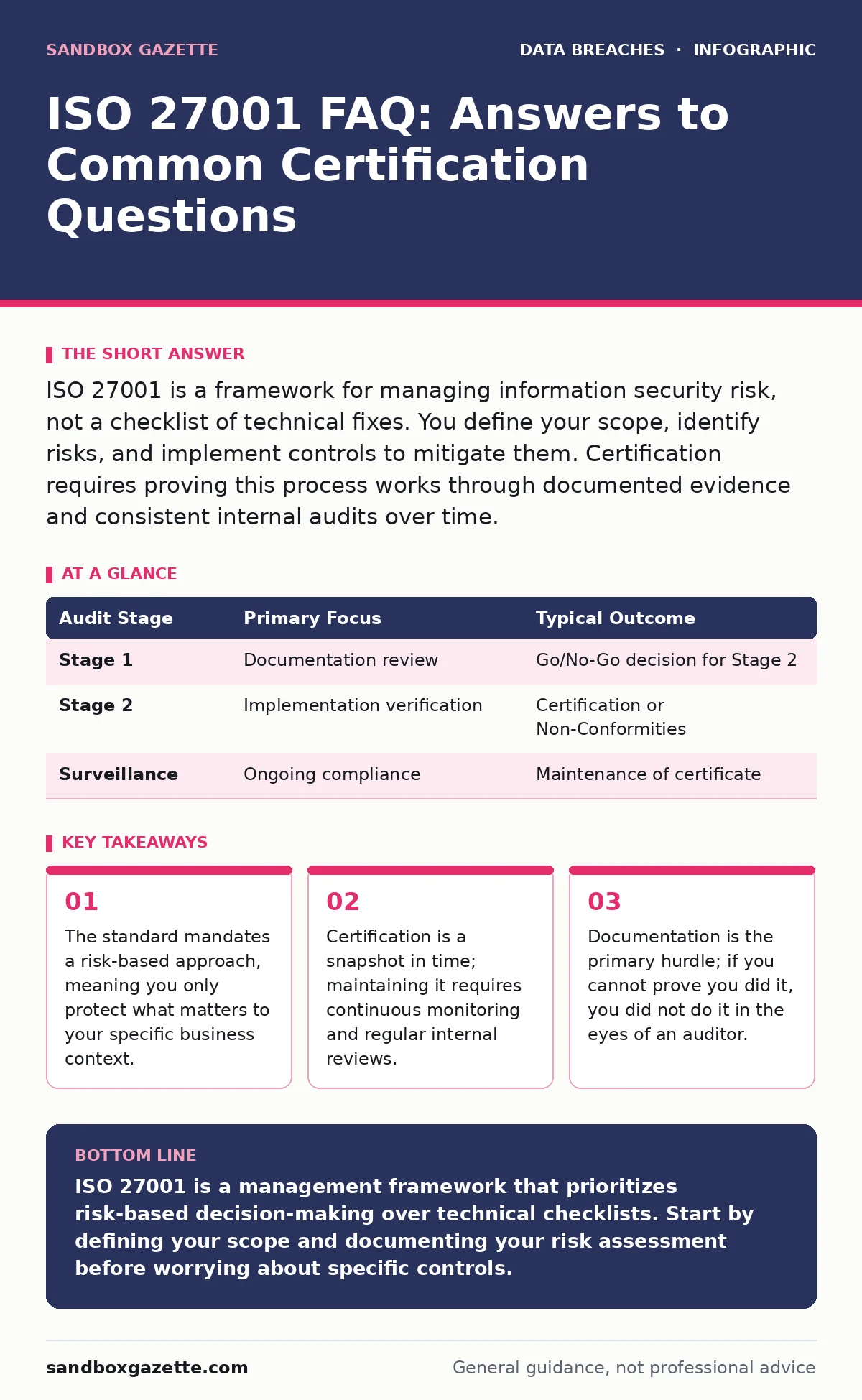
ISO 27001 is a framework for managing information security risk, not a checklist of technical fixes. You define your scope, identify risks, and implement controls to mitigate them. Certification requires proving this process works through documented evidence and consistent internal audits over time.
What exactly is ISO 27001?
ISO 27001 is an international standard that specifies requirements for establishing, implementing, maintaining, and continually improving an Information Security Management System (ISMS). It does not dictate specific technologies or tools. Instead, it provides a structured framework for managing the confidentiality, integrity, and availability of information. You apply it to any organization, regardless of size or industry. The standard focuses on processes and governance rather than just technical defenses.
Do I need to be a large enterprise to certify?
No, the standard applies to organizations of all sizes, from small startups to multinational corporations. The complexity of your ISMS should match the complexity of your business and its risk profile. A small team might have fewer controls, but the rigor of their documentation and risk assessment must remain high. Auditors look for proportionality, not volume. If your scope is narrow, your evidence base is smaller, but the logic must be sound.
How does ISO 27001 differ from other frameworks?
Unlike compliance checklists that demand specific technical configurations, ISO 27001 is outcome-focused. It requires you to justify why you chose certain controls based on your risk assessment. For example, you might not implement strict software restriction policies if your risk assessment shows that application whitelisting introduces unacceptable operational friction without reducing critical risk. The standard accepts this trade-off if documented properly. Other frameworks often mandate specific controls regardless of context, whereas ISO 27001 demands you prove your choices are rational.
What is the Statement of Applicability?
The Statement of Applicability (SoA) is a central document in your ISMS that lists every control from Annex A of the standard. For each control, you state whether it is applicable and provide a justification for your decision. If you exclude a control, you must explain why it is not needed to mitigate your identified risks. This document prevents auditors from assuming you missed a control. It forces you to consciously decide on every security measure. Ignoring a control without justification is a non-conformity.
How do I handle third-party risks within the framework?
The standard requires you to manage security risks introduced by suppliers and partners. You must define requirements for information security in contracts and monitor supplier performance. This often involves conducting third-party risk assessments to ensure their security posture aligns with your needs. If a vendor holds your data, their breach is effectively your breach. You cannot outsource your responsibility to protect that data. The SoA must reflect these contractual and monitoring controls.
See also: Strategic Threat Intelligence Explained for Beginners · AI Risk Management Checklist for Secure Deployment
What happens during the certification audit?
The audit process has two distinct stages. In Stage 1, auditors review your documentation to ensure your ISMS meets the standard's requirements. In Stage 2, they verify that you are actually implementing these controls in practice. They will interview staff, observe processes, and check records. If you fail Stage 1, you do not proceed to Stage 2. If you fail Stage 2, you must correct the non-conformities before re-auditing. The goal is to prove consistent operation, not just theoretical compliance.
| Audit Stage | Primary Focus | Typical Outcome |
|---|---|---|
| Stage 1 | Documentation review | Go/No-Go decision for Stage 2 |
| Stage 2 | Implementation verification | Certification or Non-Conformities |
| Surveillance | Ongoing compliance | Maintenance of certificate |
How do I maintain certification after passing?
Certification is valid for three years, but you undergo surveillance audits annually. These audits check that you are maintaining your controls and continuing to improve your system. You must conduct internal audits and management reviews regularly. If you change your scope or significant controls, you must update your documentation and notify your certification body. Neglecting these ongoing tasks leads to suspension of your certificate.
Does certification prevent data breaches?
No certification guarantees immunity from attacks. ISO 27001 reduces the likelihood and impact of incidents by enforcing rigorous risk management. However, determined attackers can still bypass controls. The standard helps you detect and respond to incidents faster. It ensures you have a plan for breach notification and recovery. Think of it as a seatbelt; it does not prevent crashes, but it significantly reduces injury when they happen.
How does this relate to password security?
The standard requires you to manage access rights and authentication methods. This often leads to stronger password policies, but the standard does not prescribe password length. You must define what is appropriate for your risk. If you manage password leaks through a breach, your incident response plan must address credential resets. The focus is on ensuring that only authorized individuals can access specific information.
Key takeaways
- The standard mandates a risk-based approach, meaning you only protect what matters to your specific business context.
- Certification is a snapshot in time; maintaining it requires continuous monitoring and regular internal reviews.
- Documentation is the primary hurdle; if you cannot prove you did it, you did not do it in the eyes of an auditor.
ISO 27001 is a management framework that prioritizes risk-based decision-making over technical checklists. Start by defining your scope and documenting your risk assessment before worrying about specific controls.
Frequently asked questions
How long does it take to get ISO 27001 certified?
The timeline varies based on organization size and existing maturity, but it typically takes several months to over a year to prepare and audit.
Can I self-certify for ISO 27001?
No, you must be audited by an accredited certification body to receive the certificate. Self-assessments are useful for internal improvement but hold no external weight.
What if I only want to certify a specific department?
You can limit your scope to a specific department or system, but you must clearly define the boundaries and interactions with other parts of the organization.
Does ISO 27001 cover cloud security?
Yes, the standard applies to any environment, including cloud. You must assess the risks associated with cloud service providers and include them in your ISMS.
How this guide was produced: written by the Sandbox Gazette editorial team with AI assistance, checked against the public references listed below, and reviewed when the facts change. See our editorial policy or report an error.