Choose SOC 2 if you need to prove trust to specific customers or partners in the US market. Select ISO 27001 if you require a globally recognized certification for your entire information security management system. Many organizations pursue both to satisfy diverse stakeholder expectations.
Which Stakeholders Demand Proof?
Your primary audience dictates the starting point. If your sales cycle relies on reassuring US-based enterprise clients about data handling, SOC 2 is the standard language they speak. It addresses specific concerns such as security, availability, processing integrity, confidentiality, and privacy. These are known as trust service criteria.
ISO 27001 speaks a different dialect. It is a global standard that validates your information security management system, or ISMS. This framework is often required by international partners or regulated industries outside the United States. If your customers are in Europe or Asia, they likely expect ISO 27001 certification rather than a SOC 2 report.
How Flexible Must Your Controls Be?
SOC 2 allows you to tailor the scope of your audit. You select which trust service criteria apply to your business. If you do not handle personal data, you might exclude the privacy criteria. This flexibility reduces the audit burden and focuses resources on relevant risks.
ISO 27001 requires a more rigid approach. You must implement controls from Annex A, though you can justify exclusions in your statement of applicability. The standard demands a holistic view of risk management. You cannot simply pick and choose controls without a documented risk assessment to support each decision.
Suppose your company only offers a basic API service. SOC 2 lets you audit just the security and availability criteria. ISO 27001 would require you to document the entire lifecycle of information security, including physical security and human resources, even if they seem minor.
What Is Your Risk Management Maturity?
ISO 27001 is built on the principle of continuous improvement. It requires you to define a risk management process, assess risks, treat them, and monitor changes. This creates a mature security culture that adapts to new threats. It is not just a checklist; it is a management system.
SOC 2 evaluates whether your controls are designed correctly and operating effectively. It is a point-in-time assessment. While it encourages good practices, it does not mandate the same level of ongoing risk governance as ISO 27001. You can pass a SOC 2 audit with static controls that have not evolved in years.
Which Situation Favors Which Standard?
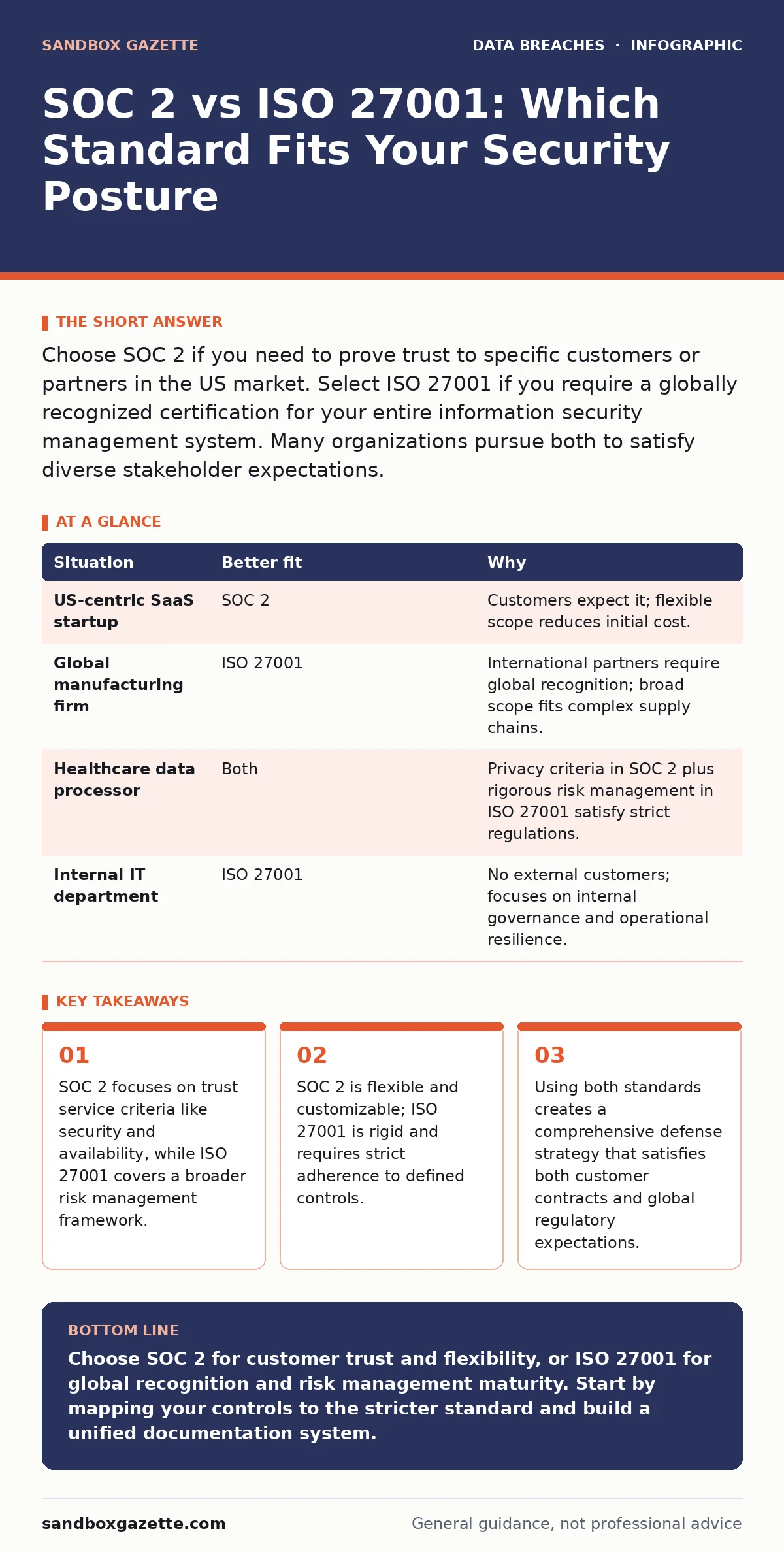
Different business models align better with specific standards. The table below summarizes common scenarios.
| Situation | Better fit | Why |
|---|---|---|
| US-centric SaaS startup | SOC 2 | Customers expect it; flexible scope reduces initial cost. |
| Global manufacturing firm | ISO 27001 | International partners require global recognition; broad scope fits complex supply chains. |
| Healthcare data processor | Both | Privacy criteria in SOC 2 plus rigorous risk management in ISO 27001 satisfy strict regulations. |
| Internal IT department | ISO 27001 | No external customers; focuses on internal governance and operational resilience. |
The Hidden Cost of Dual Certification
Pursuing both standards seems like maximum coverage, but it introduces complexity. You must maintain two different documentation sets. SOC 2 reports focus on control descriptions and testing results. ISO 27001 requires policy documents, risk assessments, and management reviews.
The audit processes also differ. SOC 2 auditors are CPAs or CRISCs who test controls. ISO 27001 auditors are certified by national accreditation bodies and assess the management system. You may need two separate audit teams.
However, the controls overlap significantly. A strong access control policy satisfies both standards. The key is to build one system that meets the stricter requirements of both. This avoids duplication and reduces long-term maintenance effort.
See also: What Is User Provisioning: The Hidden Access Risk · Email Encryption Best Practices for Secure Data Exchange
Integrating with Other Security Practices
These standards do not exist in a vacuum. They interact with other security initiatives. For instance, third-party risk assessments are a core part of ISO 27001. You must evaluate the security of your suppliers. SOC 2 also requires vendor management, but the depth varies by scope.
Consider how shadow IT data exposure impacts your audit. Unapproved applications can bypass controls, leading to failures in both standards. You must have processes to detect and remediate these tools.
Similarly, email encryption and password leaks are specific control areas. ISO 27001 mandates technical controls for these. SOC 2 tests whether those controls are operating as intended. If you have a guide on breach notification, ensure your incident response plan aligns with the reporting requirements of both standards.
When to Use Both Together
Use both standards when you face diverse stakeholder demands. Large enterprises often require ISO 27001 for their own governance and SOC 2 for their vendor contracts. This dual approach satisfies internal board requirements and external customer demands.
It also strengthens your security posture. ISO 27001 provides the strategic framework, while SOC 2 provides tactical validation. You get the best of both worlds: a mature management system and proven control effectiveness.
Key takeaways
- SOC 2 focuses on trust service criteria like security and availability, while ISO 27001 covers a broader risk management framework.
- SOC 2 is flexible and customizable; ISO 27001 is rigid and requires strict adherence to defined controls.
- Using both standards creates a comprehensive defense strategy that satisfies both customer contracts and global regulatory expectations.
Choose SOC 2 for customer trust and flexibility, or ISO 27001 for global recognition and risk management maturity. Start by mapping your controls to the stricter standard and build a unified documentation system.
Frequently asked questions
Can I get SOC 2 without ISO 27001?
Yes, SOC 2 is independent. You can achieve it without implementing a full ISMS, though the controls may be less structured.
Does ISO 27001 guarantee no breaches?
No, it reduces risk by ensuring you have a management system to identify and treat threats. It does not eliminate all vulnerabilities.
How often do I need to renew certification?
SOC 2 Type 2 requires annual audits. ISO 27001 requires surveillance audits annually and full recertification every three years.
Which is cheaper to implement?
SOC 2 is often cheaper initially due to its flexible scope. ISO 27001 requires more documentation and process maturity, increasing upfront costs.
How this guide was produced: written by the Sandbox Gazette editorial team with AI assistance, checked against the public references listed below, and reviewed when the facts change. See our editorial policy or report an error.