
Machine learning does not replace security logic; it automates pattern matching. Misunderstanding this leads to over-reliance on automated triage, ignoring the need for human context, and failing to protect the model itself from adversarial manipulation or data leakage.
Misreading: The model understands intent
Correct reading: Machine learning models process numerical vectors, not semantic meaning. They identify correlations between input features and historical labels. A model flagging a file as malicious because it resembles known malware signatures does not "know" the file is dangerous. It recognizes a statistical pattern.
This distinction matters when attackers modify code slightly to break the pattern without changing the function. If you treat the model’s output as a definitive judgment of intent, you miss the nuance of how the decision was made. The model sees shapes, not motives. This is why prompt injection attacks can succeed; the model follows syntactic instructions rather than understanding the underlying policy violation.
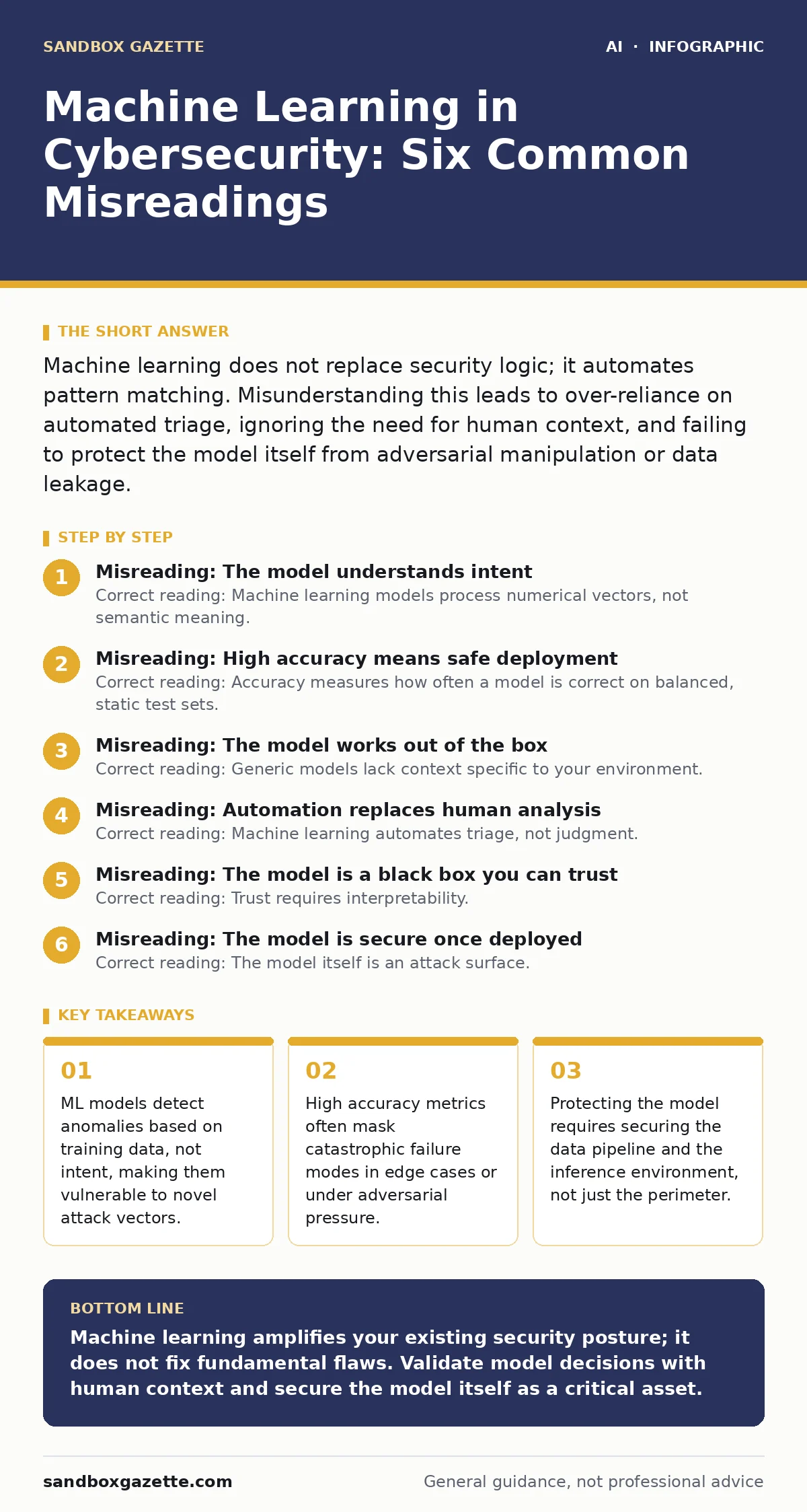
Misreading: High accuracy means safe deployment
Correct reading: Accuracy measures how often a model is correct on balanced, static test sets. It does not measure resilience against adversarial inputs or performance on skewed, real-world data.
You must evaluate false negatives and false positives separately. In security, a false negative allows an intrusion, while a false positive wastes analyst time. Optimizing for overall accuracy often sacrifices sensitivity to rare events. You need precision-recall curves to understand the trade-off. Relying solely on accuracy creates a false sense of security that collapses under targeted pressure.
Misreading: The model works out of the box
Correct reading: Generic models lack context specific to your environment. They require fine-tuning on your network traffic, log formats, and user behavior baselines. Without this calibration, the model treats normal local variations as threats or ignores genuine anomalies because they look normal in a global context.
This requirement creates a hidden cost: you must maintain high-quality, labeled data for your specific infrastructure. If your data quality degrades, the model’s performance degrades. This connects to training data leakage, where sensitive information embedded in your logs can be inferred by attackers analyzing the model’s responses. You are not just deploying software; you are managing a data supply chain.
Misreading: Automation replaces human analysis
Correct reading: Machine learning automates triage, not judgment. It ranks alerts by likelihood of threat, allowing analysts to focus on high-priority items. It does not understand business context, legal implications, or complex multi-stage attacks that span multiple systems over time.
Imagine a model flags a user logging in from a new country. It cannot determine if the user is traveling or if the account was compromised. Only a human can correlate this with HR records or recent security incidents. Over-automating leads to alert fatigue and missed context. Use AI in security operations to handle volume, but keep humans in the loop for decision-making. The model is a filter, not a commander.
Misreading: The model is a black box you can trust
Correct reading: Trust requires interpretability. You must be able to trace why a model made a specific prediction. If you cannot explain the decision, you cannot defend it against false positives or investigate false negatives. Black-box models hide biases and errors in their internal weights.
Techniques like SHAP or LIME help approximate feature importance, but they are approximations. They do not reveal the full logic. You must validate model decisions against known ground truths regularly. If you cannot explain why a file was blocked, you cannot justify the business impact. This opacity also complicates compliance audits. Transparency is not optional; it is a security control.
See also: Implement Machine Learning for Fraud Detection: A Step-by-Step Plan · How MITRE ATLAS Prevents AI Model Supply Chain Failures
Misreading: The model is secure once deployed
Correct reading: The model itself is an attack surface. Adversaries can probe the model to learn its decision boundaries, a technique known as model inversion. They can also poison the training data to create backdoors that trigger only under specific conditions.
Securing the model requires protecting the inference API from excessive probing and ensuring the training data is clean. This overlaps with AI model theft, where attackers steal proprietary models by querying them extensively. You must implement rate limiting, input validation, and monitoring for anomalous query patterns. The model is not just a tool; it is an asset that needs defense.
Misreading: One model fits all threats
Correct reading: Different threats require different models. A model trained to detect phishing emails will fail to detect ransomware behavior. Each threat vector has unique features and patterns. Using a single monolithic model creates brittle systems that fail when faced with unfamiliar attack types.
You should use an ensemble of specialized models. One might analyze network flows, another might inspect file hashes, and a third might review user activity. This approach reduces the risk of a single point of failure. It also allows you to update individual components without retraining the entire system. This aligns with MITRE ATLAS, which maps AI-specific attack techniques, highlighting the need for diverse defenses.
Misreading: The model learns continuously without oversight
Correct reading: Continuous learning introduces drift and instability. As the model updates with new data, its behavior can shift unpredictably. Without rigorous validation, the model might start ignoring previously learned threats or become biased toward recent noise.
You need a gated update process. New models must pass strict testing before replacing the live version. This ensures stability and predictability. Unsupervised continuous learning is risky in production environments. It also increases the surface area for shadow AI, where unauthorized or unmonitored model updates occur. Control the update pipeline as tightly as you control code deployments.
Key takeaways
- ML models detect anomalies based on training data, not intent, making them vulnerable to novel attack vectors.
- High accuracy metrics often mask catastrophic failure modes in edge cases or under adversarial pressure.
- Protecting the model requires securing the data pipeline and the inference environment, not just the perimeter.
Machine learning amplifies your existing security posture; it does not fix fundamental flaws. Validate model decisions with human context and secure the model itself as a critical asset.
Frequently asked questions
Does machine learning replace the need for security rules?
No. Rules provide deterministic controls for known threats, while ML handles probabilistic detection of unknowns. They complement each other.
How do I prevent data poisoning?
Validate data sources, use anomaly detection on input streams, and maintain versioned datasets for reproducibility.
Is federated learning secure?
It reduces data exposure by keeping data local, but it does not eliminate risks like model inversion or gradient leakage.
Can I use open-source models for security?
Yes, but you must audit them for vulnerabilities and fine-tune them for your specific environment.
How this guide was produced: written by the Sandbox Gazette editorial team with AI assistance, checked against the public references listed below, and reviewed when the facts change. See our editorial policy or report an error.