
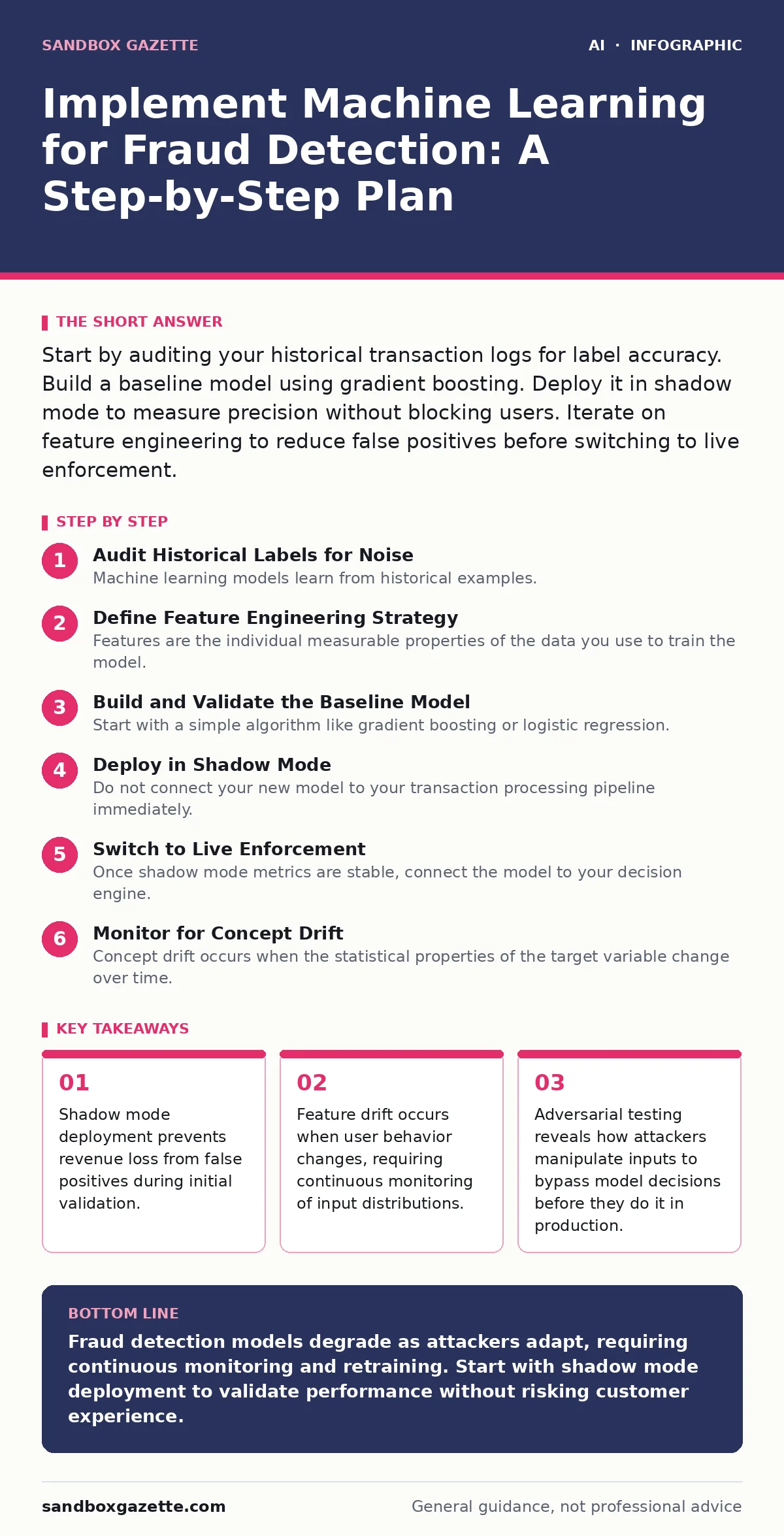
Start by auditing your historical transaction logs for label accuracy. Build a baseline model using gradient boosting. Deploy it in shadow mode to measure precision without blocking users. Iterate on feature engineering to reduce false positives before switching to live enforcement.
Audit Historical Labels for Noise
Machine learning models learn from historical examples. If your past fraud labels are incorrect, the model will learn to miss fraud. You must verify that transactions marked as legitimate were truly clean and those marked as fraud were not false alarms.
Imagine a transaction flagged as fraud because it occurred at an unusual hour. If the customer was simply traveling, that label is noise. Training on noise teaches the model to punish legitimate behavior.
Review a random sample of your labeled data. Check for consistency in how your previous rules engine marked events. Inconsistent labeling creates a weak foundation that no algorithm can fix. See our guide on data poisoning attacks to understand how bad data corrupts model integrity from the start.
Define Feature Engineering Strategy
Features are the individual measurable properties of the data you use to train the model. Raw data like "transaction amount" is rarely enough. You need derived features that capture context, such as "velocity of transactions in the last hour" or "distance from last known location."
Avoid using features that are direct outputs of your previous fraud rules. This creates circular reasoning where the model only learns what your old rules already knew. It will miss new attack patterns.
Focus on behavioral signals. Look for sequences of actions rather than single events. A user logging in from a new device is not fraud. A user logging in from a new device, changing their password, and initiating a large transfer within six minutes is suspicious.
Build and Validate the Baseline Model
Start with a simple algorithm like gradient boosting or logistic regression. These models are easier to interpret and debug than deep neural networks. Interpretability matters because you need to explain why a transaction was blocked to your support team and to the customer.
Split your data into training, validation, and test sets. Train on the first, tune hyperparameters on the second, and evaluate final performance on the third. Never use the test set for tuning. This prevents data leakage, where the model accidentally memorizes the answer key.
Check for class imbalance. Fraud is rare. Use techniques like oversampling minority classes or adjusting class weights to handle this imbalance.
Deploy in Shadow Mode
Do not connect your new model to your transaction processing pipeline immediately. Instead, deploy it in shadow mode. The model runs in parallel with your existing system, making predictions on live traffic, but those predictions do not affect the outcome.
This allows you to measure precision and recall against real-world conditions without risking false positives. You can see how many legitimate transactions the model would have blocked.
Monitor the latency. Machine learning inference adds processing time. If the model takes too long, it will slow down your checkout process. Shadow mode reveals these performance bottlenecks before they impact users. Refer to AI in security operations for strategies on integrating these tools into your existing workflow.
Step 1: Configure Parallel Processing
Route a copy of every transaction request to the ML engine. Ensure the ML response is logged but ignored by the payment gateway. This requires minimal code changes but provides maximum visibility.
Check logs to ensure predictions are recorded accurately.
Step 2: Analyze False Positive Rate
Compare the model’s "fraud" predictions against the final outcome of the transaction. If the transaction was later confirmed as legitimate by the user or bank, the model generated a false positive.
Verification: Calculate the false positive rate over a two-week period. If it exceeds your acceptable threshold, halt deployment and return to feature engineering.
Step 3: Tune Decision Thresholds
Most models output a probability score, not a binary yes/no. You choose the threshold that triggers a block. A lower threshold catches more fraud but blocks more legitimate users. A higher threshold is safer for users but misses more fraud.
Verification: Adjust the threshold in your shadow environment. Plot the trade-off between catch rate and false positive rate. Choose the point that aligns with your business risk tolerance.
Switch to Live Enforcement
Once shadow mode metrics are stable, connect the model to your decision engine. Start with a "review" action rather than a "block" action. Flagged transactions go to a manual review queue instead of being automatically rejected.
This provides a safety net. Your human analysts can approve or reject the flagged items. Their decisions become new training data, improving the model.
Gradually increase the automation. As confidence grows, move more transactions from "review" to "auto-block" or "auto-approve." Always keep a manual override available for customer support teams.
See also: Machine Learning in Cybersecurity: Six Common Misreadings · How MITRE ATLAS Prevents AI Model Supply Chain Failures
Monitor for Concept Drift
Concept drift occurs when the statistical properties of the target variable change over time. Attackers adapt. If they find a way to bypass your model, the pattern of fraud changes. Your model, trained on old patterns, will stop catching the new ones.
Monitor the distribution of your input features. If the average transaction amount shifts significantly, or if the ratio of mobile to desktop transactions changes, your model may be drifting.
Set up alerts for performance degradation. If the precision drops below a certain level, trigger a retraining pipeline. Do not wait for a breach to notice the model is stale. See AI transparency for methods to track why model predictions shift over time.
Conduct Adversarial Testing
Your model is only as good as the attacks it has seen. You must actively try to break it. This is not just about finding bugs; it is about finding model weaknesses.
Imagine an attacker who slightly alters transaction amounts to stay just below your model’s detection threshold. Or one who uses synthetic identities that look statistically normal but are fake.
Use red teaming exercises to simulate these attacks. Test your model against known evasion techniques. Document the failures and add those examples to your training data. This closes the loop between detection and prevention. Check out MITRE ATLAS for a framework of adversary tactics against machine learning systems.
Maintain Data Hygiene
Machine learning is not a set-and-forget solution. It requires continuous data management. Ensure that new data is labeled consistently. If your manual review team changes their criteria for what constitutes fraud, the model will learn the new criteria. This is good, but it must be intentional.
Archive old models and their corresponding data snapshots. This allows you to rollback if a new model performs poorly. It also helps you audit historical decisions if a customer disputes a blocked transaction.
Regularly review the features used by the model. Some features may become less predictive over time. Others may become sensitive privacy liabilities. Prune features that add complexity without improving accuracy. Be mindful of training data leakage where private information inadvertently becomes part of the model’s decision logic.
- Audit historical labels for consistency and noise
- Define derived features that capture behavioral context
- Validate baseline model on held-out test data
- Deploy in shadow mode to measure latency and precision
- Tune decision thresholds based on risk tolerance
- Switch to live enforcement with manual review fallback
- Monitor for concept drift in input distributions
- Conduct adversarial testing to find evasion paths
- Maintain data hygiene and feature relevance
Key takeaways
- Shadow mode deployment prevents revenue loss from false positives during initial validation.
- Feature drift occurs when user behavior changes, requiring continuous monitoring of input distributions.
- Adversarial testing reveals how attackers manipulate inputs to bypass model decisions before they do it in production.
Fraud detection models degrade as attackers adapt, requiring continuous monitoring and retraining. Start with shadow mode deployment to validate performance without risking customer experience.
Frequently asked questions
How much data do I need to start training a fraud detection model?
You need enough labeled examples to represent both common and rare fraud patterns. Start with a few thousand high-quality labeled transactions. Quality matters more than quantity.
Can I use pre-trained models for fraud detection?
Pre-trained models are rarely useful for specific fraud detection tasks. Fraud patterns are highly specific to your industry, user base, and transaction types. You must train on your own data.
How do I handle imbalanced data where fraud is rare?
Use techniques like oversampling the minority class, undersampling the majority class, or using algorithms that handle imbalance natively. Adjust class weights during training to penalize missing fraud more heavily.
What is the biggest risk of deploying an ML model for fraud?
The biggest risk is false positives blocking legitimate customers. This damages trust and revenue. Always start with shadow mode and manual review to minimize this risk.
How this guide was produced: written by the Sandbox Gazette editorial team with AI assistance, checked against the public references listed below, and reviewed when the facts change. See our editorial policy or report an error.