Small business artificial intelligence monitoring requires tracking input drift, output anomalies, and token consumption spikes using lightweight logging tools and scheduled human reviews.
Why Small Businesses Need Model Oversight
Small organizations deploy automated decision systems without realizing that machine learning models degrade silently over time. Data patterns shift, customer expectations change, and software dependencies break behind the scenes. Without active observation, your automated assistant might start hallucinating incorrect pricing or leaking proprietary data. Enterprise tools assume massive budgets and dedicated engineering squads, leaving lean operations to find alternative ways to maintain reliability.
Data drift occurs when real-world inputs diverge from the examples used during initial training. Small teams rarely notice this divergence because outputs still appear grammatically correct even as factual accuracy plummets. Establishing basic observation routines prevents these subtle regressions from damaging your reputation. Managing this risk connects directly to broader concerns about shadow AI inside growing companies.
Understanding the Hidden Costs of Unmonitored Systems
Unmonitored automated systems accumulate expenses through excessive API calls and bad outputs that require manual correction. When a recursive loop triggers thousands of rapid requests, your monthly software bill explodes overnight. Hidden financial drains hurt lean balance sheets far worse than massive enterprise budgets. Furthermore, corrupted responses waste staff hours fixing errors that the automation was supposed to prevent.
Compute expenses represent only one dimension of unmonitored risk. Security liabilities compound when models accept malicious prompts designed to extract internal secrets. Malicious actors constantly probe endpoints for vulnerabilities similar to those found in exposed AI model servers. Simple input validation catches many of these attempts before processing begins.
Affordable Monitoring Methods for Lean Teams
Budget constraints force smaller organizations to rely on lightweight, open-source logging frameworks rather than expensive commercial platforms. You can configure simple script wrappers that intercept queries and responses, saving them to a local database for daily review. Random sampling provides a practical compromise when you lack the time to inspect every single interaction.
Automated assertion checks evaluate outputs against strict formatting rules before delivering them to users. If a customer service assistant returns a response containing prohibited words, the system intercepts the message and falls back to a safe template. Implementing these guardrails costs very little in developer time compared to cleaning up after a public failure.
Deciding What to Delegate to External Providers
Outsourcing your infrastructure management frees internal staff to focus on core business operations, but you must define clear boundaries. Managed service providers handle hardware uptime, patch management, and basic throughput scaling effectively. You must retain control over output evaluation, prompt engineering policies, and final approval for high-stakes decisions. Delegating quality evaluation usually results in missed context and unaddressed hallucinations.
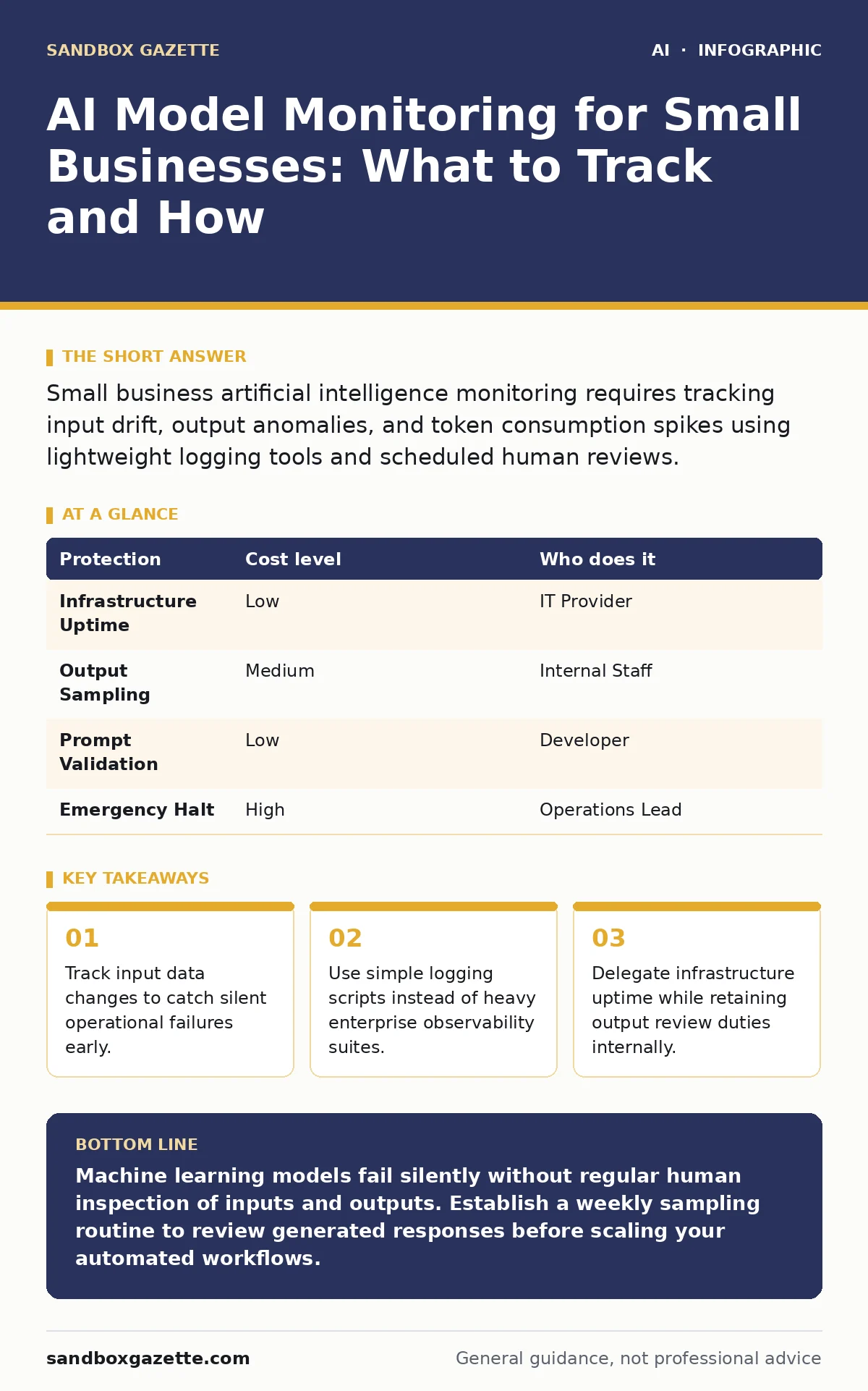
| Protection | Cost level | Who does it |
|---|---|---|
| Infrastructure Uptime | Low | IT Provider |
| Output Sampling | Medium | Internal Staff |
| Prompt Validation | Low | Developer |
| Emergency Halt | High | Operations Lead |
External vendors care primarily about service availability rather than semantic accuracy or business logic correctness. An IT provider will ensure the model endpoint responds to requests, but they will not check whether the generated advice makes financial sense. Maintaining an internal review process ensures the technology serves your specific operational goals rather than generic metrics.
Questions for Your Technology Provider
Evaluating external technical partners requires asking targeted questions about how they handle operational anomalies and data privacy. You must understand their specific alerting mechanisms and response times when service degradation occurs. Vague promises about reliability leave your organization vulnerable during unexpected outages or security incidents.
- What exact triggers cause your operations team to initiate an emergency stop for AI systems?
- How do you isolate customer datasets to prevent cross-contamination during model retraining cycles?
- What logging mechanisms do you provide for tracking historical input and output pairs over time?
- How quickly do you notify clients when upstream API providers alter model behaviors or deprecate features?
Asking these specific questions clarifies the division of responsibility between your organization and your technology vendor. Providers who offer transparent monitoring interfaces make it significantly easier to maintain internal compliance without building custom tooling from scratch.
See also: Account Takeover Risks and Low-Cost Defenses for Small Teams · Understanding neural networks and how they process complex patterns
Handling Unexpected Drift and Anomalies
Addressing drift requires maintaining a golden dataset of trusted input and output pairs that you test against the model weekly. When accuracy drops below an acceptable threshold, you must decide whether to adjust your prompts or restrict the system capabilities. Ignoring minor degradations invariably leads to catastrophic failures during peak usage periods.
Small teams must establish clear protocols for disabling automated features when strange behaviors emerge without warning. Having a manual override switch prevents minor software glitches from cascading into major customer service disasters. Treating machine learning systems like experimental machinery rather than infallible software keeps your operations resilient.
Key takeaways
- Track input data changes to catch silent operational failures early.
- Use simple logging scripts instead of heavy enterprise observability suites.
- Delegate infrastructure uptime while retaining output review duties internally.
Machine learning models fail silently without regular human inspection of inputs and outputs. Establish a weekly sampling routine to review generated responses before scaling your automated workflows.
Frequently asked questions
How often should a small business review AI model outputs?
Review a random sample of outputs weekly to catch behavioral drift and factual errors before they impact customers.
Can open-source tools replace enterprise monitoring platforms?
Lightweight open-source logging scripts and custom database wrappers provide adequate visibility for small teams without expensive licensing fees.
What is the biggest monitoring mistake small teams make?
Trusting default provider dashboards completely while ignoring semantic accuracy and runaway token consumption spikes.
How do you handle model failures when you have no dedicated engineers?
Rely on managed infrastructure providers for uptime while keeping output evaluation and manual kill switches under internal control.
How this guide was produced: written by the Sandbox Gazette editorial team with AI assistance, checked against the public references listed below, and reviewed when the facts change. See our editorial policy or report an error.