
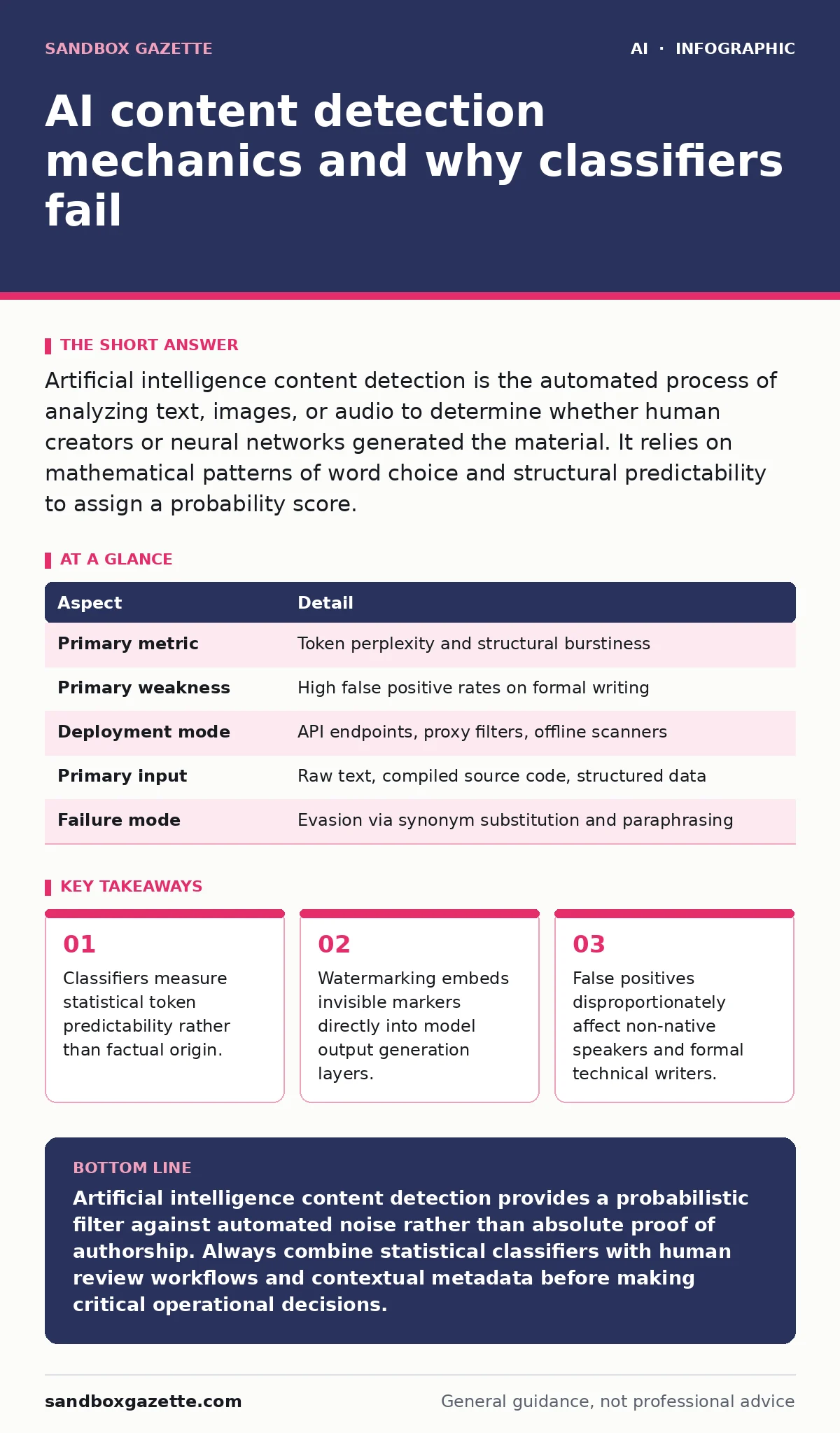
Artificial intelligence content detection is the automated process of analyzing text, images, or audio to determine whether human creators or neural networks generated the material. It relies on mathematical patterns of word choice and structural predictability to assign a probability score.
Understanding machine generation through the forged art analogy
Art forgery detection relies on identifying brushstroke consistency, pigment composition, and canvas aging that matches a specific historical era. Artificial intelligence content detection operates on a parallel principle by examining digital artifacts for mathematical signatures left behind by neural networks. Large language models generate text by calculating the most statistically probable next token based on training weights.
Human writers introduce erratic vocabulary choices, emotional pacing, and structural deviations that deviate sharply from these smooth mathematical distributions. Spotting the difference requires measuring perplexity, which quantifies how surprised a model is by a sequence of words, and burstiness, which measures variation in sentence length and complexity across a document.
Defining artificial intelligence content detection and its core purpose
Artificial intelligence content detection evaluates digital artifacts to assign a quantifiable metric indicating whether a neural network or a human created the material. The core purpose centers on establishing provenance in environments where automated generation scales faster than human review cycles.
Organizations deploy these systems to prevent automated fraud, maintain academic integrity, and secure internal documentation pipelines against unverified synthetic inputs. Security teams often encounter this technology when evaluating the risks introduced by shadow AI deployments across corporate networks where employees paste proprietary data into unvetted public models without centralized authorization.
The fundamental problem solved by probabilistic text filters
Unchecked synthetic generation creates severe operational risks by flooding communication channels with plausible falsehoods and convincing phishing lures generated at zero marginal cost. Automated detectors mitigate this volume problem by filtering out low-effort synthetic submissions before they reach human reviewers or downstream processing engines. Traditional perimeter defenses fail against these threats because malicious text arrives through legitimate authentication channels disguised as standard user input. Mathematical classifiers attempt to restore an asymmetry of trust by flagging anomalies in token distribution that humans miss during rapid visual scans.
Main functional components of a detection pipeline
- Tokenization analyzers break incoming text down into discrete sub-word units to evaluate frequency distribution against known language model outputs.
- Perplexity calculators measure how predictable a phrase appears by testing it against large reference corpora of human and synthetic writing.
- Burstiness evaluators compute variance metrics across sentence structures to check whether the rhythm matches natural human composition habits.
- Watermark decoders scan for cryptographic or statistical biases intentionally baked into specific model generation weights during training phases.
| Aspect | Detail |
|---|---|
| Primary metric | Token perplexity and structural burstiness |
| Primary weakness | High false positive rates on formal writing |
| Deployment mode | API endpoints, proxy filters, offline scanners |
| Primary input | Raw text, compiled source code, structured data |
| Failure mode | Evasion via synonym substitution and paraphrasing |
Where content verification fits with broader enterprise defenses
Content verification operates downstream from network perimeters, acting as an internal content hygiene layer rather than a hard boundary block. Security architects integrate these checkers into document ingestion pipelines, code review gates, and customer support triage systems to catch anomalous inputs.
Effective deployment requires pairing detection tools with broader initiatives like AI transparency frameworks to document which internal systems generate automated outputs. Relying on detection alone invites failure, because adversaries frequently chain attacks together, moving from prompt injection flaws to automated content generation that bypasses static filters through slight stylistic modifications.
See also: AI coding assistant supply-chain risks and how to secure them
Common operational failures and hidden costs
Organizations frequently assume that high detector accuracy scores translate into reliable proof of machine origin in disciplinary or legal settings. Statistical classifiers inherently produce false positives when evaluating formal technical prose, legal documents, and non-native English speakers who rely on predictable sentence structures.
Another hidden cost involves the administrative burden of manually reviewing flagged documents, which often consumes more labor hours than the original automated triage saved. Adversaries also exploit detector blind spots by running synthetic text through secondary paraphrasing models, effectively stripping out the statistical signatures that the primary detector relies upon to identify machine origin.
Key takeaways
- Classifiers measure statistical token predictability rather than factual origin.
- Watermarking embeds invisible markers directly into model output generation layers.
- False positives disproportionately affect non-native speakers and formal technical writers.
Artificial intelligence content detection provides a probabilistic filter against automated noise rather than absolute proof of authorship. Always combine statistical classifiers with human review workflows and contextual metadata before making critical operational decisions.
Frequently asked questions
Can detectors reliably identify text written by any language model?
Detectors struggle with newer models that utilize advanced sampling techniques or customized vocabulary weights designed specifically to mimic human burstiness patterns.
Why do non-native speakers trigger false positives on these systems?
Non-native speakers often rely on formal grammar structures and highly predictable vocabulary choices that closely mirror the mathematical optimization patterns of large language models.
How do malicious actors bypass commercial content detectors?
Attackers bypass detectors by using secondary rewriting models to inject erratic sentence lengths and synonym variations that mimic human drafting habits.
Are watermarks a permanent solution for identifying synthetic content?
Watermarks degrade rapidly when users apply minor edits, translations, or paraphrasing tools to the generated text before publishing or transmitting it.
How this guide was produced: written by the Sandbox Gazette editorial team with AI assistance, checked against the public references listed below, and reviewed when the facts change. See our editorial policy or report an error.