
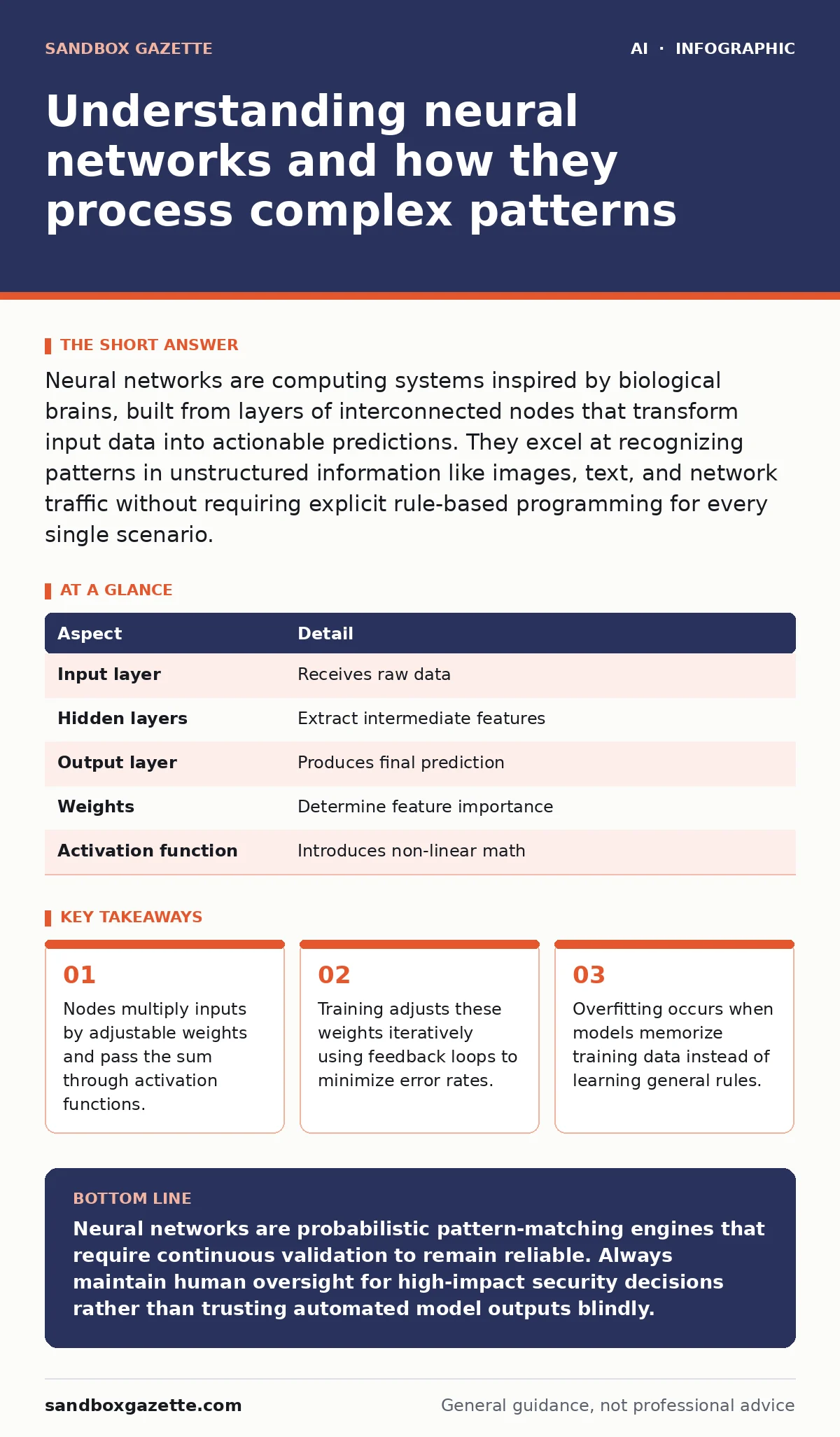
Neural networks are computing systems inspired by biological brains, built from layers of interconnected nodes that transform input data into actionable predictions. They excel at recognizing patterns in unstructured information like images, text, and network traffic without requiring explicit rule-based programming for every single scenario.
How neural networks mimic biological decision-making
Neural networks are mathematical systems designed to recognize underlying relationships in a set of data through a process that mimics the human brain. Biological brains use billions of interconnected neurons to process sensory signals. Artificial neural networks use simulated nodes arranged in sequential layers to achieve a similar pattern-matching capability.
Nodes receive numerical inputs, multiply each input by a specific weight that determines its importance, and add them together. This combined sum passes through an activation function, which decides whether the node should pass the signal along to the next layer.
| Aspect | Detail |
|---|---|
| Input layer | Receives raw data |
| Hidden layers | Extract intermediate features |
| Output layer | Produces final prediction |
| Weights | Determine feature importance |
| Activation function | Introduces non-linear math |
Adjusting these internal weights forms the core mechanism of machine learning in cybersecurity tasks like malware classification. Every node contributes a tiny fraction of the overall calculation, meaning no single part of the system holds the entire logic of the decision.
Where the architectural concept originates in practice
Researchers in the mid-twentieth century sought to build mathematical models of biological learning, creating the earliest single-layer perceptrons.
Perceptrons could solve simple logical problems but failed when presented with non-linear relationships like the classic exclusive-or puzzle. Overcoming this limitation required stacking multiple hidden layers between the input and output, creating deep architectures capable of representing complex functions.
Calculus provides the engine for training these layered systems through a technique called backpropagation. Backpropagation calculates the error at the output layer and propagates it backward through the network, allowing optimization algorithms to tweak every weight systematically.
How these systems operate during day-to-day use
Operating a neural network involves 2 distinct phases: training and inference. Training consumes vast amounts of computational power and historical data to establish the correct internal weights, turning raw observations into a functional model.
Inference happens when the trained model encounters new, unseen data in real time to make rapid classifications. Network defenders rely on this inference speed to spot anomalous traffic patterns or analyze behavior during AI-assisted threat detection workflows.
Inference requires far fewer resources than training, enabling lightweight models to run on edge devices or standard server hardware. The system simply takes the input numbers, passes them forward through the pre-calculated weights, and outputs a classification score within milliseconds.
What people usually get wrong about artificial cognition
Observers frequently attribute human-like understanding to neural networks, assuming the software comprehends the semantic meaning of the data it processes. Statistical correlation replaces true comprehension, meaning a model identifies patterns and co-occurrences without understanding context or intent.
Another common misconception assumes that adding more layers automatically yields better security outcomes for complex analytical tasks. Deeper architectures increase computational overhead and data requirements while making the internal decision path much harder to audit.
See also: Preventing data poisoning attacks by fixing 6 data pipeline flaws · Difference between fine-tuning and rag for system accuracy
Hidden costs and edge cases in production environments
Neural networks demand continuous monitoring because operational environments drift over time, causing previously accurate models to degrade in reliability. Adversaries actively exploit this dependency by crafting inputs designed to fool the classifier while appearing completely normal to human analysts.
Explainability remains a persistent bottleneck, as tracing millions of interacting weights makes it difficult to prove why a specific decision occurred. Analysts often pair these models with tools focused on AI transparency to generate human-readable justifications for automated security actions.
Building secure systems also requires strict access controls for AI agents to prevent unauthorized modification of the underlying model weights or training pipelines. Without these safeguards, an attacker who gains write access can subtly alter how the system evaluates incoming threats.
Key takeaways
- Nodes multiply inputs by adjustable weights and pass the sum through activation functions.
- Training adjusts these weights iteratively using feedback loops to minimize error rates.
- Overfitting occurs when models memorize training data instead of learning general rules.
Neural networks are probabilistic pattern-matching engines that require continuous validation to remain reliable. Always maintain human oversight for high-impact security decisions rather than trusting automated model outputs blindly.
Frequently asked questions
Can a neural network learn from a single example?
Standard architectures require many examples to adjust their internal weights reliably through statistical iteration. Few-shot learning techniques attempt to bridge this gap, but traditional training relies on vast datasets.
Why do neural networks need so much computational power?
Every prediction involves multiplying matrices across millions of interconnected parameters simultaneously. Training amplifies this demand because the system must calculate gradients backward for every single data point processed.
What happens when a neural network encounters completely new data?
The system still produces an output based on the closest mathematical match it can find within its trained parameters. This often results in high-confidence misclassifications when the input falls far outside the distribution of the training set.
Are neural networks the same thing as artificial intelligence?
Neural networks represent just one specific subset of techniques used within the broader field of artificial intelligence. Other AI systems rely on symbolic logic, decision trees, or rule-based expert systems rather than weighted mathematical nodes.
How this guide was produced: written by the Sandbox Gazette editorial team with AI assistance, checked against the public references listed below, and reviewed when the facts change. See our editorial policy or report an error.